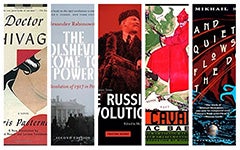
In March 1917 (February on the Julian calendar Russia used at the time) the Russian people overthrew the tsar and the Russian government as they had known it. In November (October), the new government was overthrown yet again. 2017 marks 100 years since the Russian Revolution. This book spotlight will help you get started learning about the "ten days that shook the world."
Background
Don’t know anything about the Russian Revolution and want to get the basics? Start with these books. Abraham Ascher’s The Russian Revolution: a beginner's guide, S. A. Smith’s The Russian Revolution: a very short introduction, and Harold Shukman’s The Russian Revolution are short and will get you quickly up to speed on the important events and players. The Blackwell encyclopedia of the Russian Revolution is a great place to look up specific people, places, and events.
Classics
When you are ready to move on from the basics, try one of the classic historical texts on the Russian Revolution. Read from the point of view of the revolutionary Leon Trotsky in his History of the Russian Revolution. Try one of the texts written by some of the foremost Soviet historians including Robert Service’s The Russian Revolution, 1900-1927, Sheila Fitzpatrick’s The Russian Revolution, Richard Pipes’s A Concise History of the Russian Revolution, or Alexander Rabinowitch’s The Bolsheviks Come to Power: The Revolution of 1917 in Petrograd. When you are ready for a true deep dive, try the Critical Companion to the Russian Revolution, 1914-1921 which will introduce you to much of the scholarship on the subject.
Primary Sources
If you want to learn about the revolution from the people who were there, then you will want primary sources. Try searching in our catalog under "Subject" for "Soviet Union -- History -- Revolution, 1917-1921 -- Personal narratives." You can also try the same subject, except use "Pictorial Works," "Posters," or "Sources" to find original narratives, documents, and images from the revolution. Some of the books you’ll find include The Russian Revolution: world war to civil war, 1917-1921: rare photographs from wartime archives, Russia in war and revolution, 1914-1922: a documentary history, and Competing voices from the Russian Revolution.
Literature
Literature set around the revolution can give you a special understanding of the events. A Soviet classic, which won its author Mikhail Sholokhov the Stalin and Nobel Prizes, the epic Quiet Flows the Don is set between World War I and the end of the Russian Civil War. Aleksandr Solzhenitsyn, another Nobel Prize winner, sets his Red Wheel series between 1914 and 1918 with November 1916 devoted to the events leading up to the revolution. Isaac Babel’s Odessa Stories is set in Odessa in present-day Ukraine during the Revolution. While Babel’s Red Cavalry and Mikhail Bulgakov’s White Guard are both set during the Russian Civil War right following the revolution. The first section of contemporary author Vladimir Sorokin’s Ice Trilogy starts in 1908 and continues through the revolution. And of course, there is Boris Pasternak’s classic Doctor Zhivago, which starts in the period leading up to the revolution and continues through World War II.