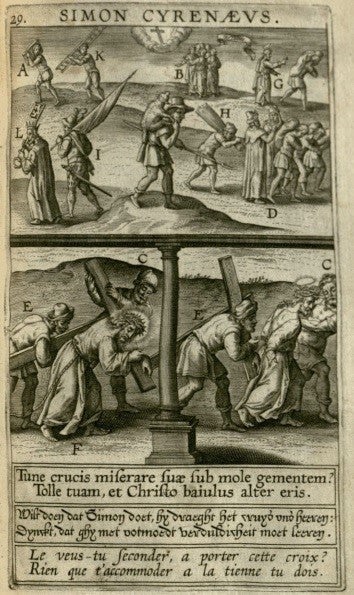
Good Friday was the day on which Jesus of Nazareth was forced to carry a cross upon which he was then crucified. For many Christians, it is a day that is commemorated through visual representation and often performatively of Jesus’s arrest to his burial. This commemoration is known as the devotion of the Stations of the Cross. This practice has its origins in the first centuries of Christianity when pilgrims traveled to the Holy Land to walk where Jesus walked and meditate at the places where he suffered and died. To this day, in Jerusalem a path called the “Via Dolorosa” (the sorrowful way) has become one of the most important and venerated sites in world religions.
The Stations of the Cross, numbering fourteen, are usually depicted, sometimes elaborately, in friezes along the walls of churches. The Stations have also been artistically rendered and included in devotional literature. Woodstock Theological Library has a variety of such texts in our rare book collection. One remarkable example of this is a book entitled Paradisus sponsi et sponsae: in quo messis myrrhae et aromatum, ex instrumentis ac mysterijs Passionis Christi colligenda, ut ei commoriamur which was published by the famous Plantin press in Antwerp in 1618. It was authored by the Belgian Jesuit Jan David (1545-1613) who was a prolific author publishing 30 books in the course of his lifetime. The page featured here depicts the 5th station where Simon of Cyrene takes up Jesus’s cross for him after he has fallen, too beaten and exhausted to carry it himself. In the scene above the 5th station are other examples of bearing burdens in the life of all people. This juxtaposition between Jesus’s way of sorrows and the lived experience aides the reader in relating in a very personal way to the events of the Passion of Christ.