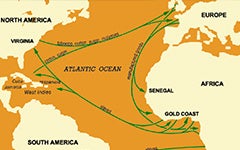
Africans have been on the move since the 1st century and across the Atlantic since the late 15th century; and the recent trends show that populations from West Africa continue to cross over into Europe, while East Africans migrate into Europe and parts of Asia and the Middle East in search of secure labor. The December – January Recommended Reading exhibit features key works on these themes.
Basic numbers have been crunched by the renowned historian Philip Curtin in his well-known history of slaving: The Atlantic Slave Trade: A Census. Other excellent scholarship on the Middle Passage include the works of Marty Klein (Slavery and Colonial Rule in French West Africa); Claude Meillassoux (The Anthropology of Slavery: The Womb of Iron and Gold); and Paul Lovejoy (Transformations in Slavery). A recent popular theme for slaving is reparations. For this, see Rhoda Howard-Hassmann’s Reparations to Africa. Africans on the move within the continent receives enlightened attention in Ed Wilmsen’s Land Filled with Flies, a Herskovitts Award winner.
It is important to remember that trans-Atlantic slaving was the largest system of forced labor in world history. Also critical is the reality that the slaving triangle between Africa, the Americas, and Europe greased the cogs of capitalism for hundreds of years. One important work making this point is Joe Miller’s Way of Death: Merchant Capitalism and the Angolan Slave Trade, winner of the Herskovitts Award. There was also slaving and movement into South Asia, as noted by Pash Obeng in Shaping Membership, Defining Nation: The Cultural Politics of African Indians in South Asia.
History, anthropology, and comparative religion have generated excellent reading on the World of the Atlantic over the past 15 years. A superb example is Randy Matory’s Black Atlantic Religion, also a winner of the Herskovitts Award. Don’t pass up Africa’s Ogun: Old World and New, ed. by Sandy Barnes, or John Thornton’s Africa and Africans in the Making of the Atlantic World, 1400-1800. Recent movement within Africa has created adverse social and medical circumstances. See Randall Packard’s excellent White Plague, Black Labor on the spread of TB; and Phil Setel’s A Plague of Paradoxes which links AIDS and displaced labor on the slopes of Kilimanjaro. A provocative book which encapsulates movement and contact of the non-European world is Eric Wolf’s Europe and the People Without History.
The Recommended Reading Book Shelf is located across from the Circulation and Research Help Desks in Lauinger Library or you may browse the display virtually. We want to hear from you! Please send us your feedback. In the meantime, happy browsing!