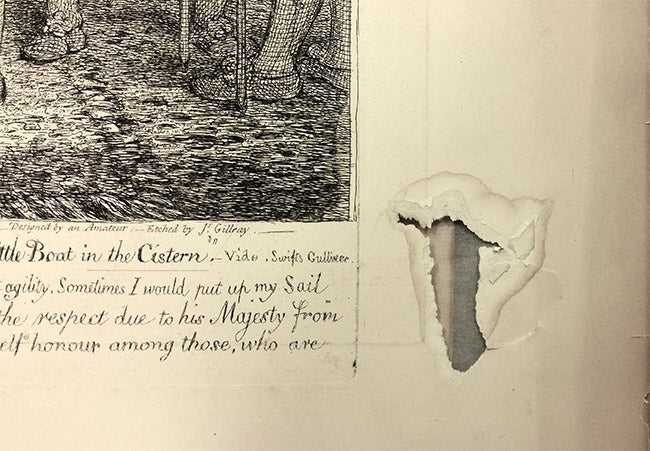
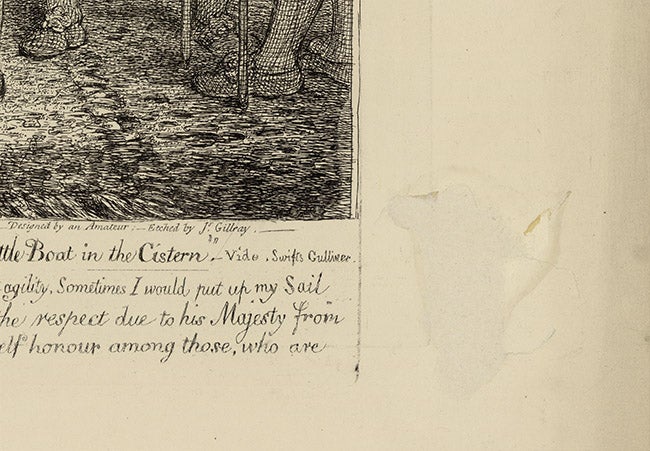
The King of Brobdingnag and Gulliver, mid-19th century, by James Gillray (1757-1815), published by H. G. Bohn (d. 1884). Etching on mid-19th-century machine-made paper. On the reverse of this image is "A Morning Ride" by James Gillray. University Art Collection; Booth Family Center for Special Collections.
Above is the bottom right quadrant in detail of a two-sided print. The two etchings on each side of this mid-19th-century sheet of paper were posthumous restrikes of Gillray's etchings, published by Henry George Bohn in bound volumes of Gillray's works. Unfortunately, paper from this time period can become brittle, and this artwork suffered damage to its edges and corners; as well as a larger two-inch area of loss at the bottom right of "The King of Brobdingnag and Gulliver" and the top right of the reverse etching, "A Morning Ride." Formerly part of a bound volume, the etchings had heavier stains near the perimeter edges, as consistent with bound materials. In addition, discoloration at the margins of the "King Brobdingnag" side suggests that it had been formerly housed in an acidic, to display that side only. To reduce acidity, the sheet was immersed in filtered water and alkalized in a bath conditioned to pH 8.5-9.0 with calcium hydroxide. The large area of loss was filled with a paper pulp slurry as well as with localized cast paper of a similar thickness, tone, and texture. This is held in place by the hydrogen bonding of paper formation, and no added adhesive was necessary. Conservators also mended edge tears, and humidified and flattened the artwork; taking extra caution to preserve the platemarks from the printing process. Since accessing both sides of the artwork is important for teaching purposes, conservators created a double-sided window mat and an enclosure to house the work safely and for ease of future usage and display.