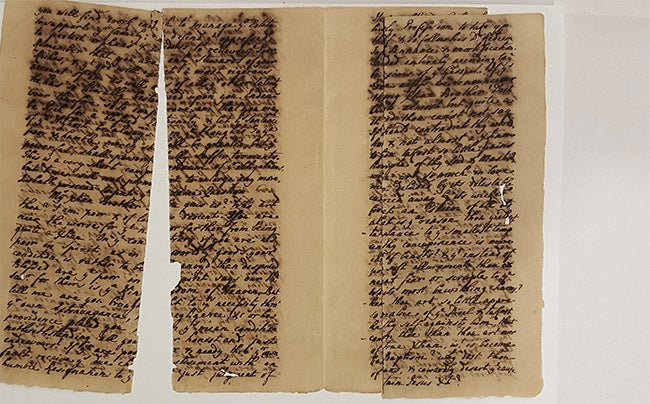
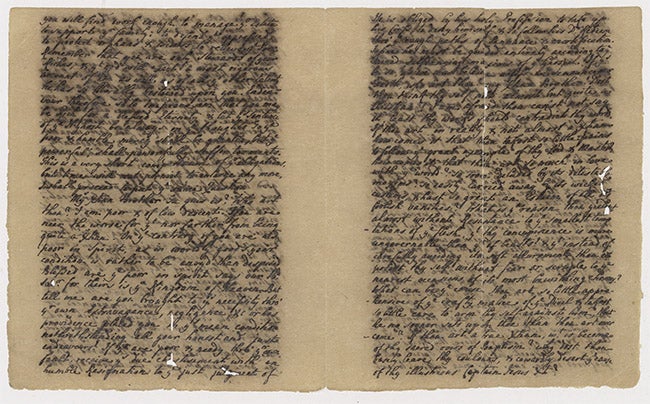
Sermon by John Lewis, S.J. to slaves attending a Mass at an Annapolis, Maryland plantation, 1761; iron gall ink on laid paper. American Catholic Sermon Collection, box 4, folder 32; Booth Family Center for Special Collections.
The sermon was written with acidic iron gall ink--that had corroded in several places--onto handmade rag paper; and the paper itself had become increasingly brittle over time. In addition, the manuscript had likely been folded in half vertically; and through the passage of 250 years, the folds had weakened the paper fibers causing complete splits on three of the eight manuscript leaves. Overall, this manuscript required a complex treatment that needed to be performed in sequence. First, the sheets were bathed in a water:ethanol solution and then in filtered water, with several changes of water, to reduce the amount acidity. Next, conservators immersed the sheets in a calcium phytate solution, to help sequester the damaging iron ions; and then alkalized them in calcium bicarbonate. Before drying, the most damaged sheets were lined with Japanese tissue and wheat starch paste to prevent further damage from ink cracking through the paper weave; and after drying, smaller breaks and tears were stabilized with Japanese tissue supports. Conservators gently humidified the manuscript after repair to promote overall flattening under moderate pressure. Lastly, the leaves were digitized. Generally, materials are digitized prior to conservation treatment, as the process of digitizing rare and fragile items can be damaging in itself. In this case, the scanning occurred after treatment to prevent further content loss due to the severe ink corrosion.