The allure of the French medieval warrior Joan of Arc, who was canonized in 1920, never seems to fade. For centuries she has remained a cultural icon of inspiration and fascination. The year 2031 will mark 600 years since the then controversial 19-year old was accused of heresy and burned at the stake by her pro-English captors during the 100 Years’ War between France and England. In the late 19th century her popularity seemed to peak with several books, plays and operas including the Personal Recollections of Joan of Arc (1896), a novel by Mark Twain published under a pseudonym and serialized in Harper’s Magazine the previous year.
We’re excited to share some recent acquisitions that reveal the enduring appeal of this inspirational and visionary heroine. Two French art nouveau posters provide contrasting interpretations of the warrior saint, both published by Maîtres de l’Affiche (Masters of the Poster) in the subscription series that ran from 1895 to 1900. The publisher, Jules Chéret, capitalized on the demand for the beautiful advertising posters throughout Paris by circulating smaller format versions to subscribers in sets of four, released four times a year. In total, 256 color lithographic posters by 97 artists were created throughout the run.
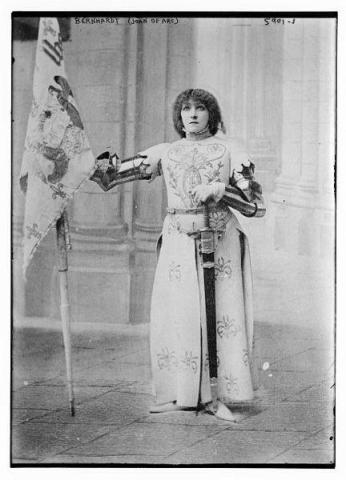
Black & white photo credit: Library of Congress, Bain Collection.
Source: Wikipedia

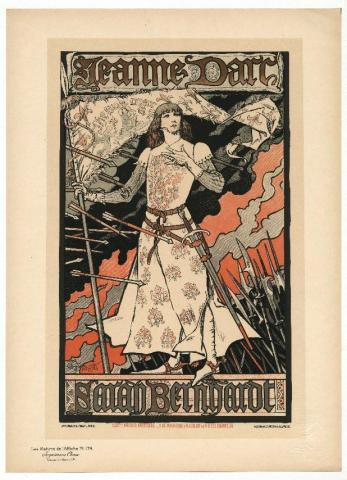
The above poster by Eugène Grasset advertises the play Jeanne d’Arc by Jules Barbier starring the legendary French actress, Sarah Bernhardt. An earlier production of the 5-act play with music by Charles Gounod premiered in Paris in 1873. It was reprised in 1890 starring Bernhardt at the Théâtre de la Renaissance and toured to other venues. In his popular 1898 poster, Grasset depicts the actress in her historical costume triumphantly impervious to an array of arrows in midair while a field of pikes looms menacingly from behind. While faithful to the historically based costume, the face has been idealized. One might never guess the actress portraying a teenager is actually 45 years old.
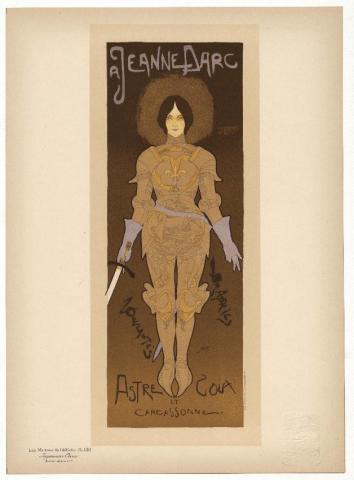
Published a year later, the poster by Georges de Feure presents an androgynous figure in full body armor. This interpretation of the maid of Orleans features feminine curves protected by a formidable layer of metal. The emphasis on the female form may be explained by the poster’s intended audience. It was created to advertise fashions by the couturier Astre & Soux of Carcassone, in the Occitanie region of France.
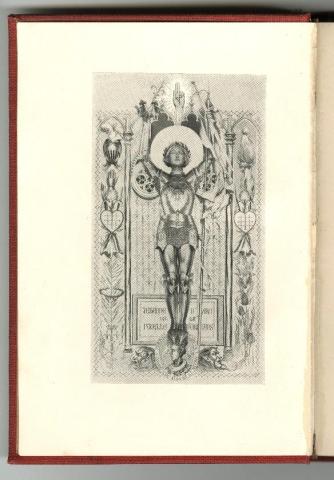
De Feure’s depiction of Joan is comparable to a frontispiece illustration by Frank DuMond in the Mark Twain novel mentioned above, published by Harper & Brothers, New York. Both images emphasize the contours of the female body and the standing pose with legs together facing front. While the book illustration shows the arms raised, both artists adopted the halo-like form surrounding Joan’s head and a similar design for the armor.
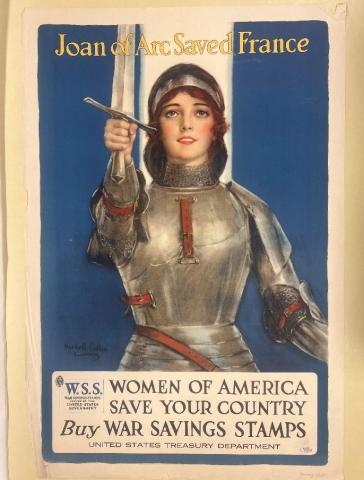
A couple of additional pieces in the art collection reveal how Saint Joan has remained a powerful symbol and still resonates as a cultural influencer. During World War I she was featured on a poster by Haskell Coffin produced by the United States Treasury Department to galvanize the public to buy war savings stamps. With her sword extended out towards the viewer she stands as a beacon of strength and virtue in support of the war effort. As described in the Gettysburg College Digital Commons, “The poster suggests that like raising one’s sword, buying War Savings Stamps will affect the outcome of World War I much as Joan of Arc’s heroic fighting impacted the Hundred Years’ War.”
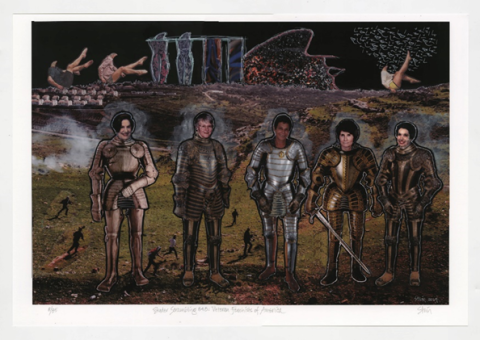
The 2015 archival pigment print by Linda Stein depicts five formidable feminists suited in armor. It belongs to a series called Gender Scrambling which blurs gender stereotypes by digitally swapping out heads with bodies of the opposite sex. To learn more about the artist and her work please visit a previous blog post. In both works, an iconic symbol of female power is used to inspire and motivate. While the wartime poster is an appeal to female patriotism, Ms. Stein’s work challenges entrenched perceptions of femininity to promote self-expression and self-determination. The legacy of Joan of Arc is still alive and well.
LuLen Walker
Art Curator