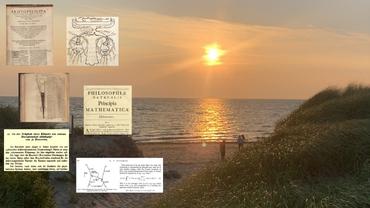
Join curator and Ph.D. candidate, Amjad Alqahtani, for an exhibition talk and opening reception to celebrate the exhibition" Capturing Light: A Time Machine from Aristotle to Feynman."
What is light?
This exhibition serves as an archival time machine, tracing humanity’s centuries-long quest to answer that fundamental question. Told through the rare books and historical documents housed in the Booth Family Center for Special Collections & the Georgetown Library Archives, the primary exhibit follows the evolution of our understanding of the nature of light from antiquity’s philosophical views to the complexities of modern quantum mechanics.
Visitors will follow a continuous thread from Aristotle’s foundational ideas, as echoed by Francisco de Toledo, past Ibn al-Haytham’s (Alhazen) 11th-century anatomical diagram of the eye. The journey then moves through Newton's corpuscular and Young's wave descriptions of light, shifts to Maxwell's formulation of light as an electromagnetic wave, and finally arrives at the modern understanding of wave-particle duality through the works of Einstein and Feynman. The exhibit also features a focused look at the legacy of physics and astronomy at Georgetown University, highlighting its own contributions to this universal endeavor—from the historic Heyden Observatory and Father Sestini's 1850 sunspot drawings, to the crucial dark matter observations of Vera Rubin.
The Evolution of Scientific Inquiry (Spotlight Exhibit)
In a special companion display located in the Booth Family Center’s Spotlight space, visitors can view several of the library's oldest and rarest holdings, including original editions of Thomas Aquinas’s Summa Theologica (1478), Francisco de Toledo’s Commentary on Aristotle (1575), and Isaac Newton’s Principia (1687). Beyond showcasing these rare artifacts, this auxiliary exhibit documents the historical evolution of scientific inquiry—charting the trajectory from the deductive reasoning of classical and medieval natural philosophers to the empirical and mathematical approach defined by Newton's Hypotheses non fingo ("I frame no hypotheses") dictum.
Refreshments will be provided by the Department of Physics and the Georgetown University Library.
Sharon Clayton <sc2520@georgetown.edu> and Amjad Alqahtani <aa2276@georgetown.edu>