To mark its 50th anniversary, CCAS has created this physical exhibition, as well as a digital archive—featuring videos, images, texts, audio recordings, and an interactive timeline—to preserve and share the Center’s rich history. Together, they not only document five decades of education, research, and public outreach, but also capture the Center’s evolving mission and enduring impact. We hope you enjoy this exhibit and invite you to visit the CCAS Digital Archive at ccasarchive.georgetown.domains. Thank you for celebrating this milestone with us.
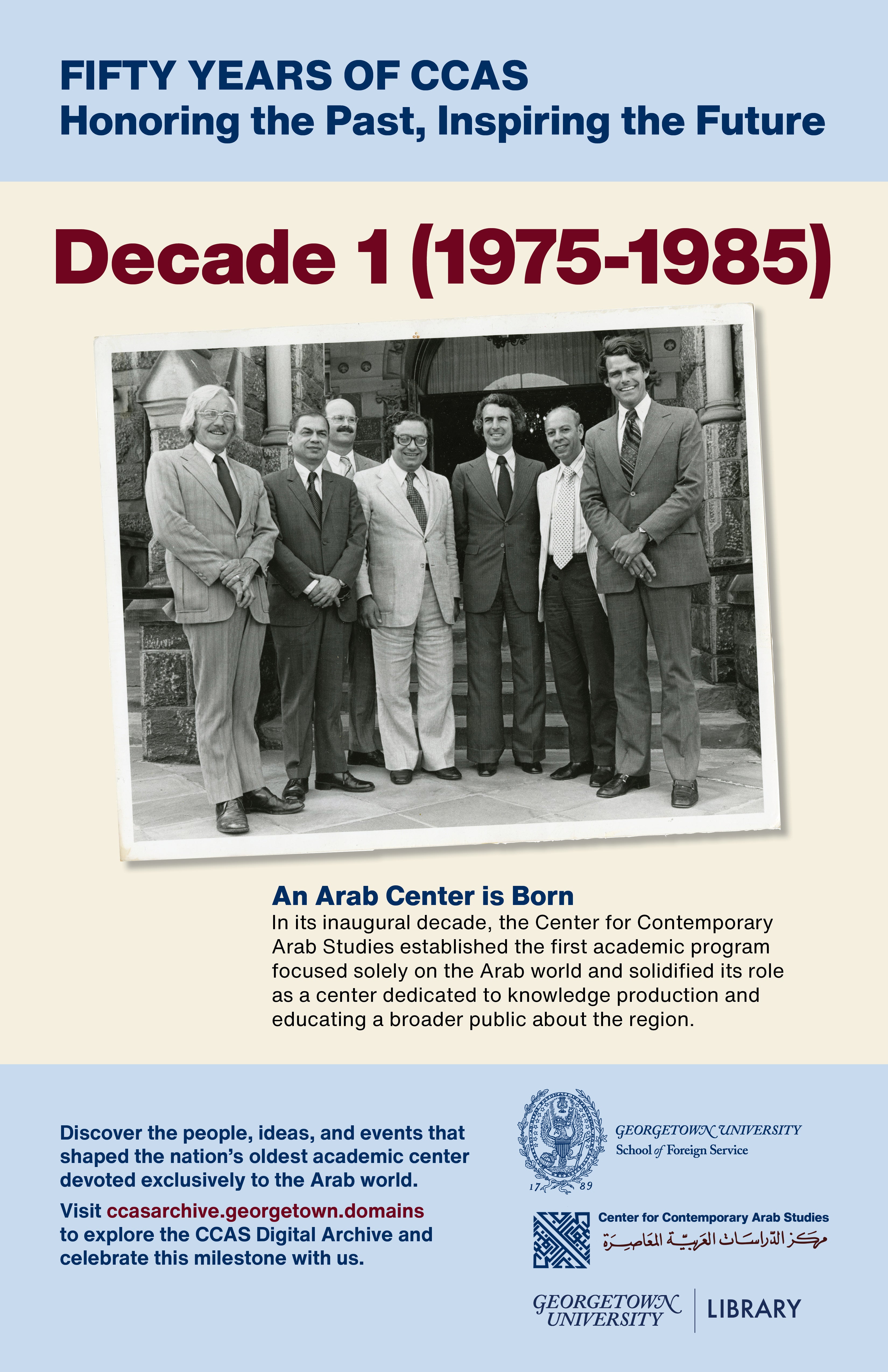
Decade 1 (1975-1985)
An Arab Center is Born. In its inaugural decade, the Center for Contemporary Arab Studies established the first academic program focused solely on the Arab world and solidified its role as a center dedicated to knowledge production and educating a broader public about the region.
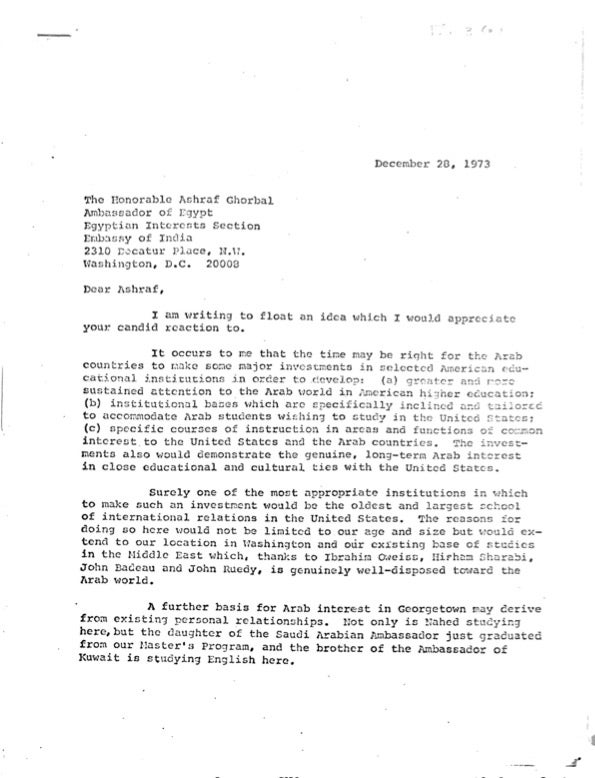
Letter from Peter Krogh to Ambassador Ghorbal
1973. CCAS Archive 1.1.7
In 1973, Peter Krogh, Dean of Georgetown's School of Foreign Service, wrote to Egyptian Ambassador Ashraf Ghorbal to encourage Arab countries to invest in the development of Middle East studies within U.S. higher education. He suggested that Georgetown, home to the oldest and largest school dedicated to international relations, was the ideal institution to house such a program.
CCAS 10 Year Anniversary Brochure
[1985]. CCAS Archive 1.1.8.
A brochure created for the tenth anniversary of CCAS documenting the Center's first decade.
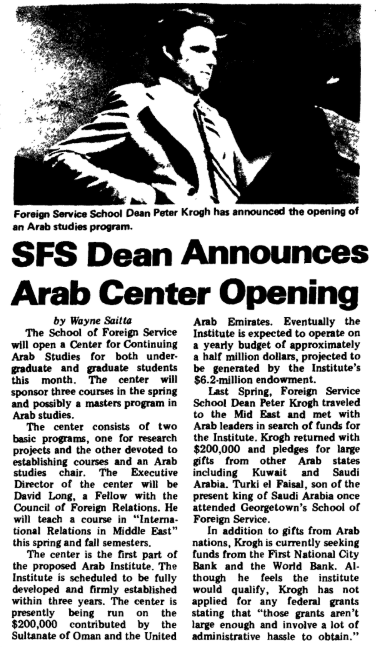
SFS Dean Announces Arab Center Opening
The Hoya. 56th year, no. 1. August 30, 1975. Georgetown University Archives.
In August 1975, The Hoya ran an article announcing the creation of a new academic center at Georgetown that would be dedicated to the study of the Arab world. The Center for Contemporary Arab Studies was inaugurated the following month.
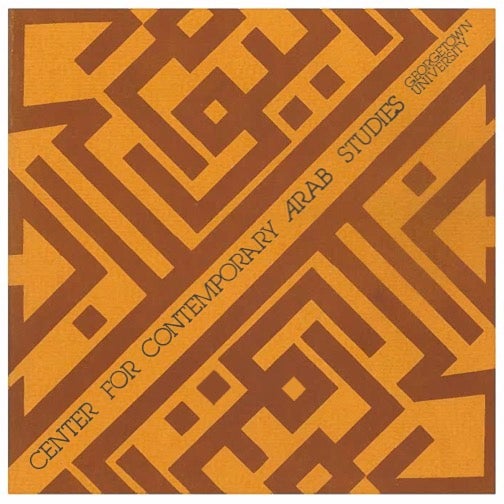
CCAS Prospectus
CCAS Archive
A prospectus prepared in 1975, the year CCAS was founded, to outline the Center's proposed programming, staffing, budget and funding. The internal text is written in both English and Arabic and the cover features the CCAS logo designed by Kamal Boullata.
Kamal Boullata and the CCAS Logo
CCAS Archive
In the early 1970s, Michael Hudson, one of the Center's founders, asked Palestinian artist Kamal Boullata to create a logo for an event surrounding the formation of the Center. Boullata sketched a diamond-shaped calligraphic depiction of the words العرب اليوم (al-‘Arab al-Yawm), which means “the Arabs today.” His caligraphic work has remained the CCAS logo for half a century and has appeared on countless CCAS publications, as well as gifts and swag.
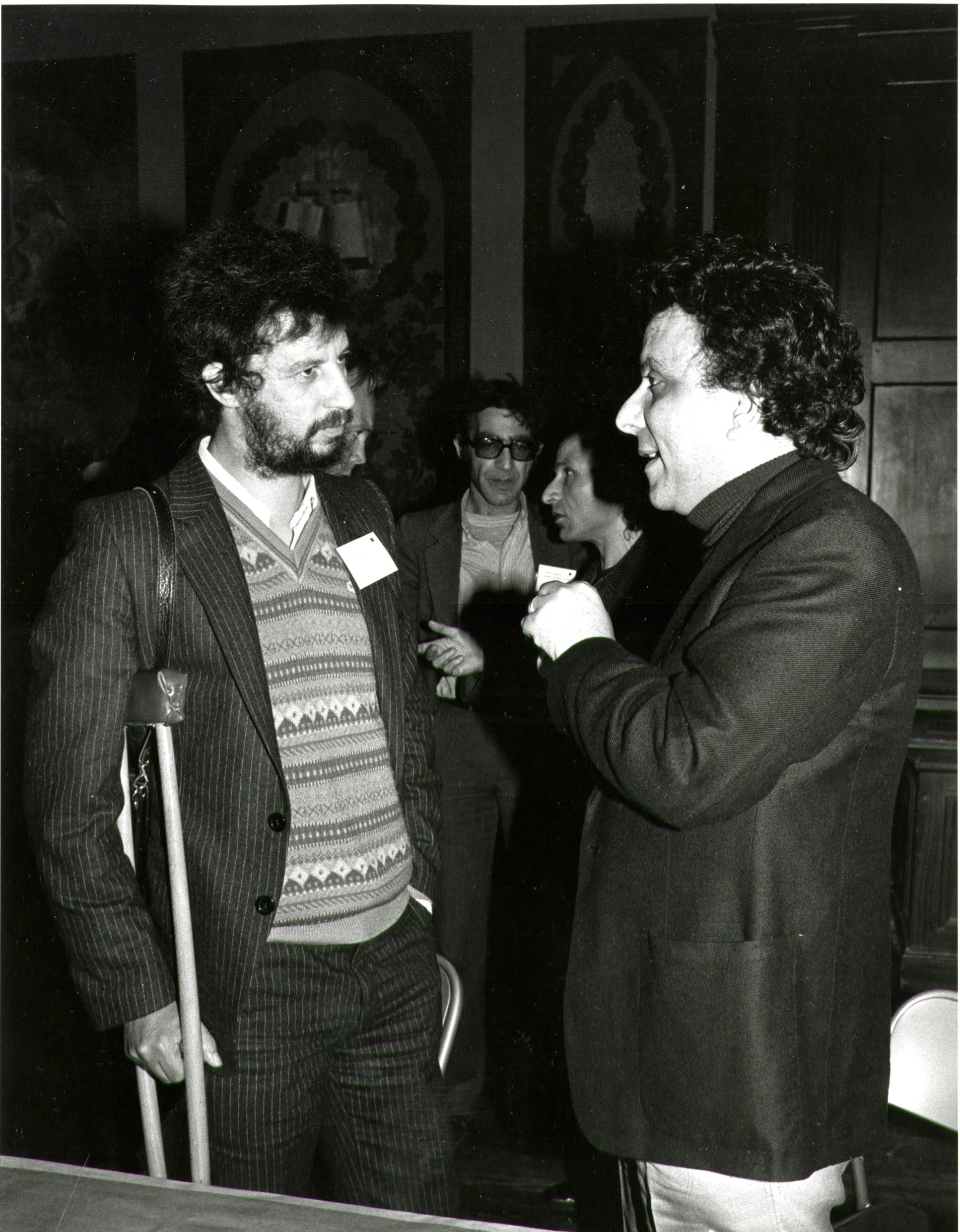
Kamal Boullata and Mohammed Bennis
CCAS Archive
Kamal Boullata (right) speaking with Moroccan poet and scholar Mohammed Bennis at a CCAS symposium in 1982.
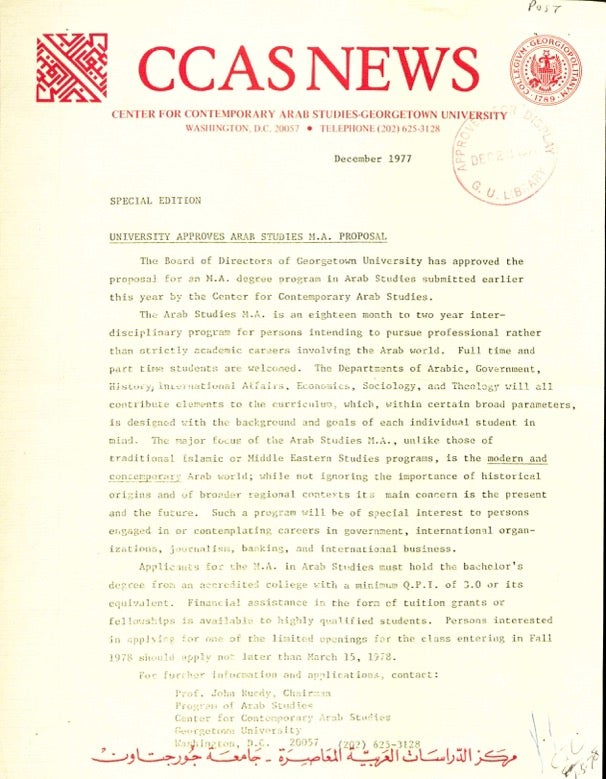
CCAS Launches MA in Arab Studies
CCAS News. December 1977. Georgetown University Archives. GTA-000749 Box 1 Folder 2.
An announcement in the December 1977 CCAS Newsletter about the creation of the M.A. in Arab Studies (MAAS), which would become the flagship academic program at the Center.
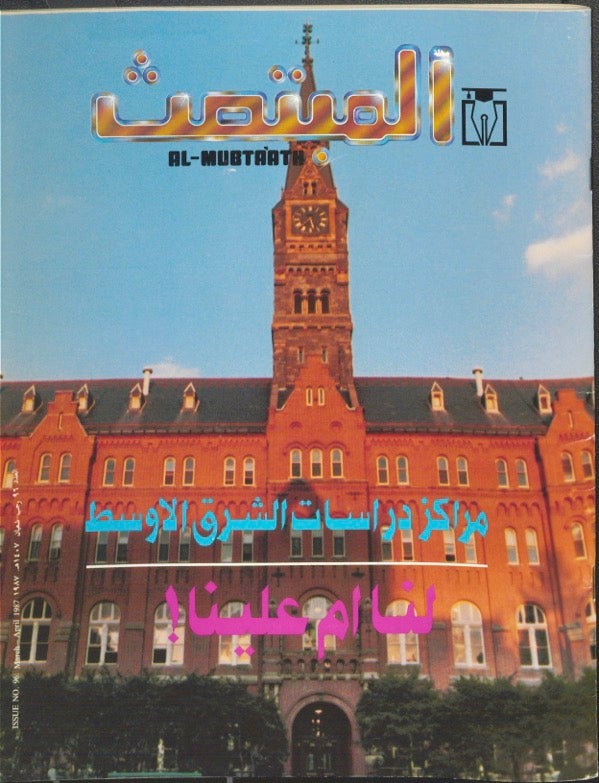
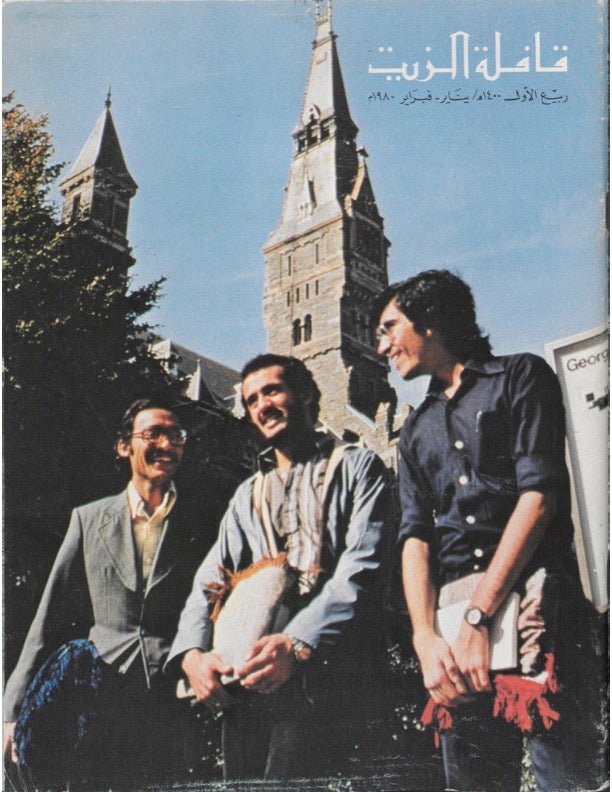
MAAS Program Featured in Arabic Magazines
al-Mubtaʻath. No. 96 March/April 1987. Georgetown University Archives. GTA-000623 Box 1 Folder 4. Qāfilat al-Zayt Vol. 3 no. 28 January/February 1980. Georgetown University Manuscripts Collection. GTM-20230816 Box 8
The newly established MAAS program soon caught the attention of the Arab community within the United States and was featured in Arabic publications: (Left) "Marākiz dirāsāt al-Sharq al-Awsaṭ : Lanā am ʻalaynā!" (“Centers for Middle East Studies: For Us or Against Us!”), a survey of Middle East programs in the U.S. published in 1987 by the Embassy of the Kingdom of Saudi Arabia in Washington DC; (Right) "al-ʿArab fī Amrīkā" ("Arabs in America"), which appeared in a 1980 issue of Qāfilat al-Zayt, published by the Arabian American Oil Company.
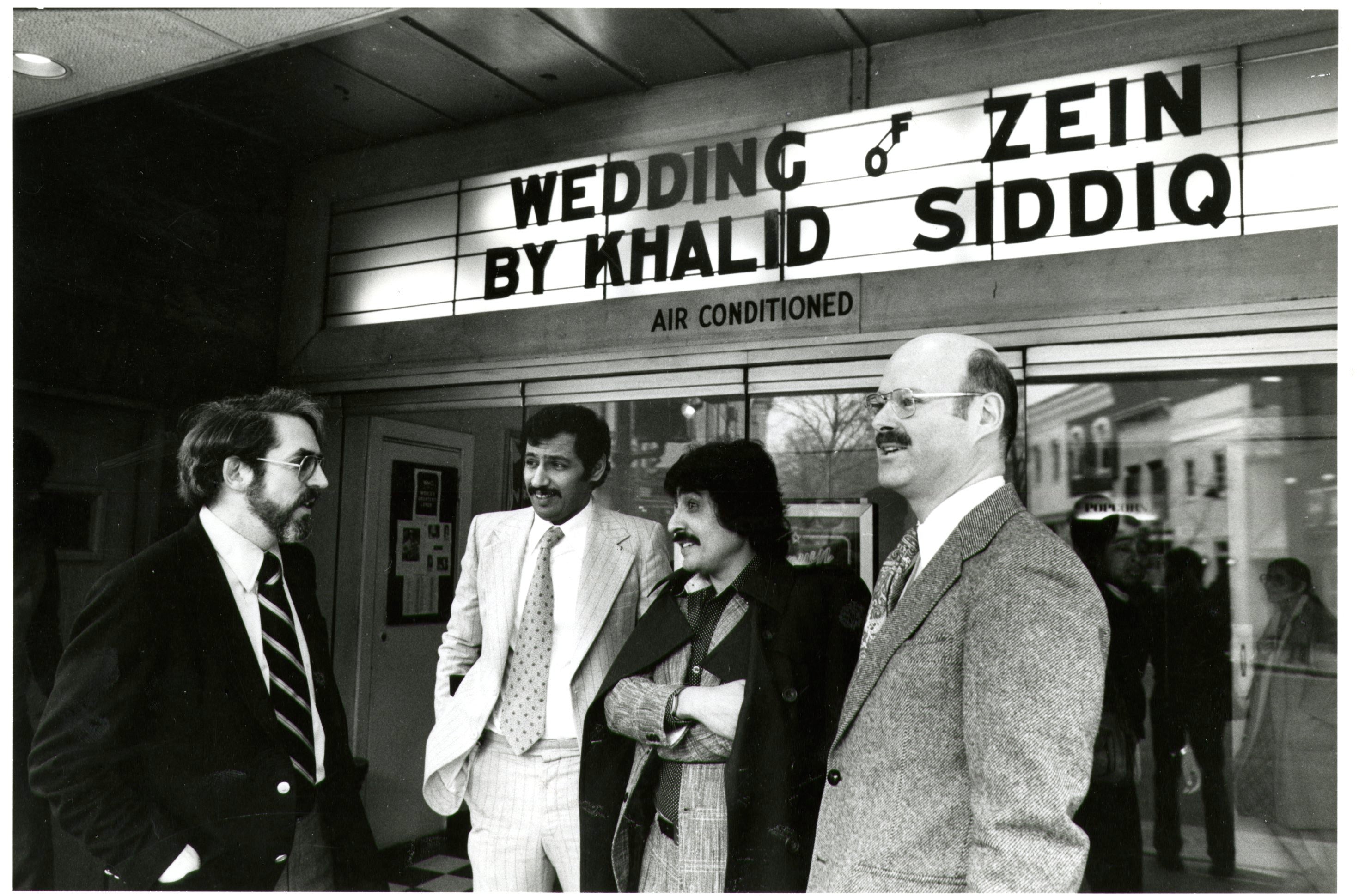
The Wedding of Zein Film Screening
1979. CCAS Archive 1.10.1
In March 1979, CCAS hosted a screening of The Wedding of Zein and discussion with director Khalid al-Siddiq, whose work influenced the development of the Kuwaiti film industry and the broader Khaleeji cinematic movement. Pictured here with CCAS Director Michael Hudson and Khalid al-Dawaisan.
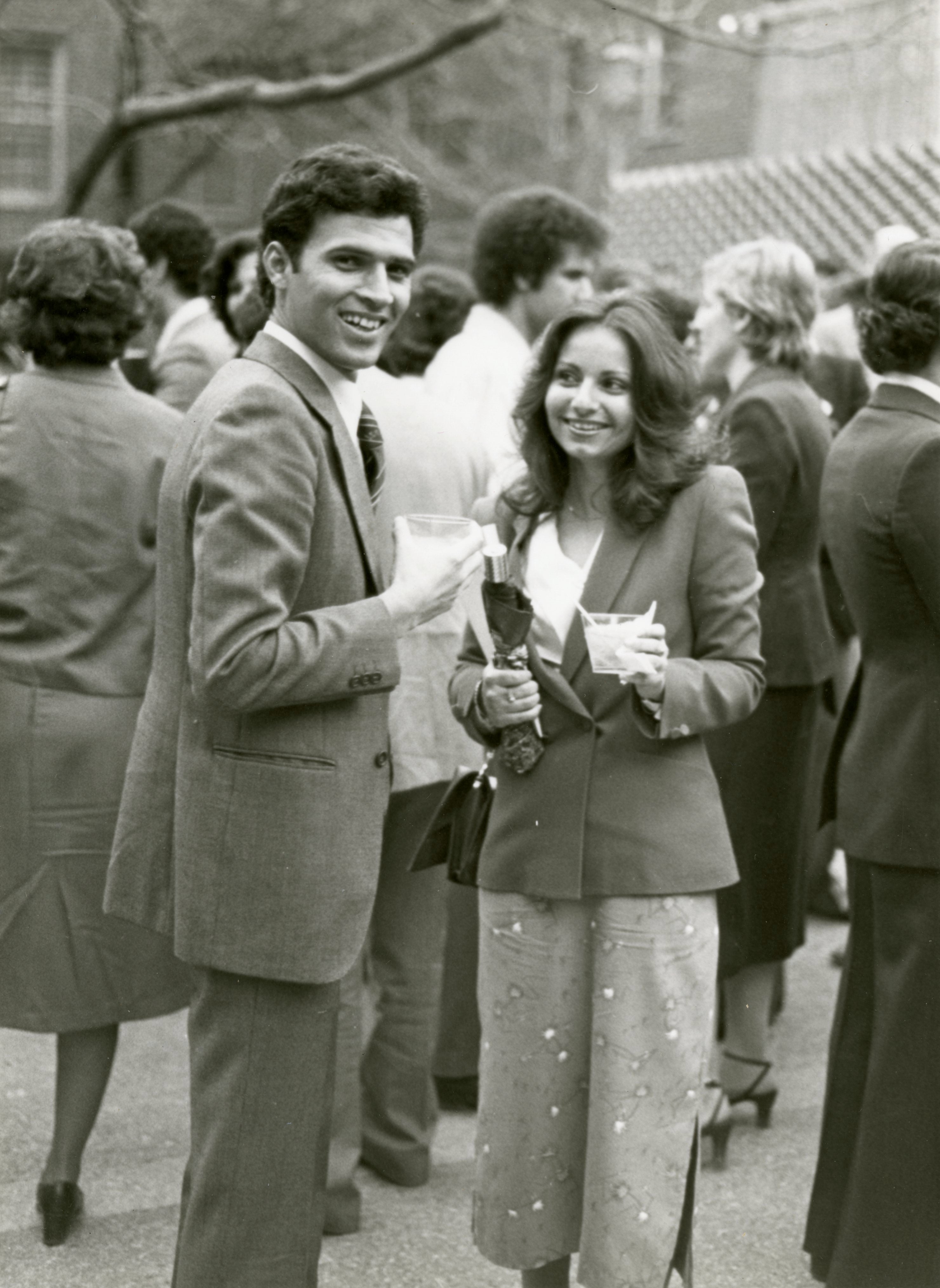
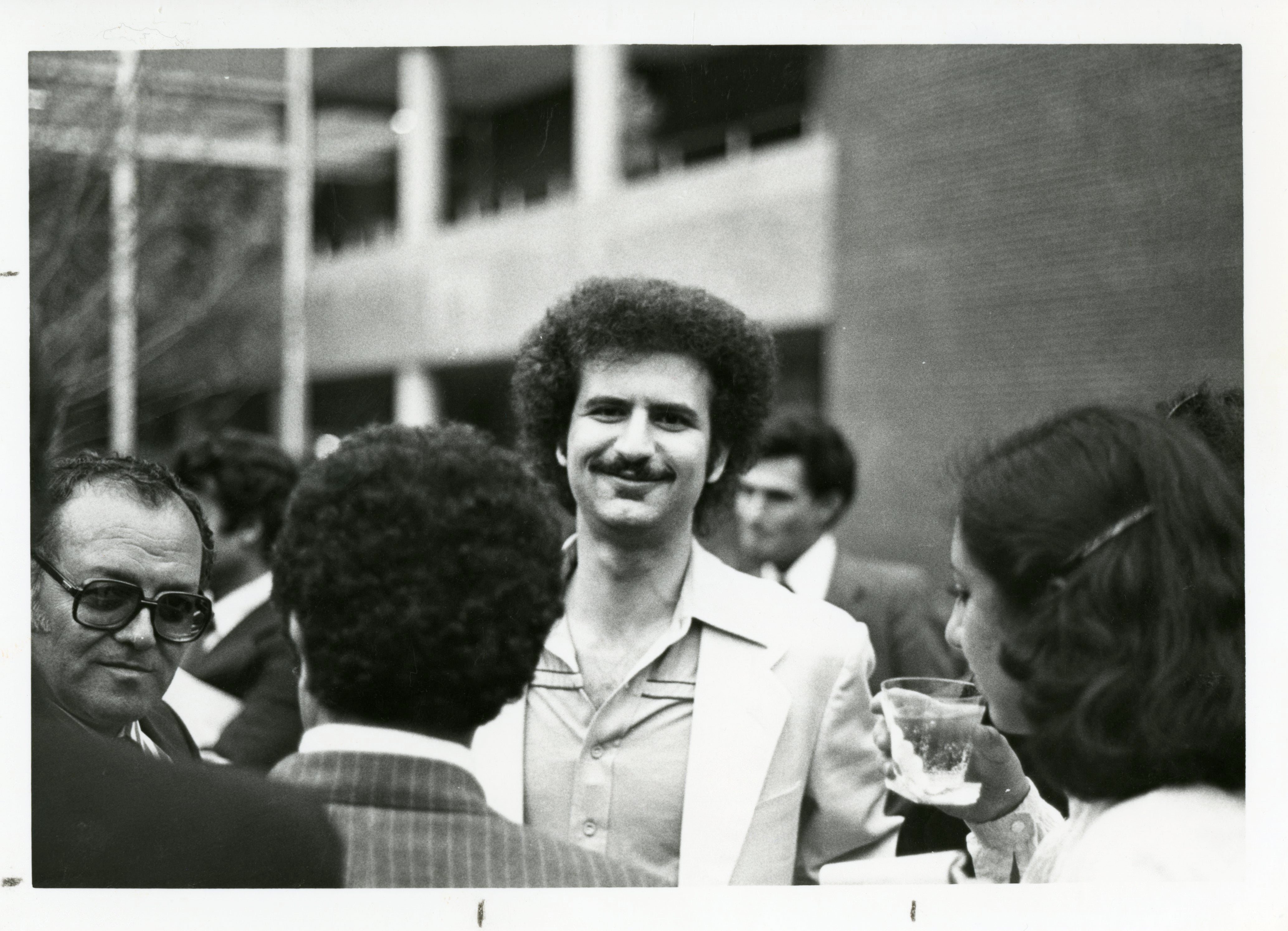
The First MAAS Cohort Graduates
1980. CCAS Archive. 1.11.1. 1980. CCAS Archive. 1.11.2. 2017. CCAS Archive. 1.11.3.
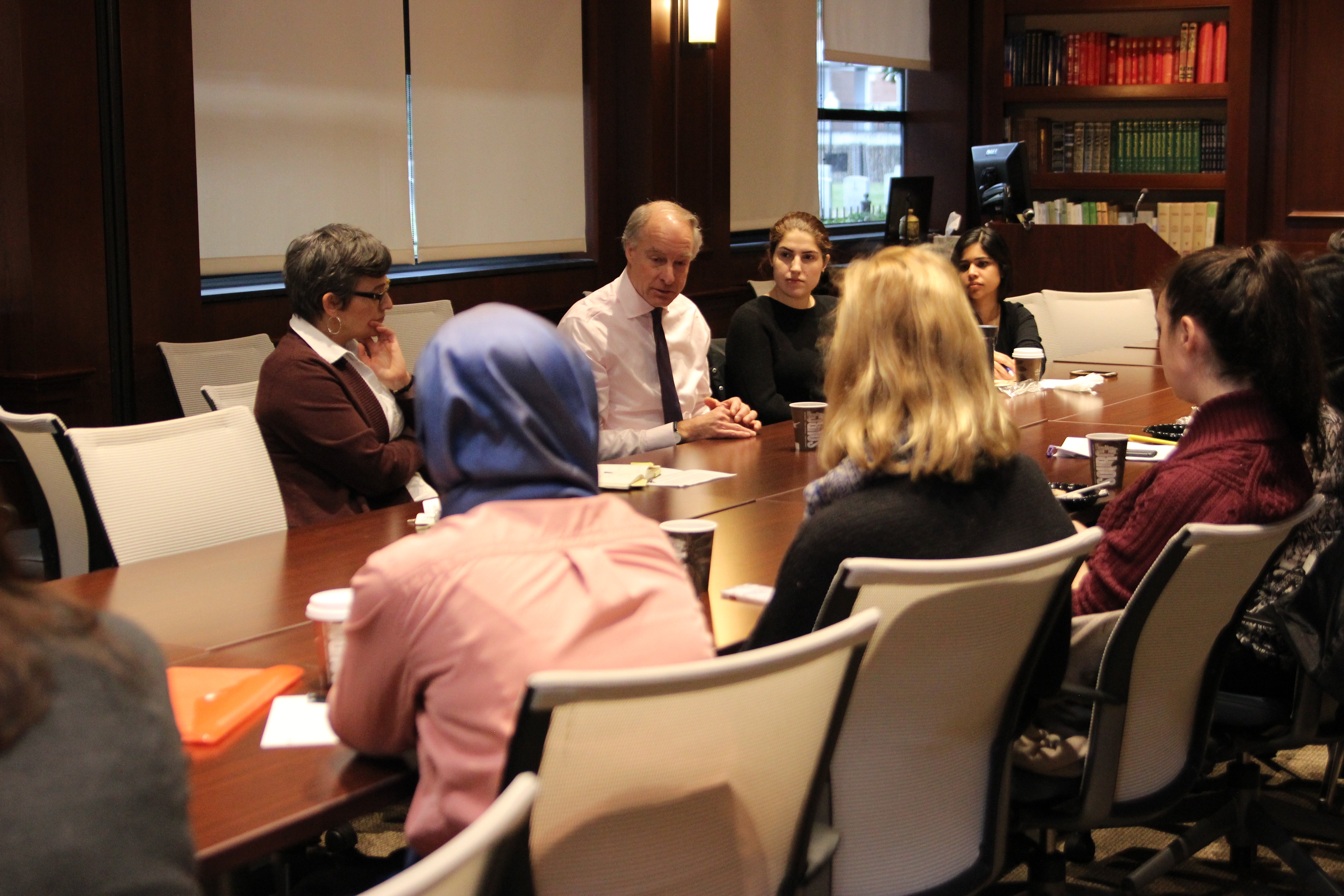
The first MAAS class—comprised of eight students—graduated in May 1980, marking a major milestone for the Center. The first cohort included Ziad Abou Amer (Pictured on the left with Nadia Abourizk, MAAS '85), who would go on to serve as Deputy Prime Minister of the State of Palestine; Beshara Doumani (Center), who later held the Mahmoud Darwish Chair in Palestinian Studies at Brown University; and Curt Goering, who served for three decades as a Middle East Program Officer at Amnesty International before becoming Executive Director of the Center for Victims of Torture. He is pictured on the right speaking to MAAS students in 2017.
"Petrodollar Surpluses: Trends and Economic Impact"
CCAS Reports. November 1983.
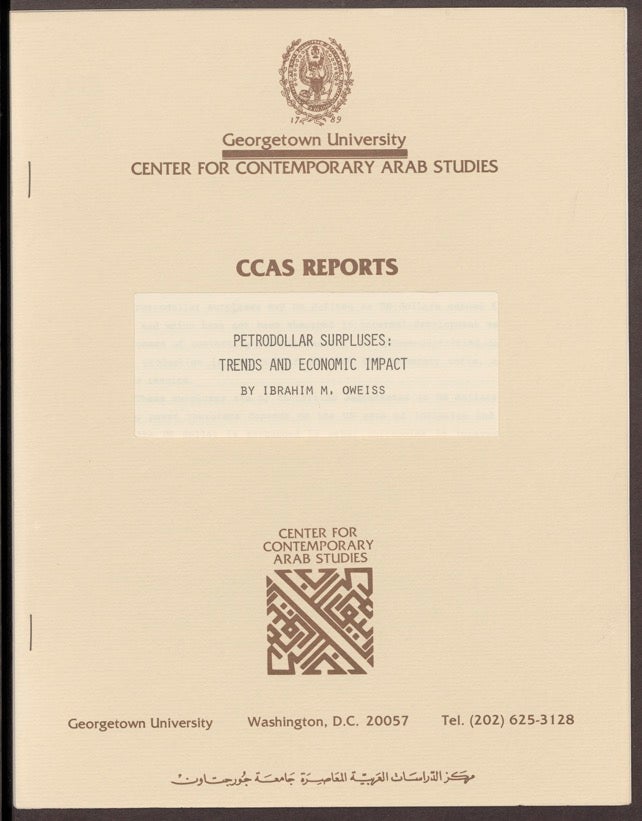
Arab economist and CCAS founding faculty member Ibrahim Oweiss popularized the now widely used term "petrodollars"—referring to crude oil export revenues denominated in U.S. dollars. Although he first coined and presented the term in 1974 in the aftermath of the oil embargo, it gained broader recognition following his 1983 CCAS-published report, “Petrodollar Surpluses: Trends and Economic Impact.”
CCAS Launches Teacher Outreach Program
1984. Georgetown University Archives. GTA-080606 Box 1 Folder 1.
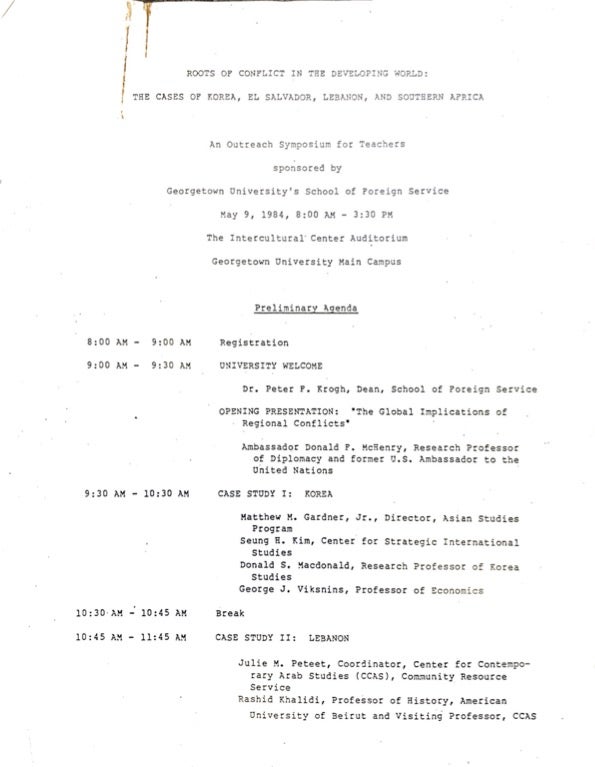
In 1983, CCAS launched the Community Resource Service (CRS) to support American educators in teaching about the Arab world and Islam with accuracy and depth. The program from the first teacher symposium, “Roots of Conflict in the Developing World,” included a letter written by CRS Director Julie Peteet explaining the goals of the new program. CRS would later evolve into CCAS’s Education Outreach program, which has provided professional development, classroom resources, and ongoing support to thousands of teachers over the decades.
Nan Anthony, First CRS Director
1984. Georgetown University Archives. University Photographer Files UP 8-91-054
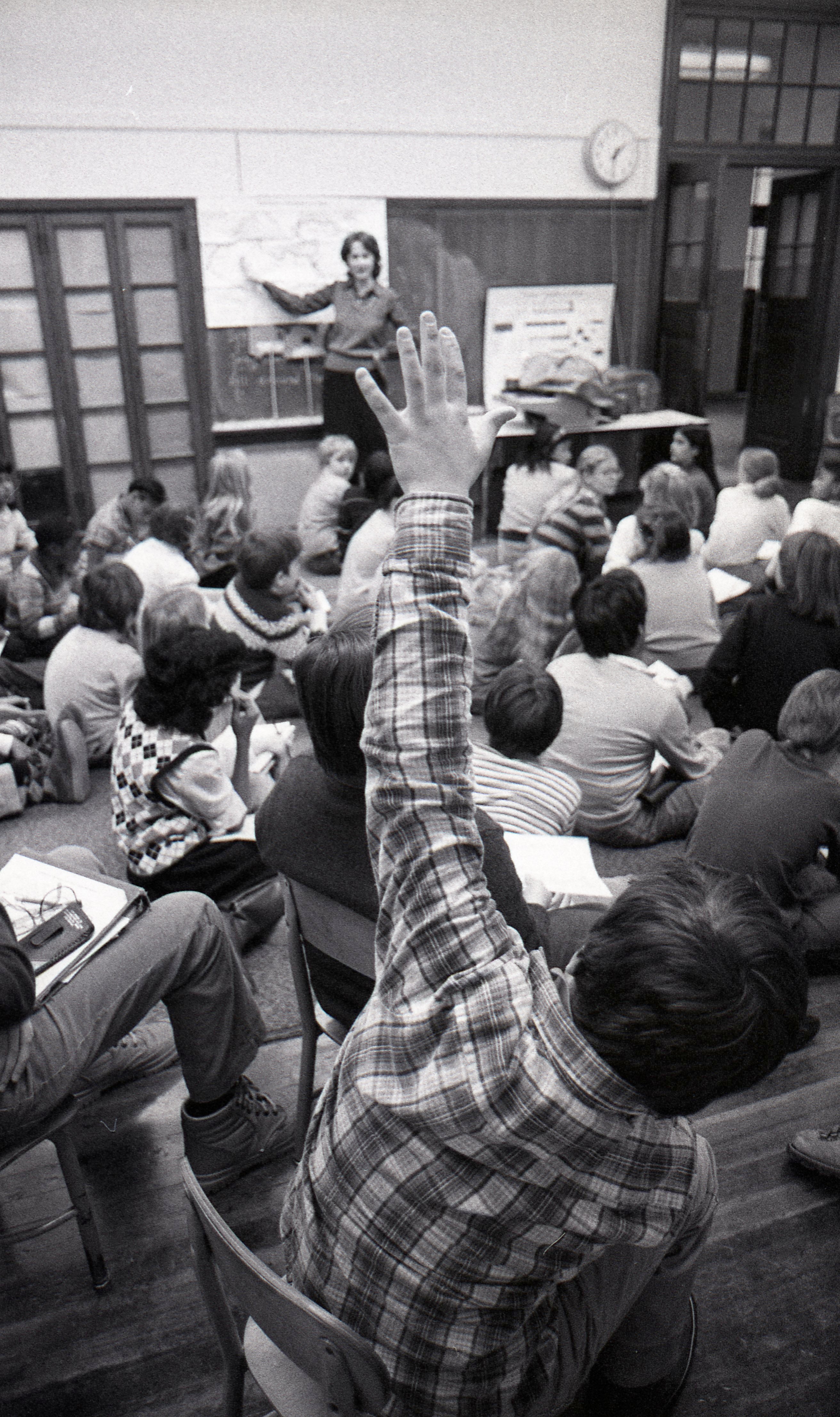
Nan Anthony, the first director of the Community Resource Service at CCAS, teaching a class in 1984.
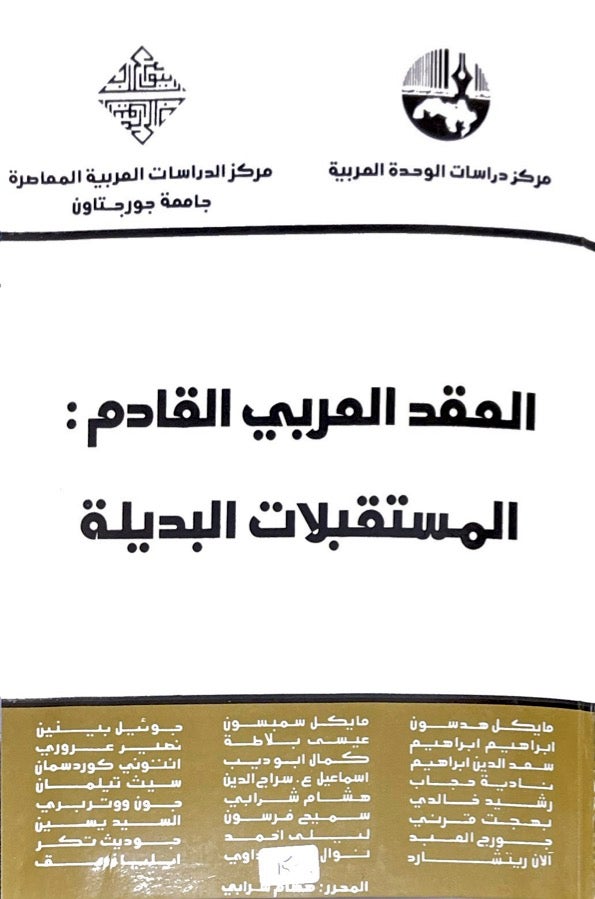
Proceedings of CCAS's 10th Annual Symposium
1986. DS63.1 .A63 1986. Georgetown University Library.
Proceedings from the 1985 CCAS Annual Symposium “al-ʻAqd al-ʻArabī al-qādim: al-mustaqbalāt al-badīlah” (The Next Arab Decade: Alternative Futures), a two-day event that brought 27 internationally renowned scholars to Georgetown to examine the political, economic, social, and cultural trajectories of the Arab world.
CCAS Faculty Books from Decade 1
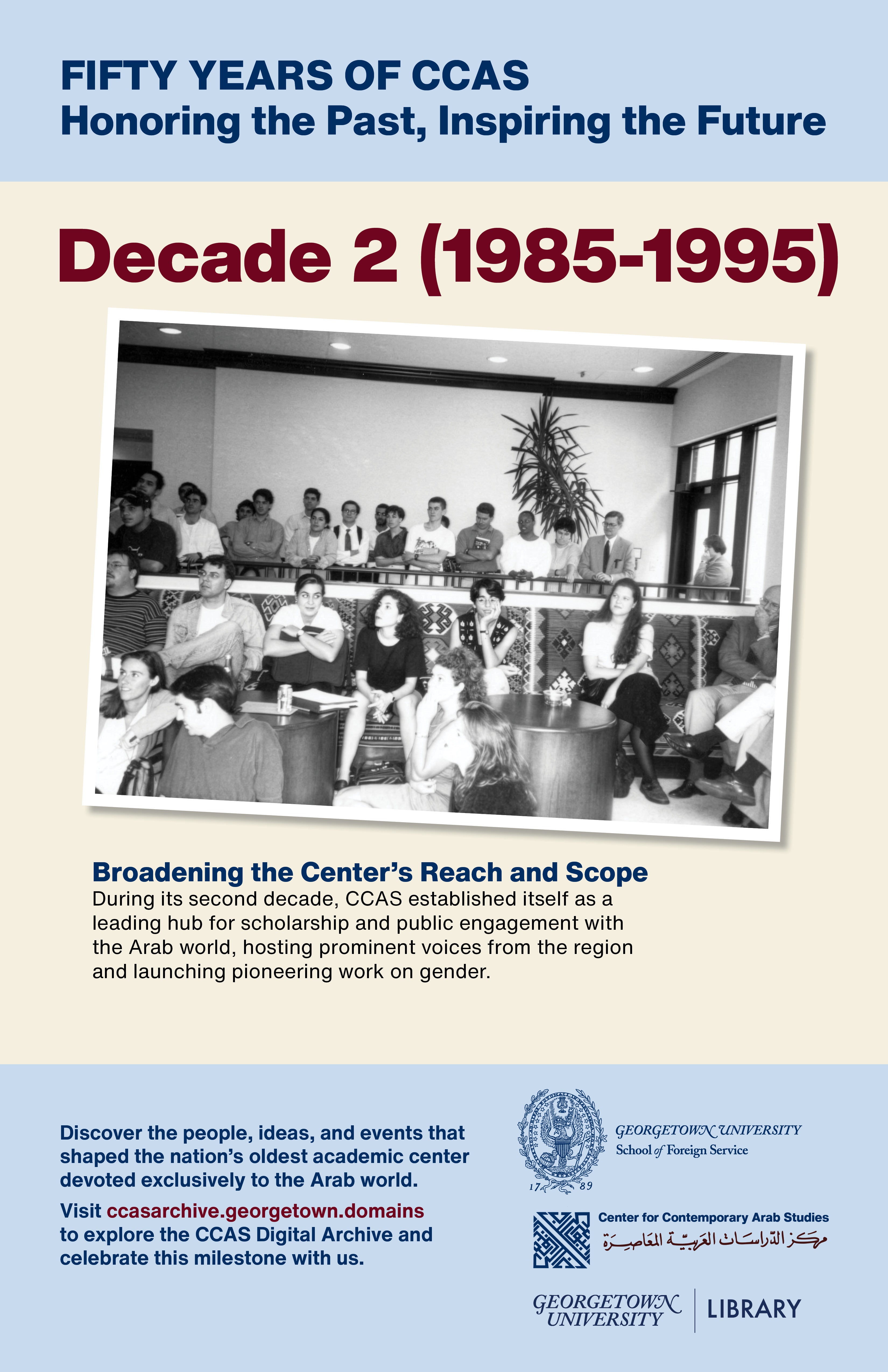
Decade 2 (1985-1995)
Broadening the Center’s Reach and Scope. During its second decade, CCAS established itself as a leading hub for scholarship and public engagement with the Arab world, hosting prominent voices from the region and launching pioneering work on gender.
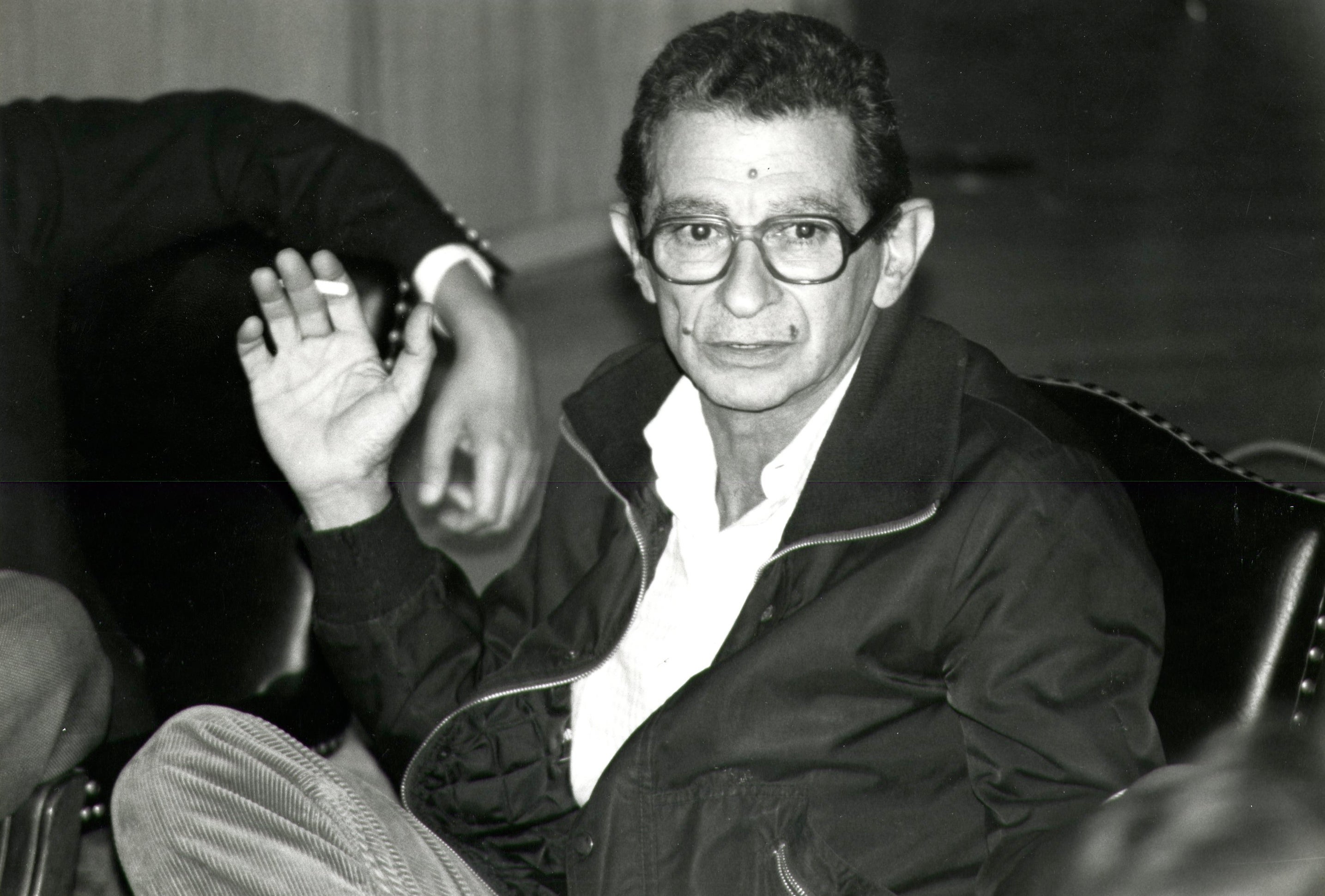
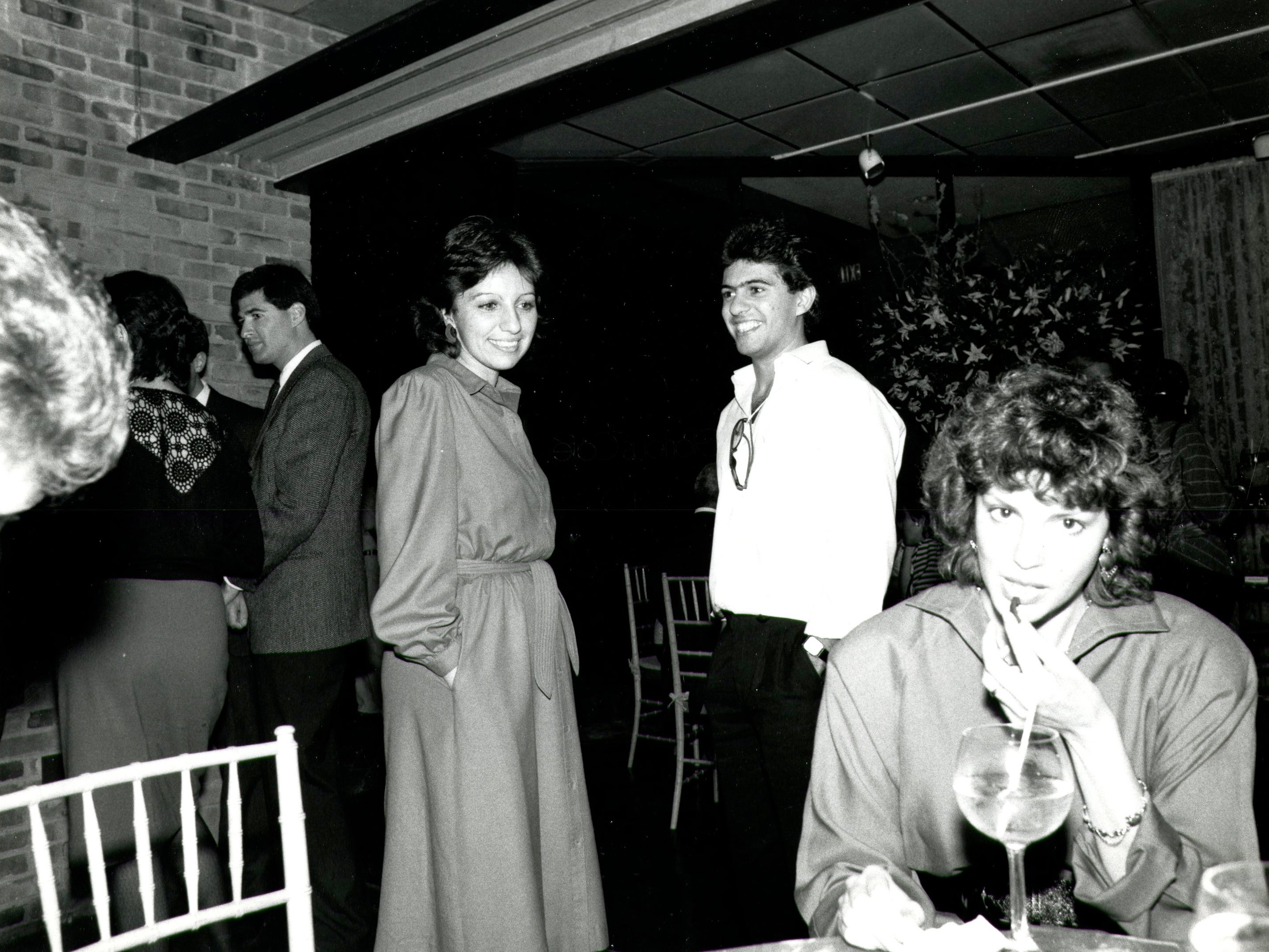
Youssef Chahine Film Festival
October 1985. CCAS Archive. 2.2.1. October 1985. CCAS Archive. 2.2.3.
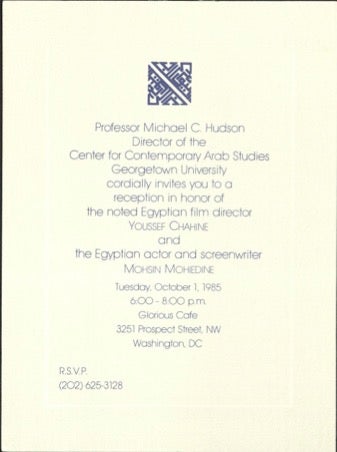
In October 1985, CCAS hosted a film festival and reception honoring Egyptian director Youssef Chahine (Left) and actor-screenwriter Mohsen Mohieddin, pictured on the right with CCAS Publications Manager Zeina Azzam during the event. This is an early example of how CCAS would continue to use cinema as a vehicle for both scholarly exchange and community building.
Invitation to Reception Honoring Chahine and Mohieddin
1985. CCAS Archive. 2.2.4.
Printed invitation to meet Chahine and Mohieddin as part of the Youssef Chahine Film Festival.
Poet Adonis Delivers Lecture at CCAS
CCAS Archive. 2.1.1.
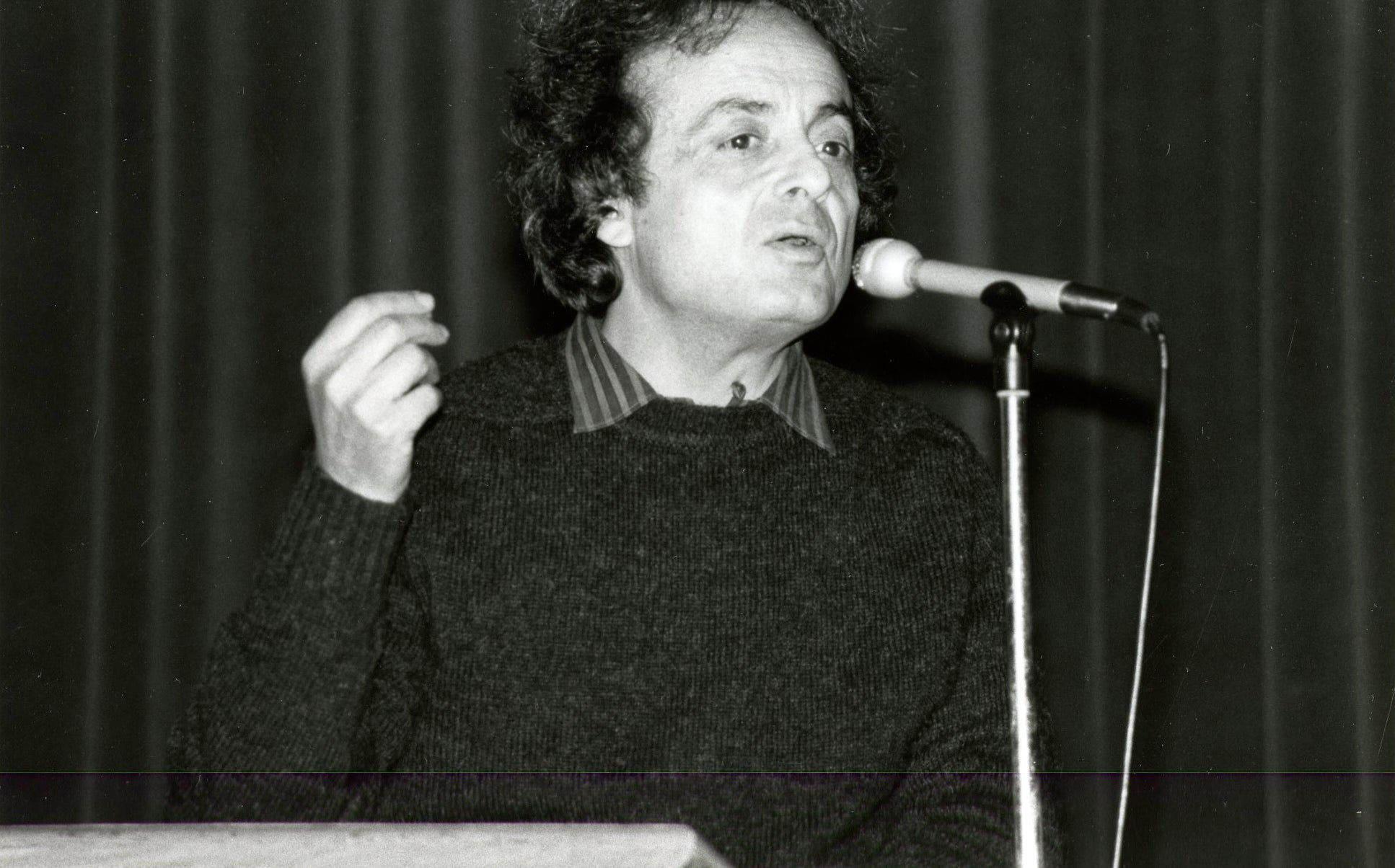
In 1985, acclaimed Syrian poet Ali Ahmad Said Esber—pen name Adonis—spent a year at CCAS as the Center’s first and only poet-in-residence. He is pictured here delivering a lecture at Georgetown.
CCAS Responds to the Iran-Iraq War
1987. CCAS Archive. 2.5.3.
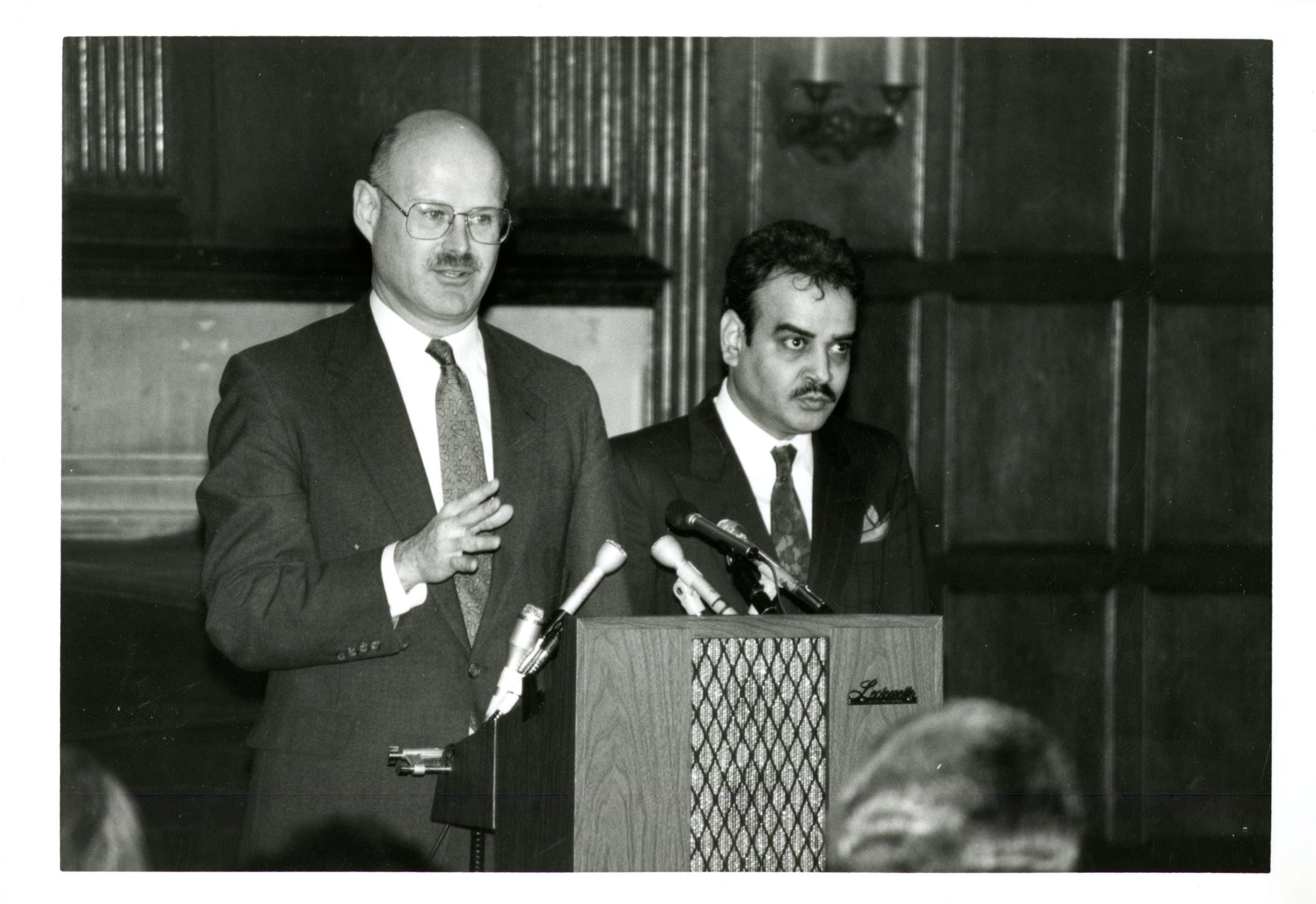
Throughout the Iran-Iraq War, CCAS hosted events examining the conflict’s historical roots and broader global implications. In 1987, as the war entered its seventh year—and as international alarm grew over Iraq’s escalating use of chemical weapons—CCAS hosted an event in which Iraqi Ambassador Nizar Hamdoon and CCAS Director Michael Hudson addressed the U.S.–Iran arms deal.
CCAS Faculty Books from Decade 2
MAAS Students Launch Arab Studies Journal
Spring 1993. Georgetown University Archives. GTA-000749 Box 1 Folder 1.
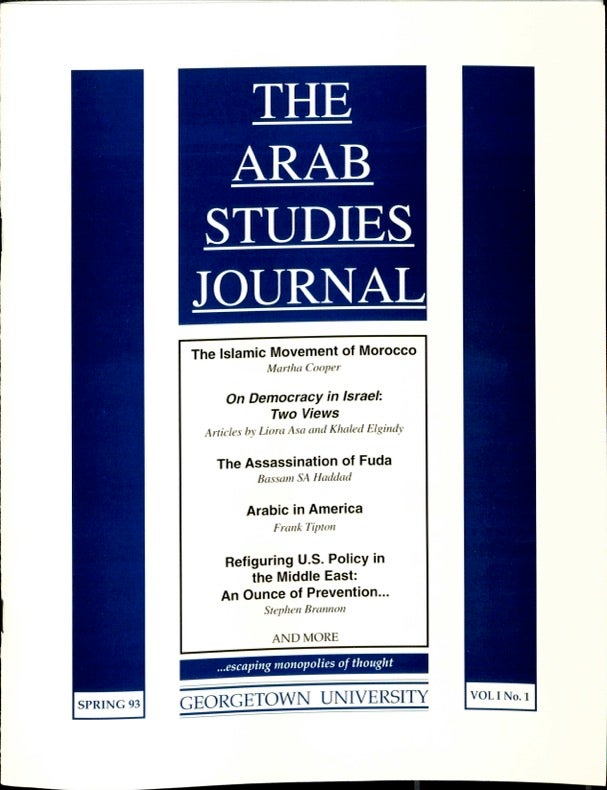
In 1992, MAAS students founded the Arab Studies Journal (ASJ), a peer-reviewed journal that continues today as a leading platform for scholarship on the Arab world. This is the inaugural issue published in 1993.
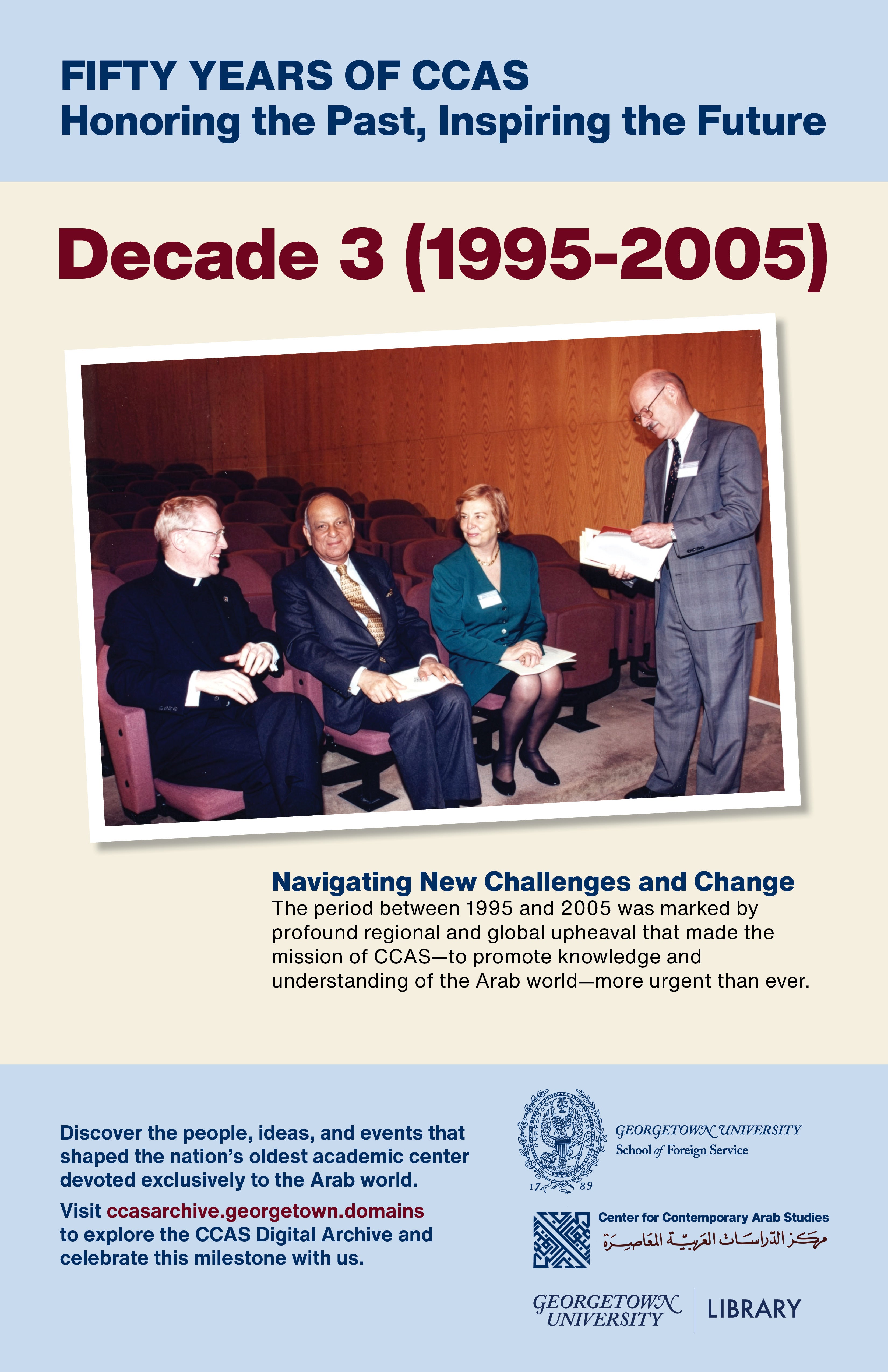
Decade 3 (1995-2005)
Navigating New Challenges and Change. The period between 1995 and 2005 was marked by profound regional and global upheaval that made the mission of CCAS—to promote knowledge and understanding of the Arab world—more urgent than ever.
The Information Revolution in the Arab World
1997. CCAS Archive. 3.2.5.
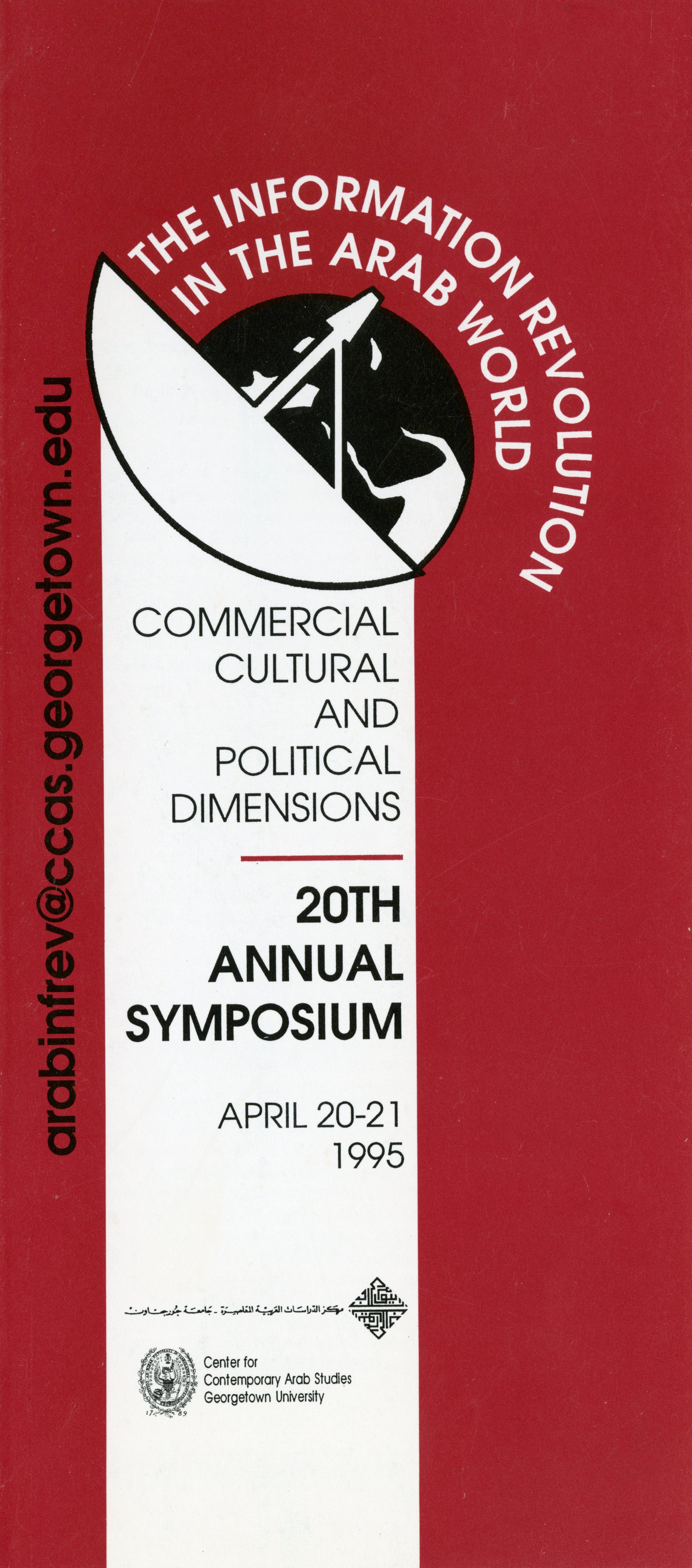
In 1995, CCAS marked its 20th annual symposium with “The Information Revolution in the Arab World,” exploring the ways that fast-changing communications technologies would impact the Arab world and beyond—from developments in electronic news media to research possibilities to questions of control and censorship.
"Computing" in Arabic
1997. CCAS Archive. 3.2.6.
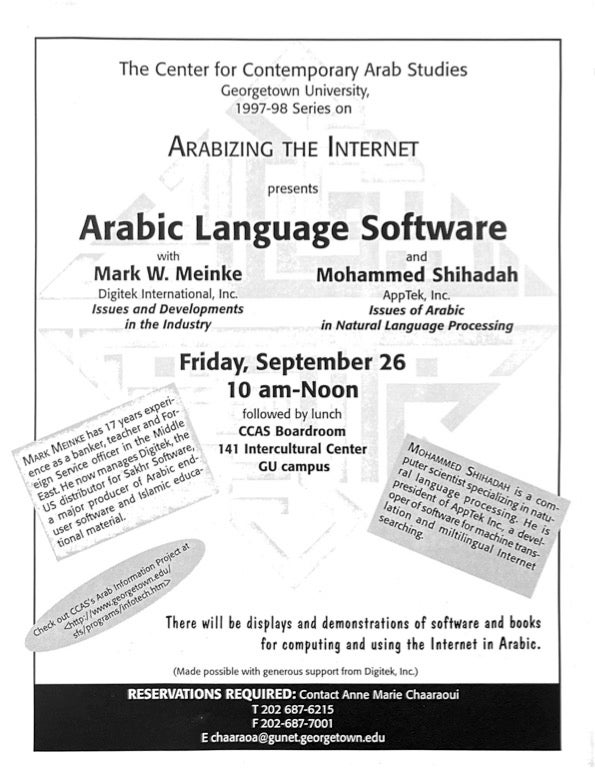
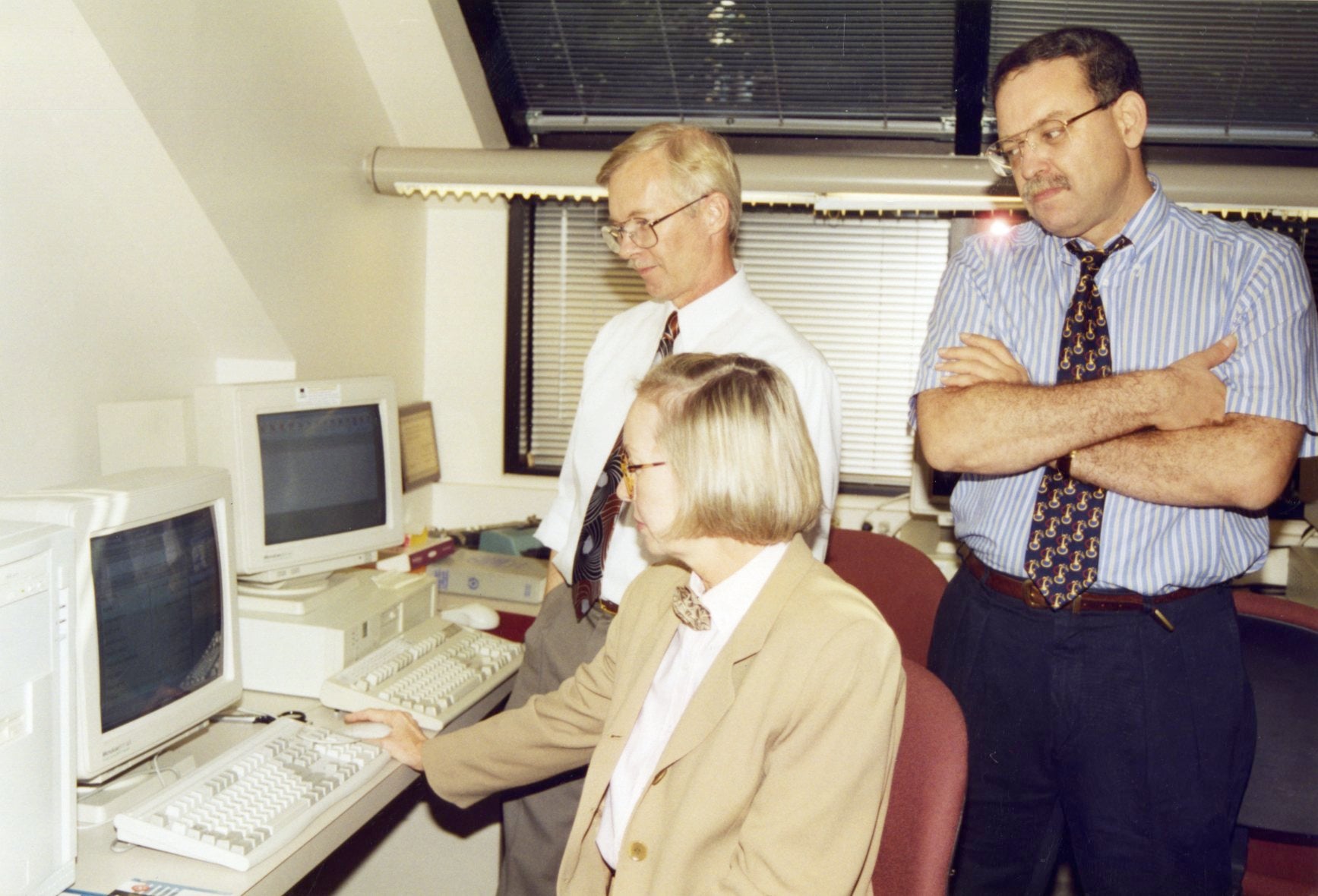
Two years later, CCAS hosted a workshop titled “Arabizing the Internet,” showcasing Arabic-language software and tools built to help people "compute" and navigate the Internet in Arabic. Workshop speakers from Digitek International, pictured here with CCAS faculty member Karin Ryding, demonstrated these new programs on equipment donated to support the CCAS Arab Information Project.
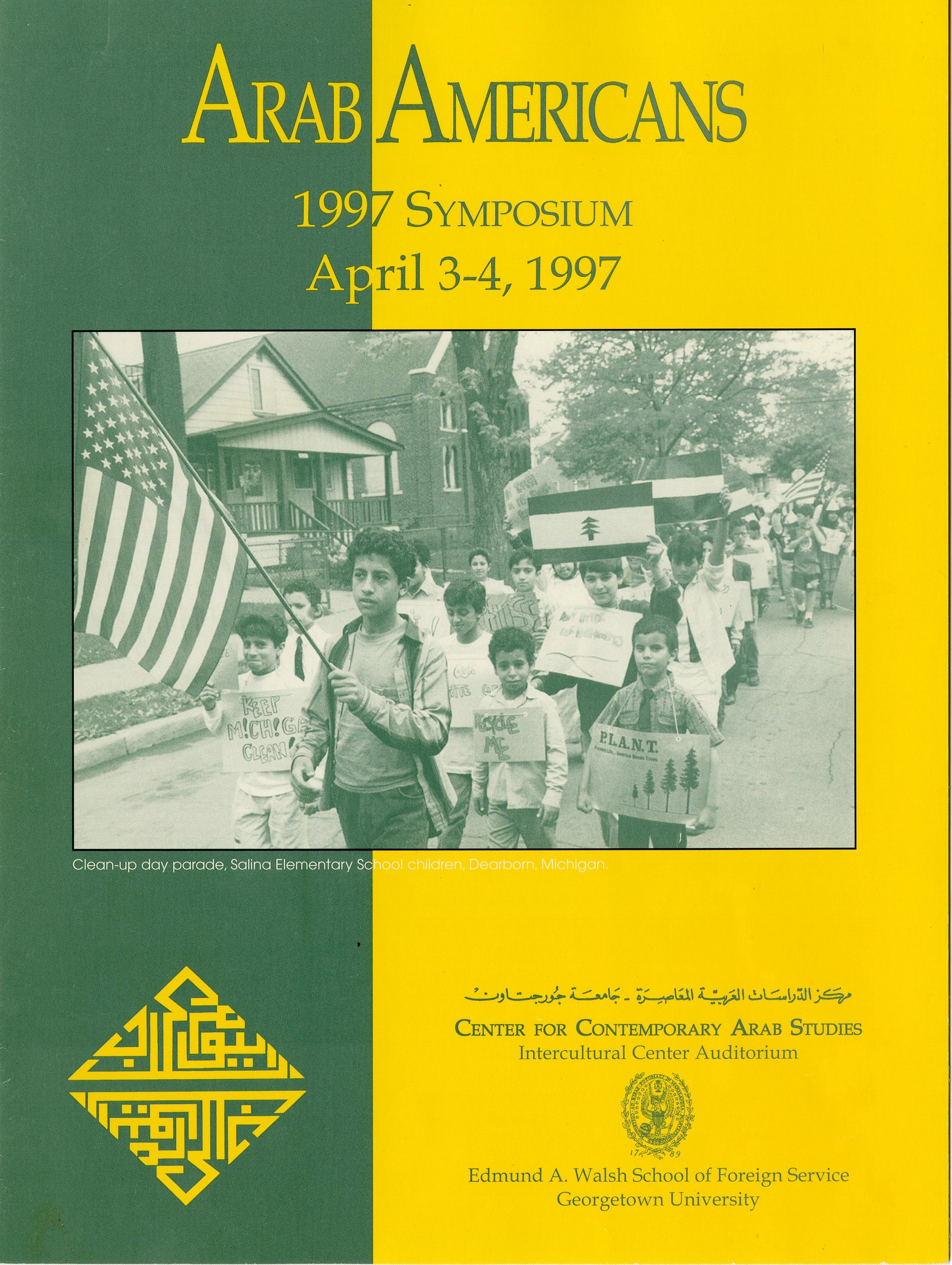
Program for "Arab Americans" 1997 Symposium
1997. CCAS Archive. 3.5.1.
In 1997, CCAS held an annual symposium exploring Arab American diasporas and identities.
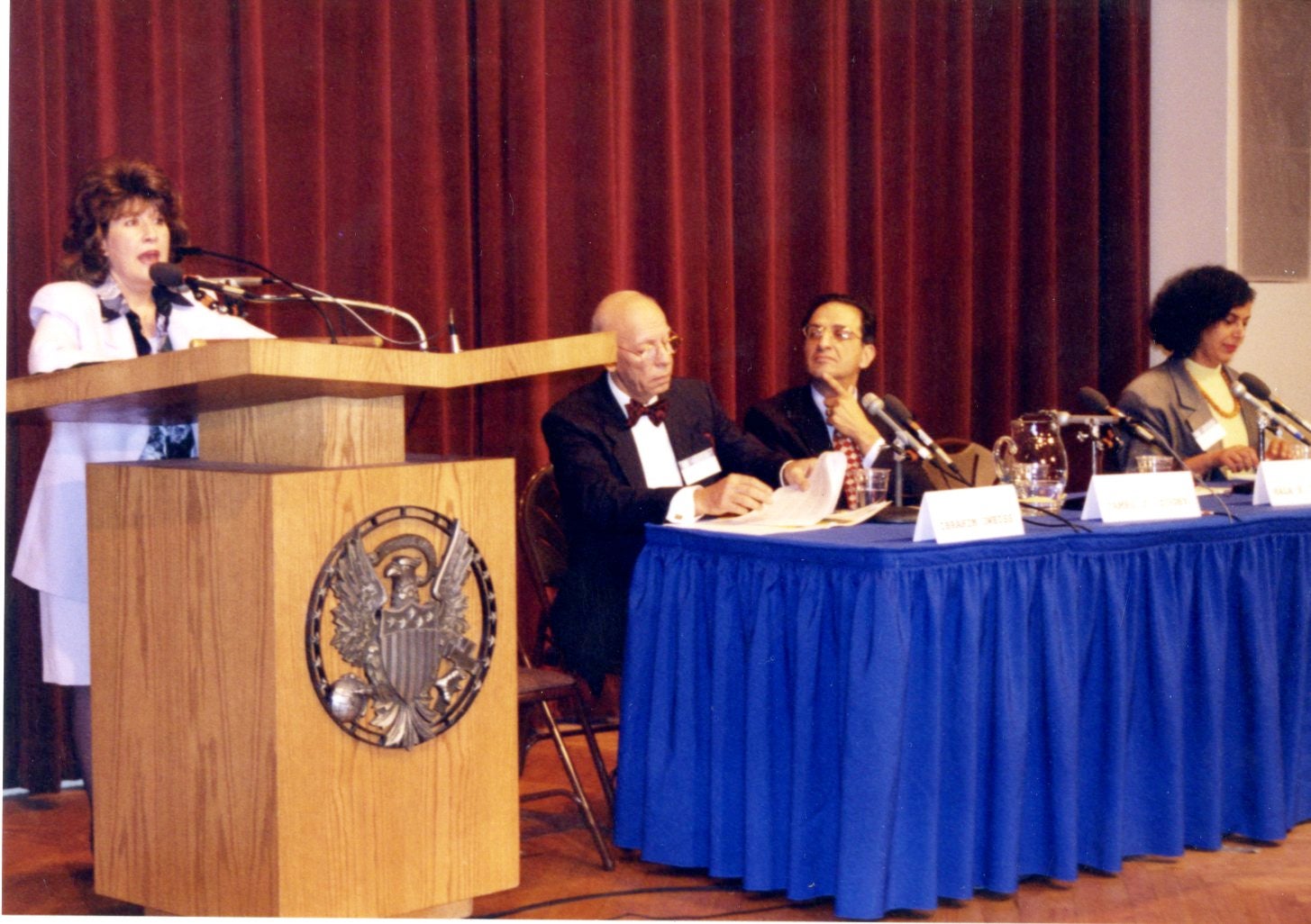
Panelists at 1997 Symposium
1997. CCAS Archive. 3.5.3.
Symposium speakers included Hala Salaam Maksoud, Ibrahim Oweiss, James Zogby, and Nadia Hijab.
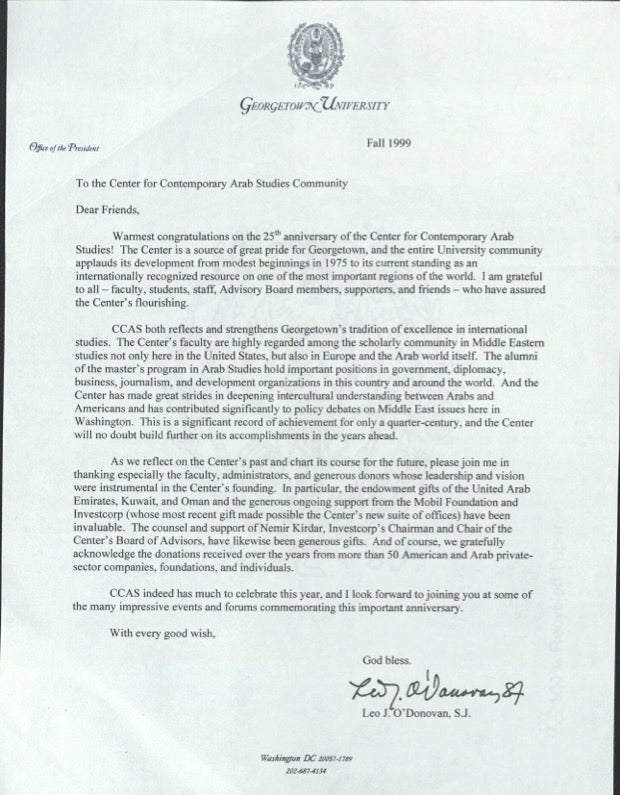
CCAS Celebrates 25 Years
1999. CCAS Archive. 3.7.1.
A congratulatory letter from Georgetown President Fr. Leo O'Donovan to the CCAS community on its 25th anniversary.
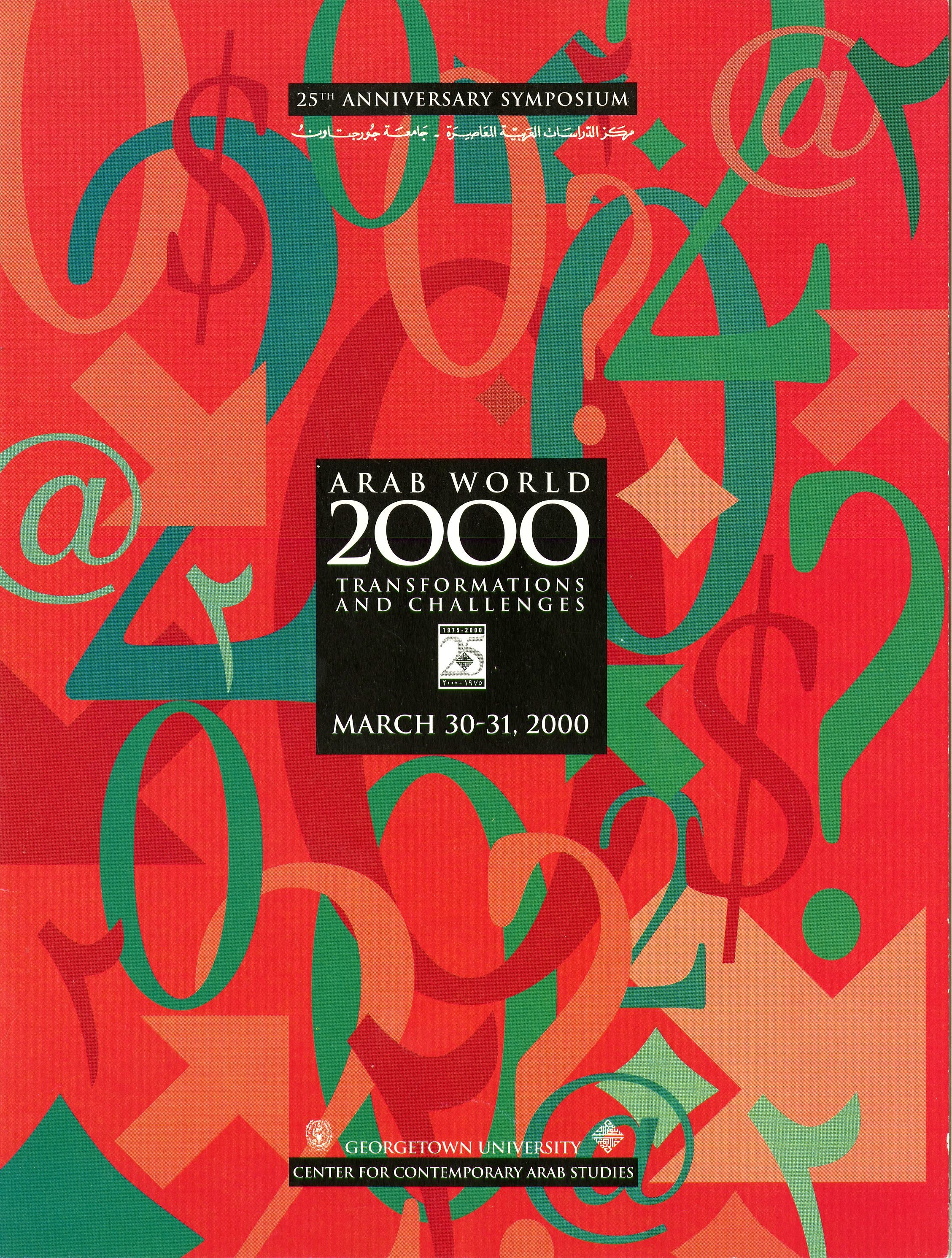
Program for "Arab World 2000" Symposium
2000. CCAS Archive. 3.7.3.
In 2000, the annual symposium, “Arab World 2000,”examined political, social, and economic shifts in the region at the turn of the new millennium.
CCAS Faculty Books from Decade 3
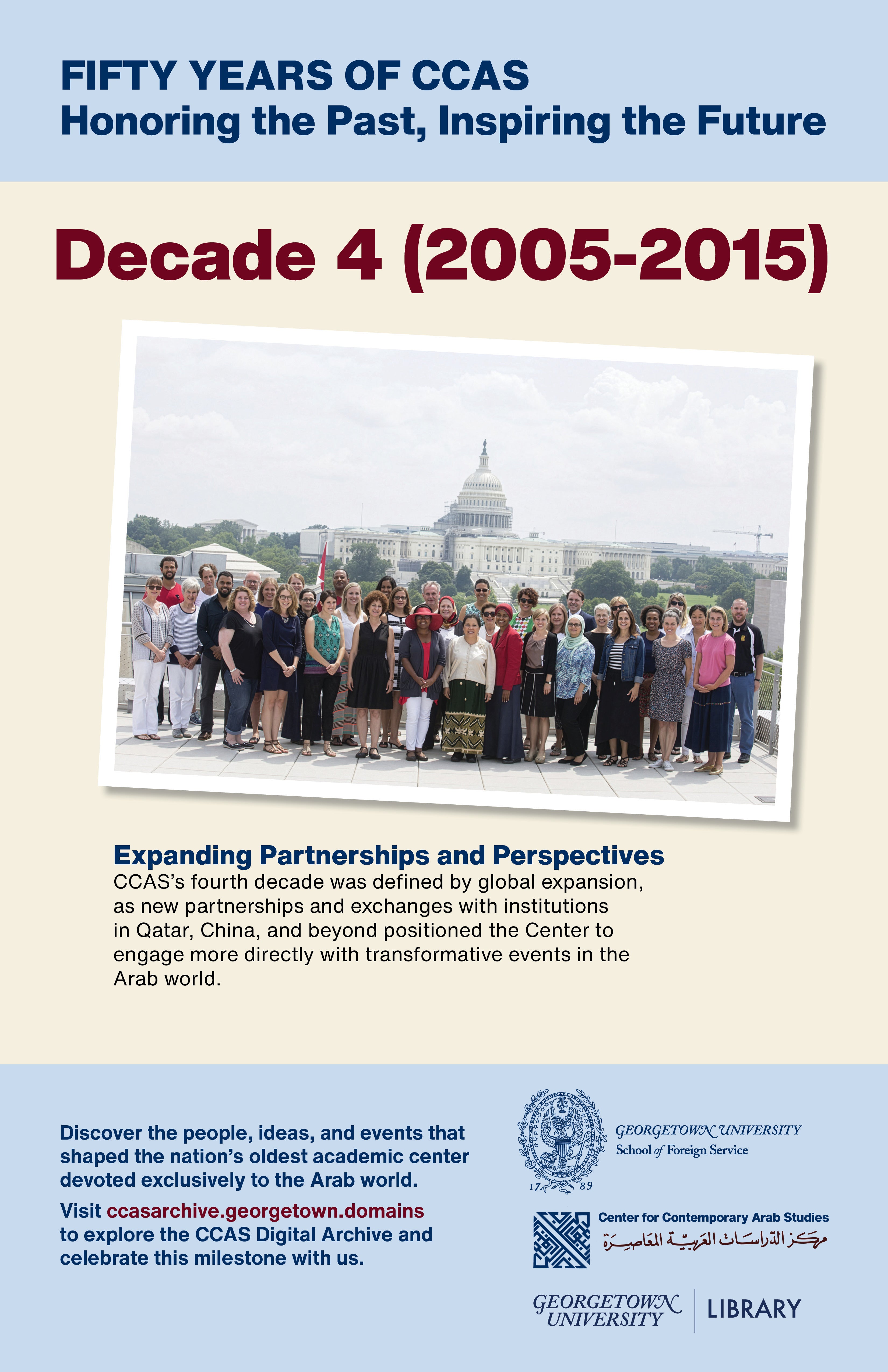
Decade 4 (2005-2015)
Expanding Partnerships and Perspectives. CCAS’s fourth decade was defined by global expansion, as new partnerships and exchanges with institutions in Qatar, China, and beyond positioned the Center to engage more directly with transformative events in the Arab world.
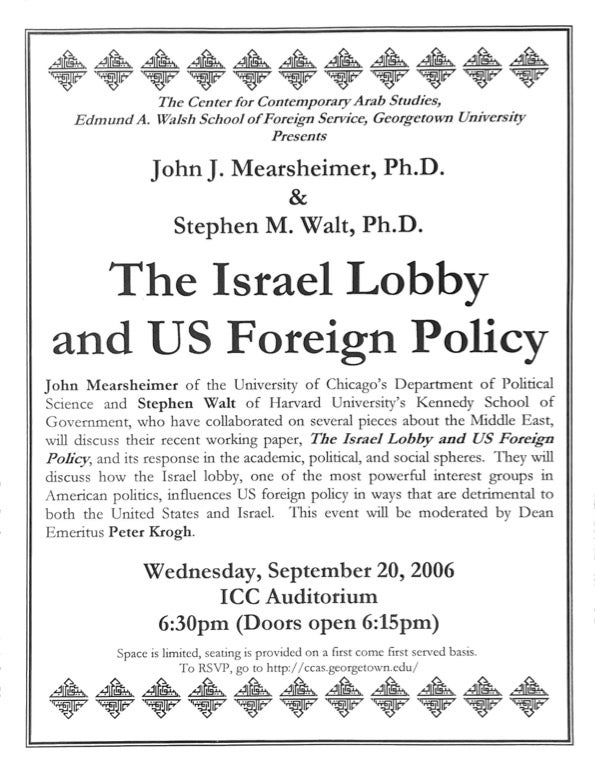
"The Israel Lobby and U.S. Foreign Policy" Lecture Flyer
2006. CCAS Archive. 4.2.1.
In September 2006, international relations scholars John Mearsheimer and Stephen Walt visited CCAS to speak on their widely discussed paper, “The Israel Lobby and U.S. Foreign Policy,” which they later expanded into a book of the same name.
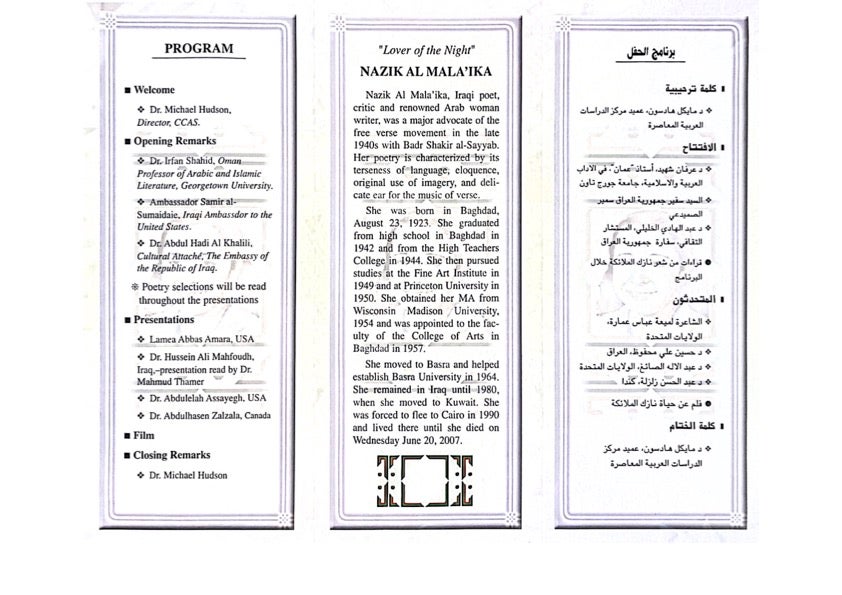
Nazik Al-Mala'ika Memorial Program
CCAS Archive
On September 8, 2007, CCAS partnered with the Embassy of Iraq in Washington, DC to host a memorial event honoring Nazik al-Malaika, a pioneering Iraqi poet, critic, and scholar. Al-Malaika is widely considered the first female poet to write in free verse and to advocate for its use.
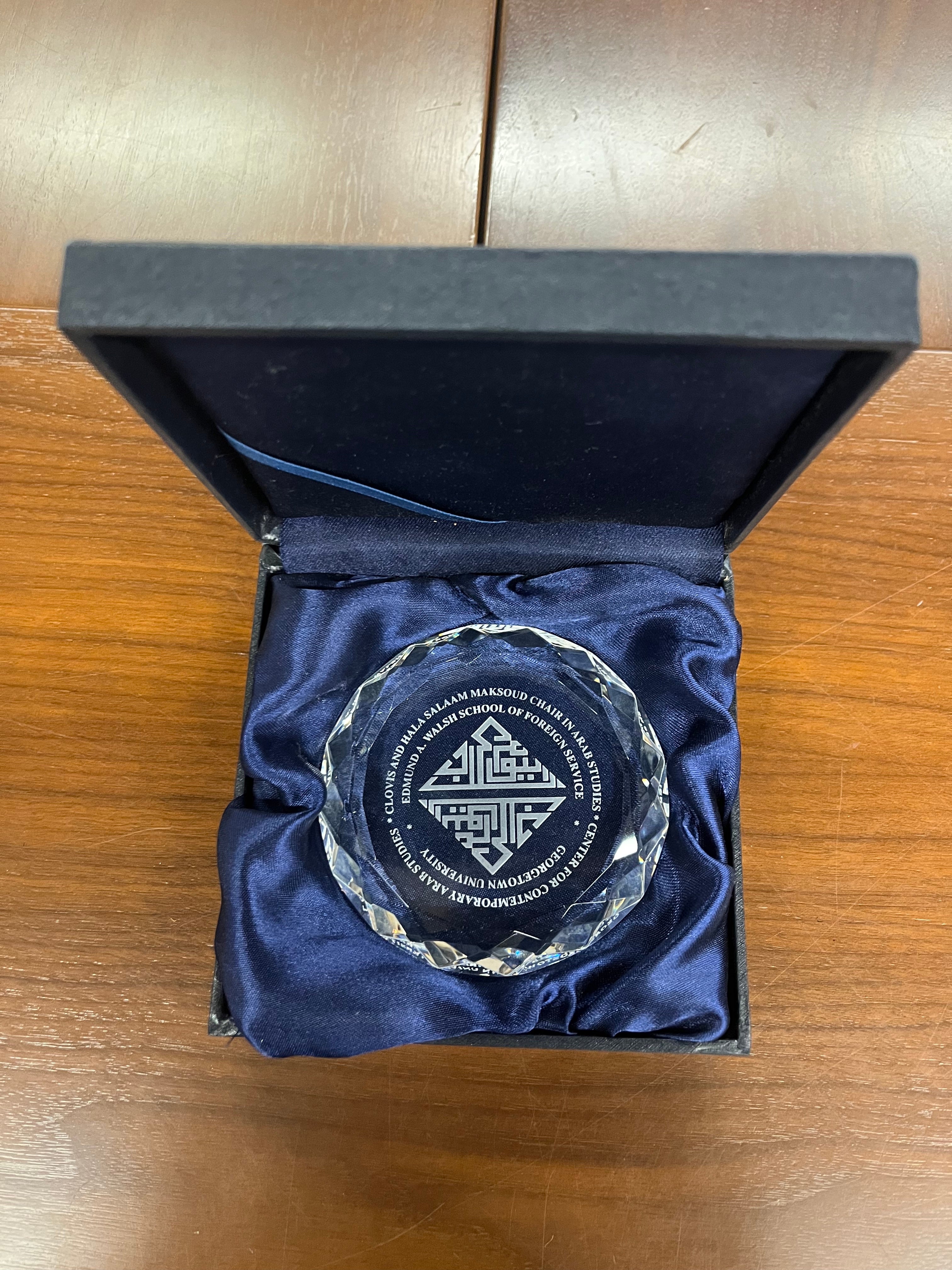
Clovis and Hala Maksoud Chair in Arab Studies Medallion
CCAS Archive
In October 2007, CCAS established a new professorship named after Clovis Maksoud and his wife Hala Maksoud to support scholarship on development in the Arab world. Fida Adely was named the first holder of the new chair and was given this medallion at the inaugural ceremony.
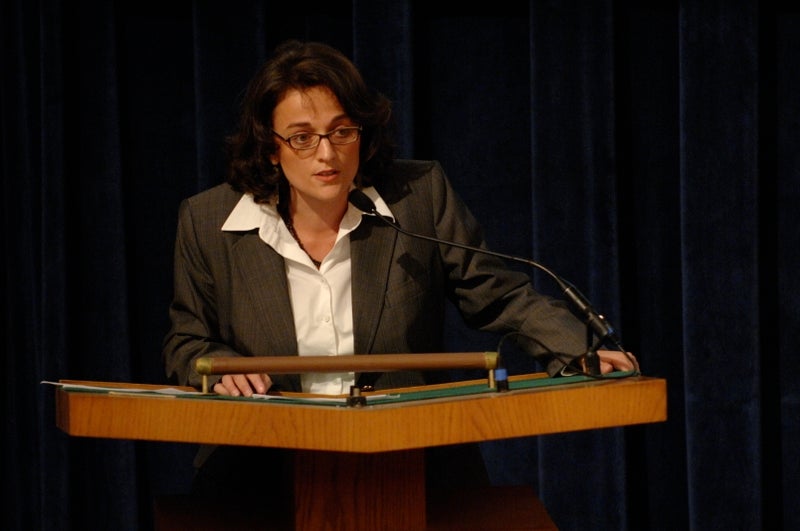
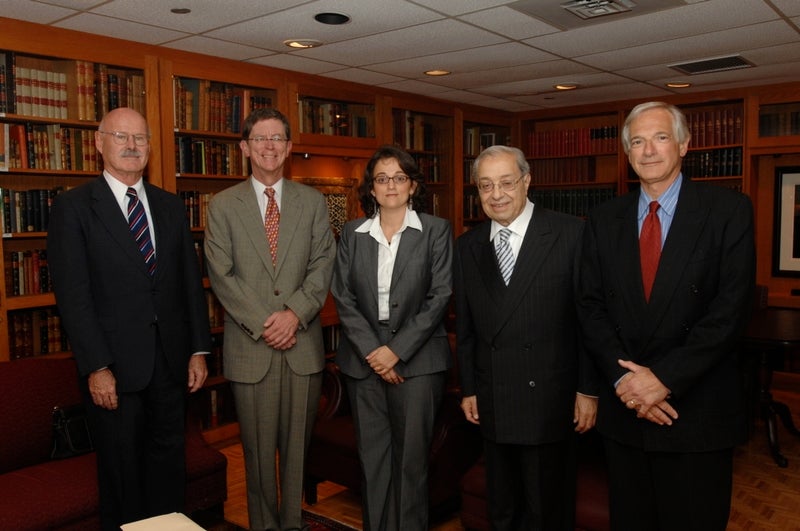
Clovis and Hala Maksoud Chair in Arab Studies Inaugural Lecture
CCAS Archive
Professor Fida Adely (Left) delivers the lecture "Education, Development, and Arab Women: Progress, Dilemmas, and American Discourse" at the inauguration of the Clovis and Hala Maksoud Chair at CCAS; (Right) Michael Hudson, James O'Donnell, Fida Adely, Clovis Maksoud, and Robert Gallucci at the inauguration.
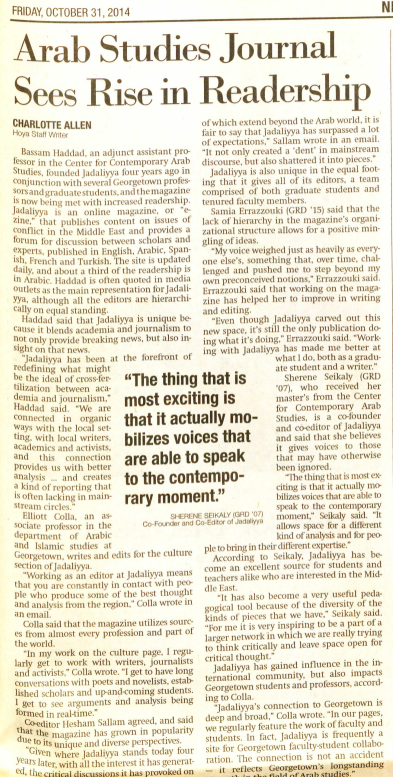
2014 article in The Hoya on the Founding of Jadaliyya
The Hoya. October 31, 2014. Georgetown University Archives.
In 2010, Jadaliyya, a groundbreaking e-zine on Middle East politics and culture, was launched by a group of scholars—many of them graduates of CCAS’s Master of Arts in Arab Studies program. The platform grew out of the editorial and intellectual community behind the Arab Studies Journal, a peer-reviewed journal founded in the 1990s by MAAS alumni.
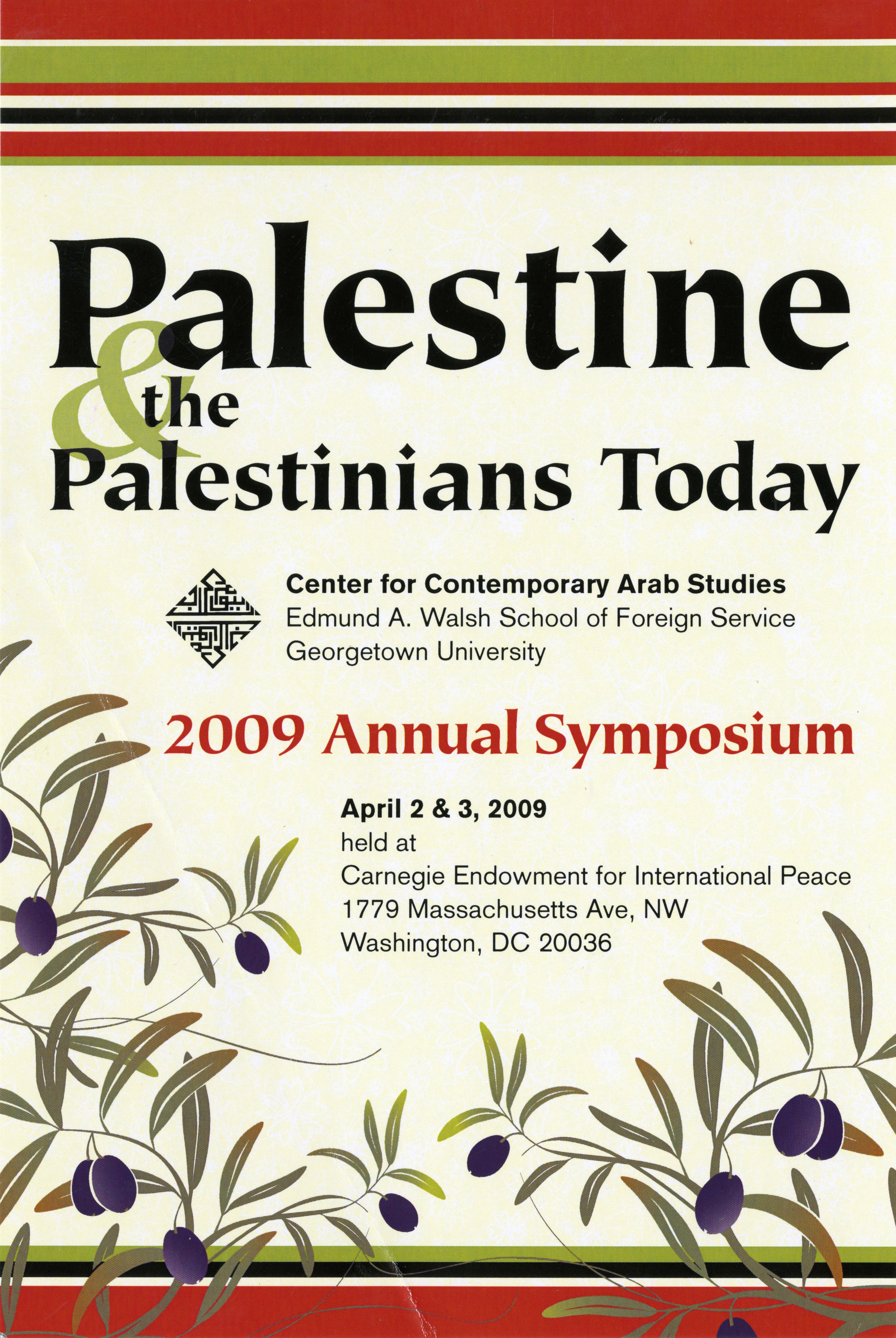
2009 Symposium Poster, "Palestine and the Palestinians Today"
CCAS Archive
In April 2009, CCAS held a symposium titled “Palestine and the Palestinians Today” at the Carnegie Endowment for International Peace. The event, which examined pathways toward peace, took place in the immediate aftermath of the First Gaza War, which resulted in over 1,000 Palestinian and 13 Israeli deaths and left more than 100,000 Palestinians homeless.
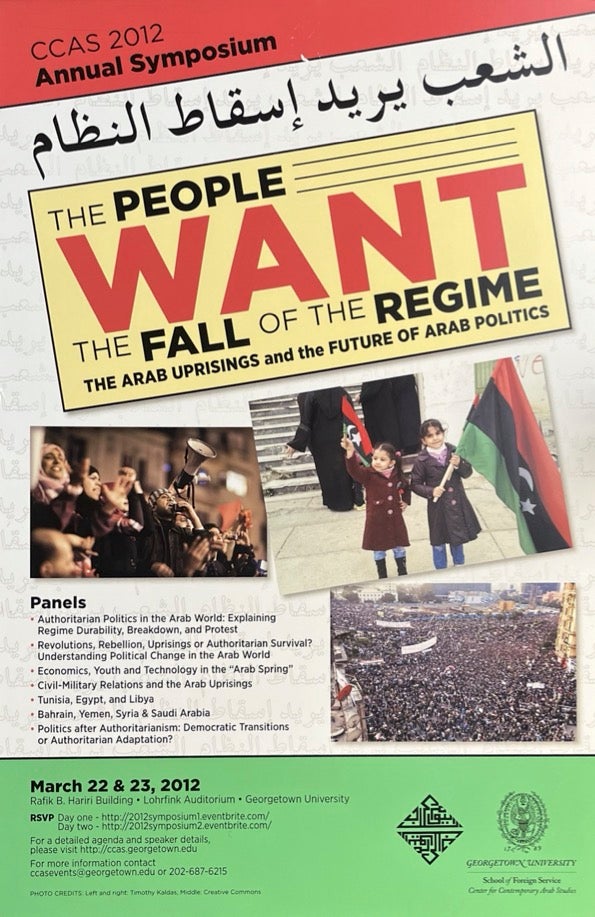
2012 Symposium Poster, "The People Want the Fall of the Regime"
CCAS Archive
The 2012 symposium, “The People Want the Fall of the Regime: The Arab Uprisings and the Future of Arab Politics,” sought to provide historical and political context for the uprisings taking place across the region while reflecting on the scale and complexity of the transformations underway.
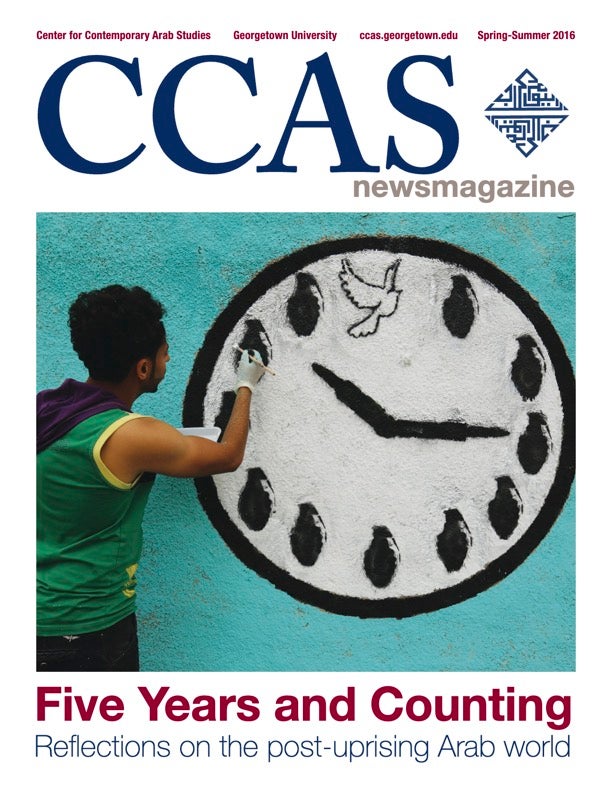
CCAS Newsmagazine Reflects on Anniversary of Uprisings
CCAS Archive
The Summer/Spring 2016 issue of the CCAS Newsmagazine, themed "Five Years and Counting," marked the uprisings’ five‑year anniversary with reflections from faculty on transformations in the post‑uprisings Arab world and challenges still facing the region.
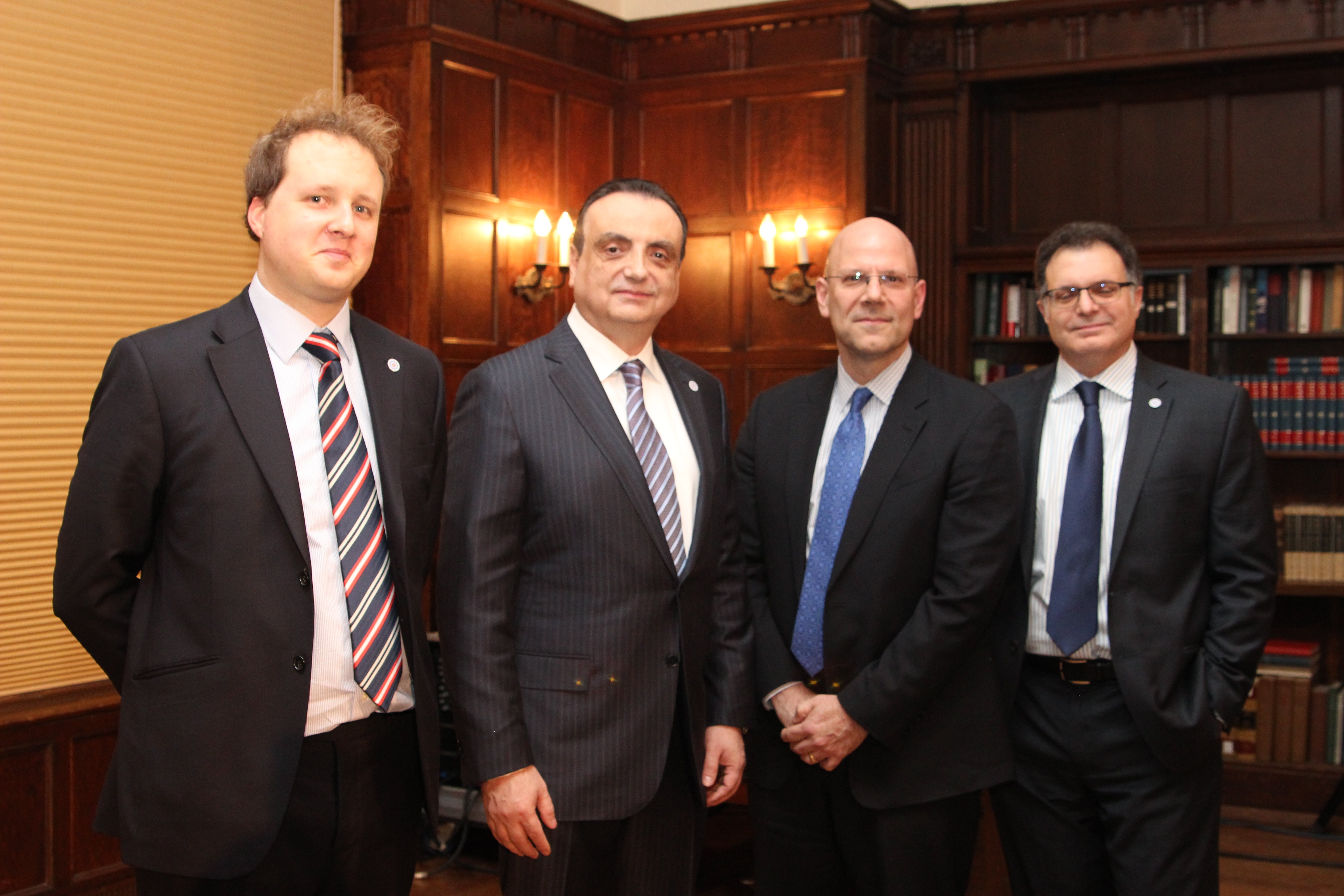
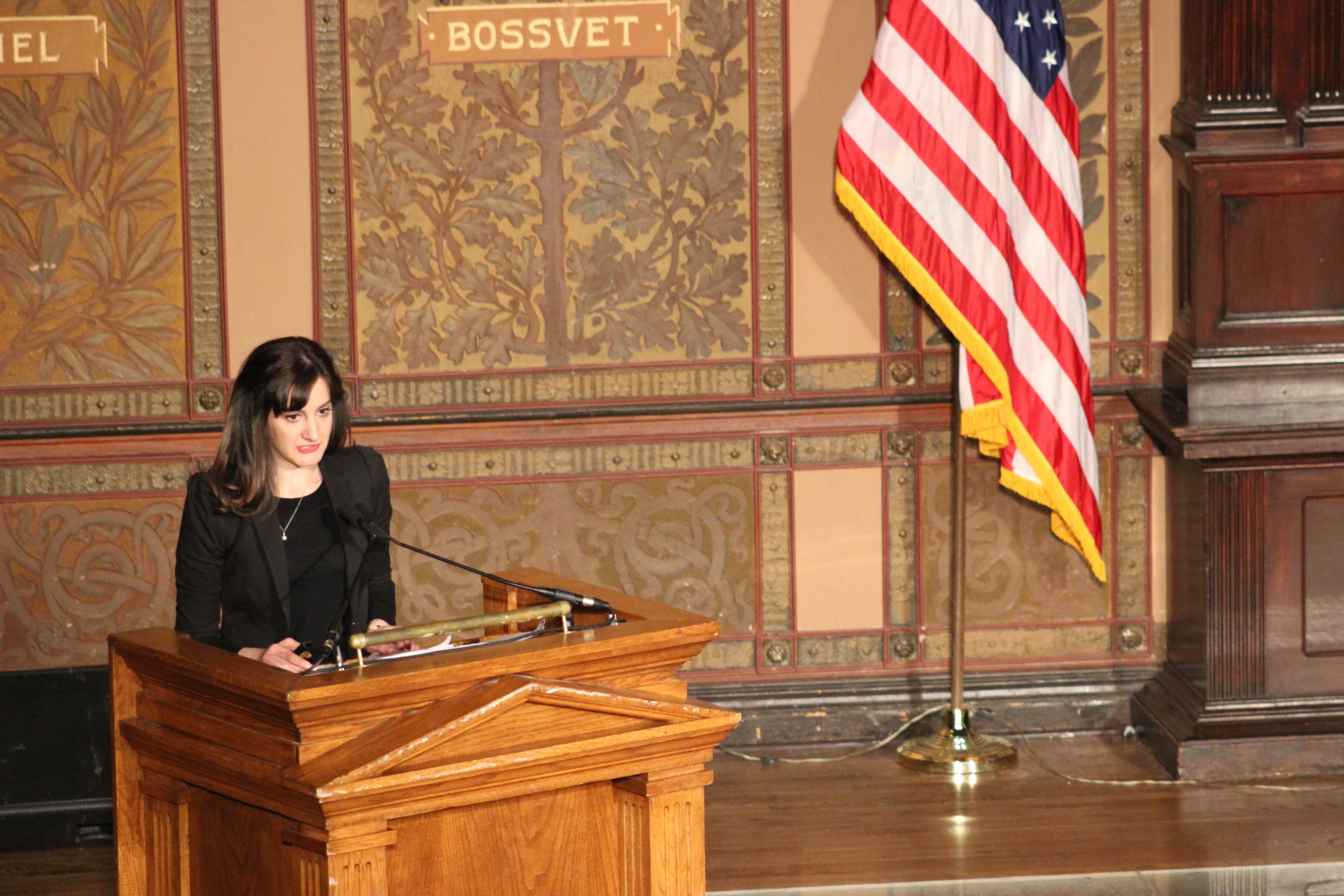
American Druze Foundation Fellowship Established
CCAS Archive
In 2012, with generous support from the American Druze Foundation (ADF), CCAS launched the ADF Fellowship in Druze and Arab Studies. The fellowship supports advanced research on Druze communities in the Arab world across academic disciplines. (Left) Inaugural fellow Alex Henley, with ADF Director Fadi Zuhayri, SFS Joel Hellman, and CCAS Director Osama Abi-Mershed at the 2016 ADF Inaugural Lecture; (Right) Reem Bailony, the 2016-2017 ADF Fellow delivers the annual lecture in Gaston Hall.
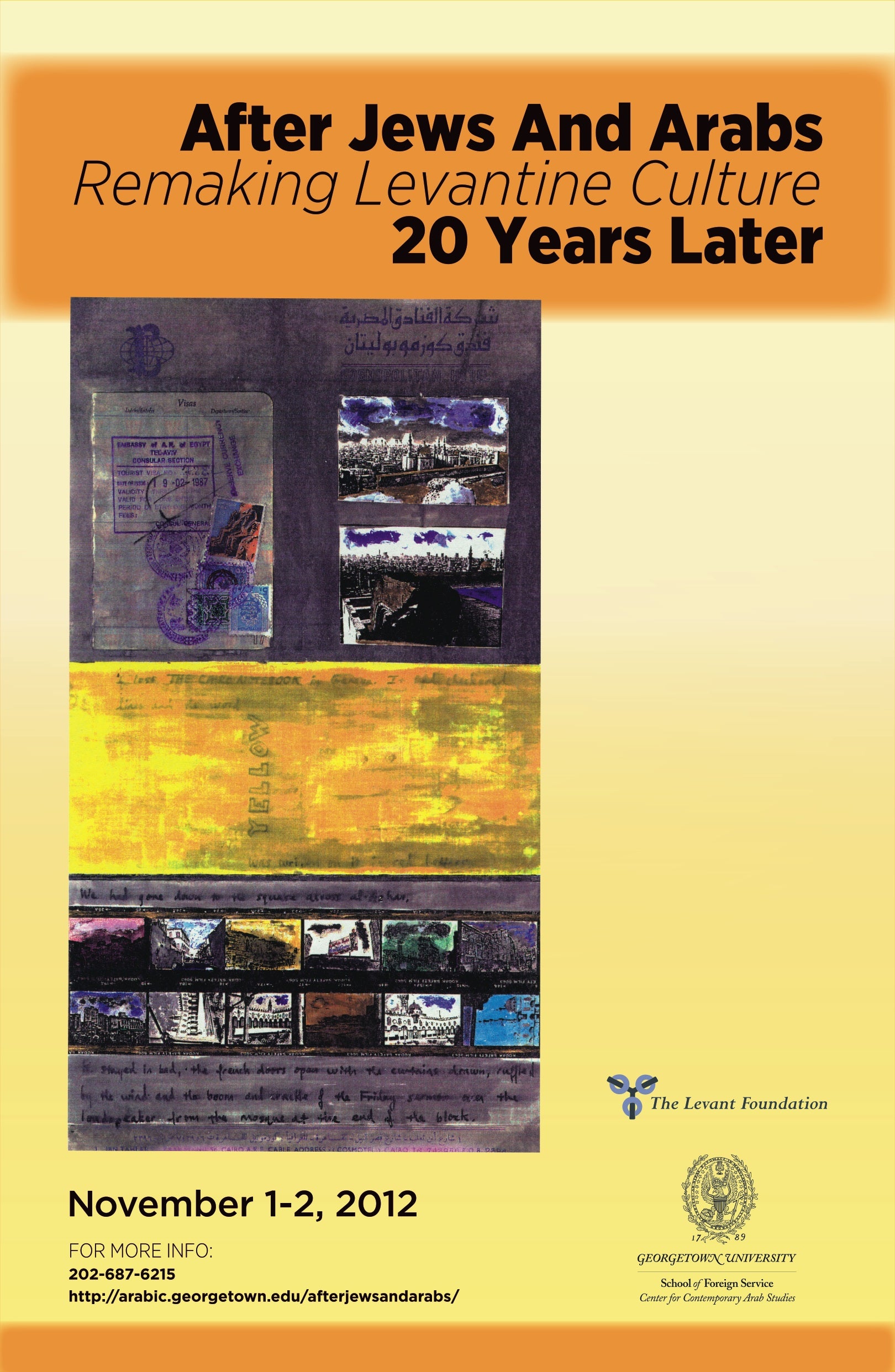
Flyer for the 2012 Symposium, "After Jews & Arabs: Twenty Years Later"
2012. CCAS Archive. 4.13.1.
In 2012, the CCAS annual symposium marked the 20th anniversary of the publication of After Jews and Arabs: Remaking Levantine Culture by poet and scholar Ammiel Alcalay. The event brought together writers, scholars, and artists to reflect on the impact of his work.
CCAS Faculty Books from Decade 4
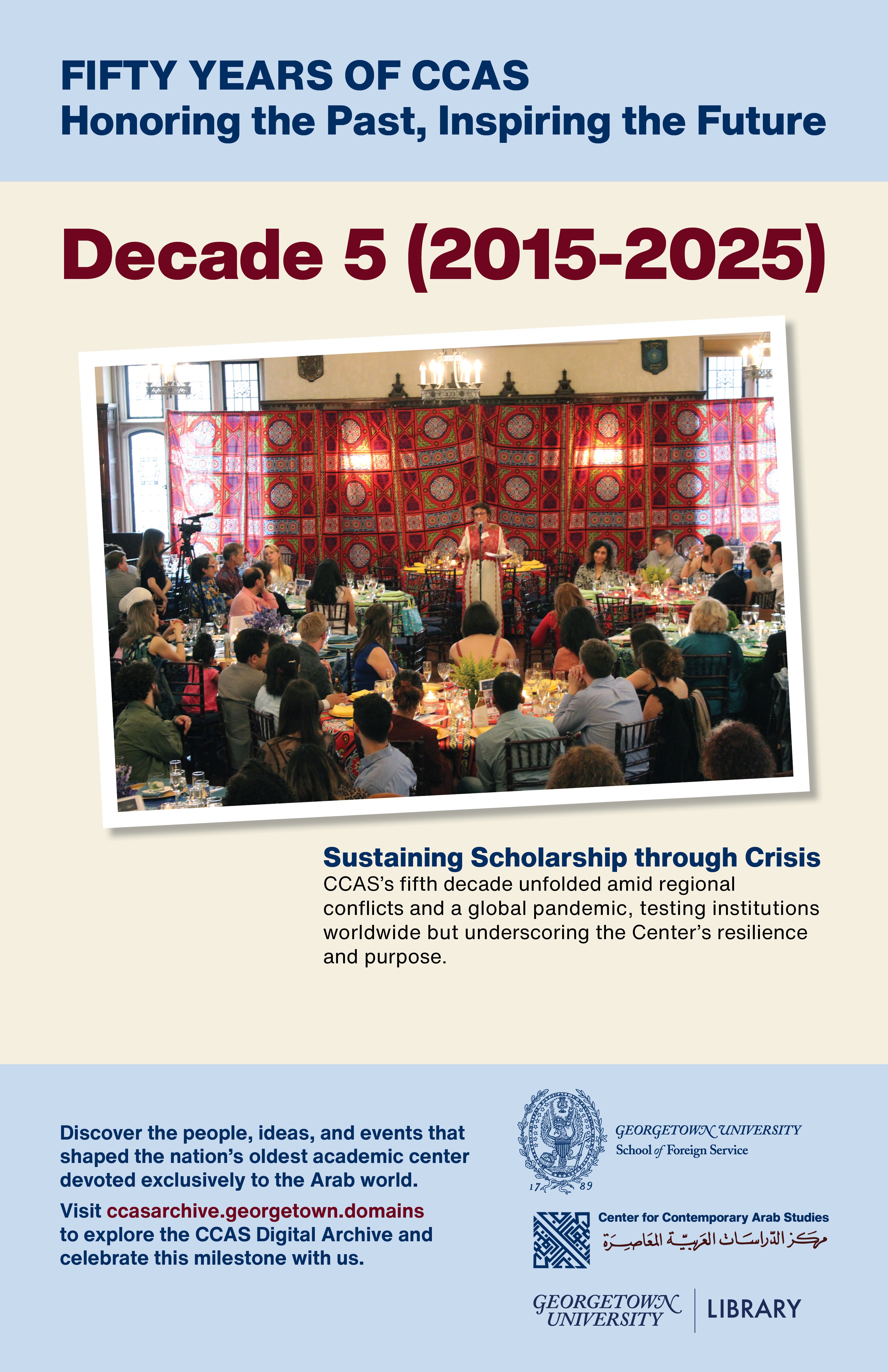
Decade 5 (2015-2025)
Sustaining Scholarship through Crisis. CCAS’s fifth decade unfolded amid regional conflicts and a global pandemic, testing institutions worldwide but underscoring the Center’s resilience and purpose.
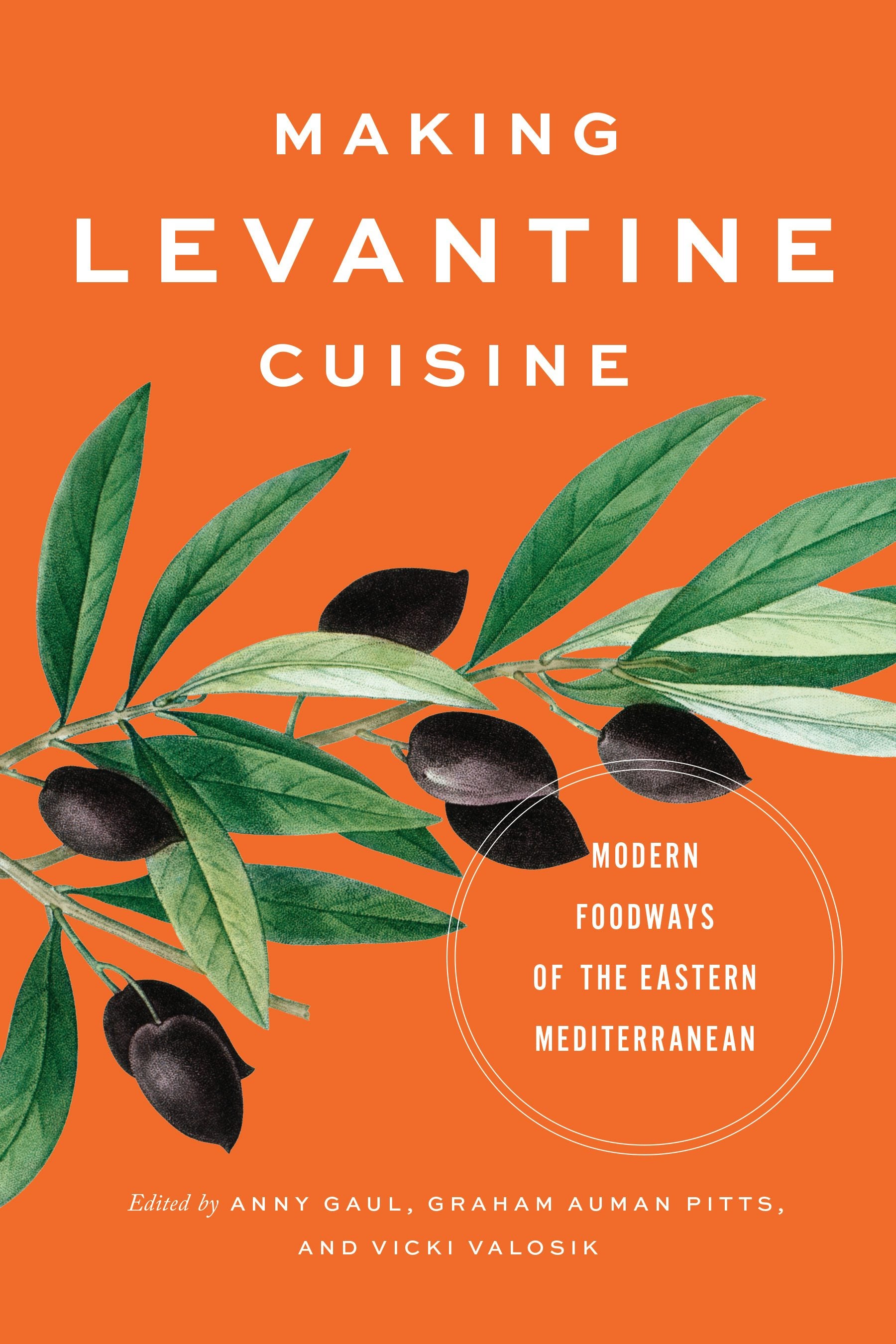
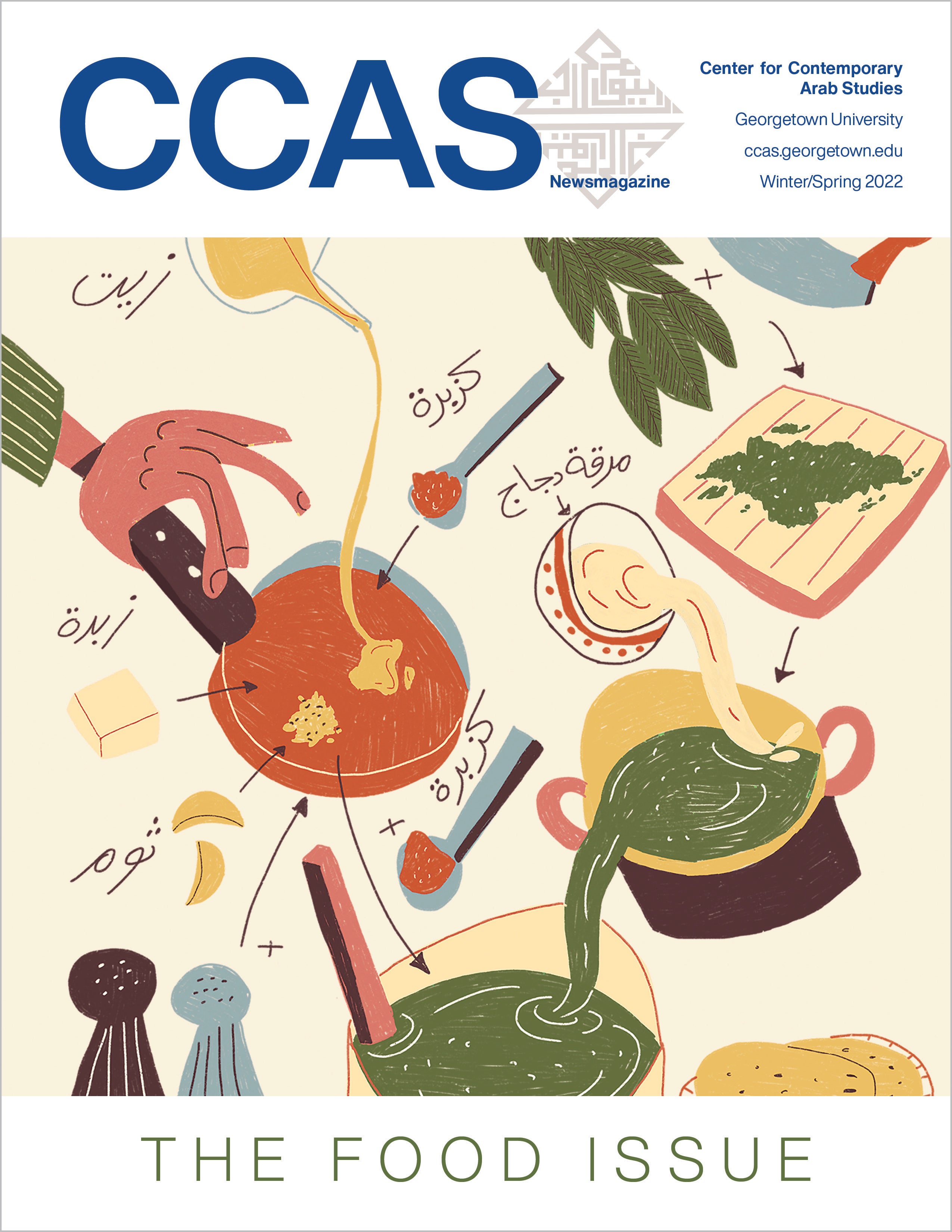
2019 CCAS Symposium Addresses Foodways of the Levant
2019. CCAS Archive. 5.8.6.
In 2019, CCAS hosted a symposium on foodways of the Levant, using the region’s culinary cultures as a lens into history, identity, and politics. Papers workshopped at the symposium, which brought together scholars, journalists, and food writers, were published in Making Levantine Cuisine: Modern Foodways of the Eastern Mediterranean (University of Texas Press, 2022). The CCAS Newsmagazine that year pursued similar themes at the intersection of food studies and Arab studies
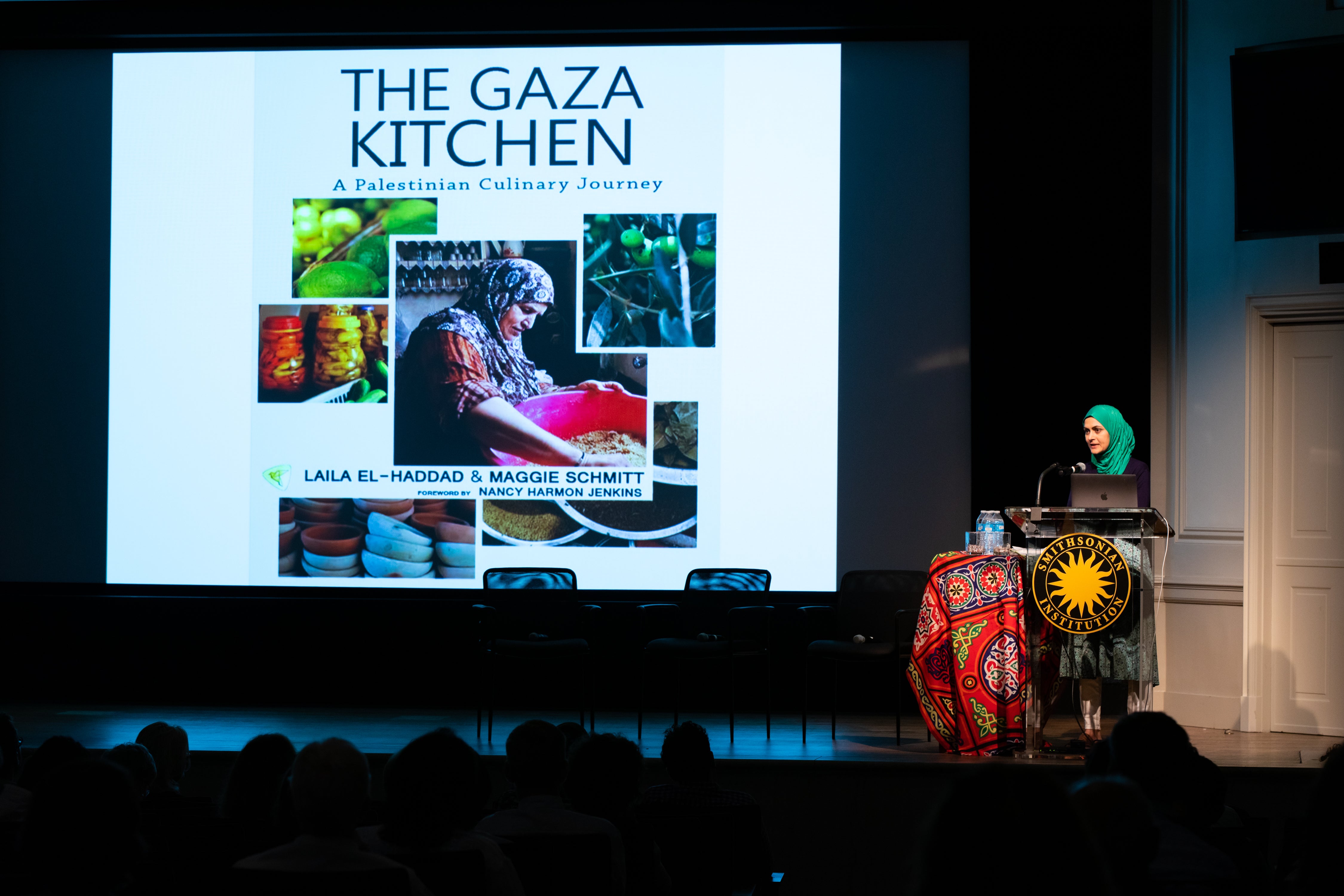
Laila El-Haddad Speaks at the Smithsonian
2019. CCAS Archive. 5.8.7.
As part of the 2019 symposium, CCAS co-sponsored a panel discussion titled "Making Middle East Cuisine" and a sampling of Levantine foods at the Smithsonian's Freer and Sackler Galleries. Food writer Laila El-Haddad, pictured here, was one of the event speakers.
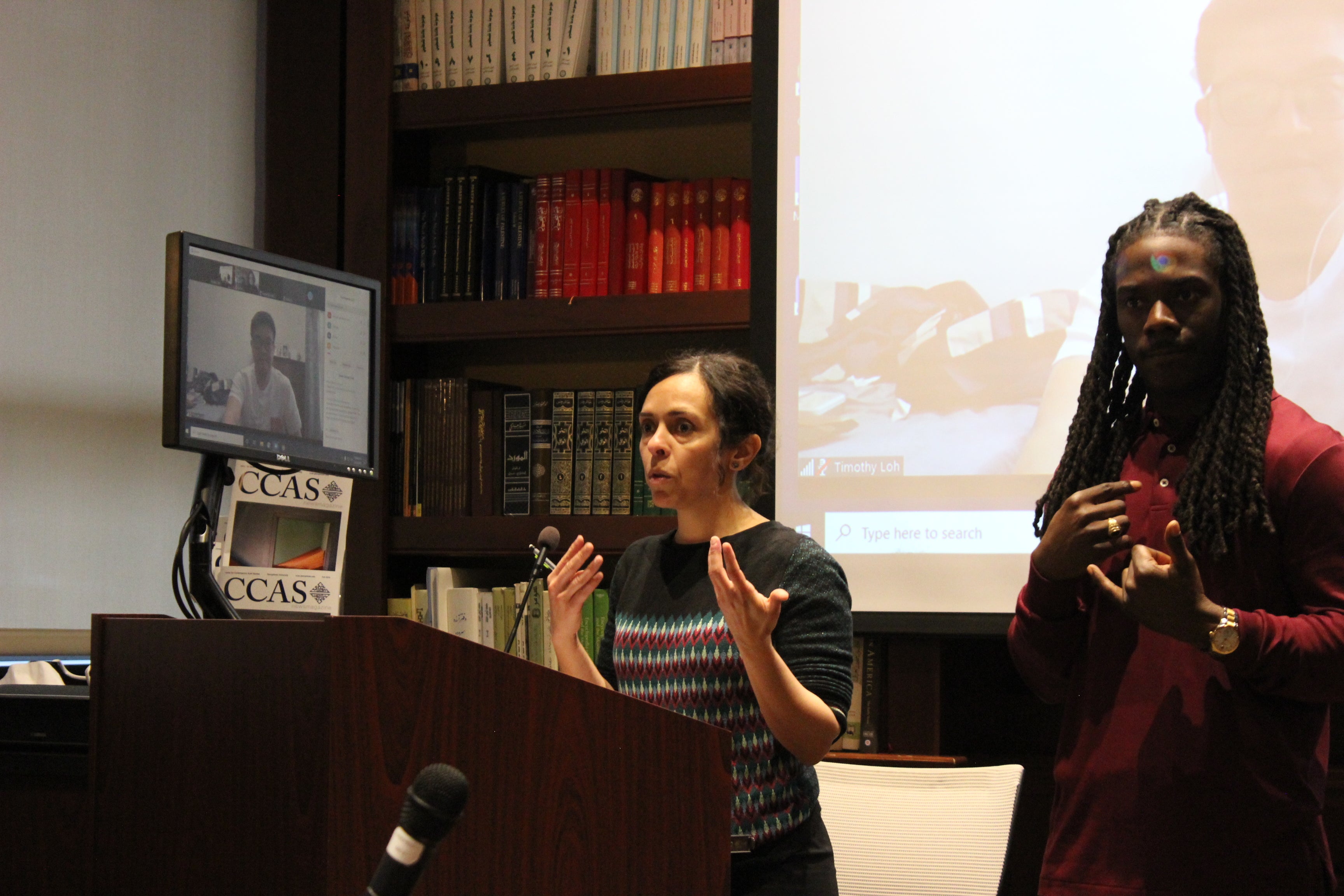
Halla Attallah speaking on Disability Studies and the Qur’an
2020. CCAS Archive. 5.9.5.
Throughout the 2019-2020 academic year, CCAS hosted a Brown Bag Lunch Series on "Disability and the Arab World," which was initiated and led by MAAS student Jinseul Jun and alum Timothy Loh. Talks address topics such as the history of disability in the Arab world, the deaf community in Turkey, and Attallah’s talk on disability studies and the Qur’an.
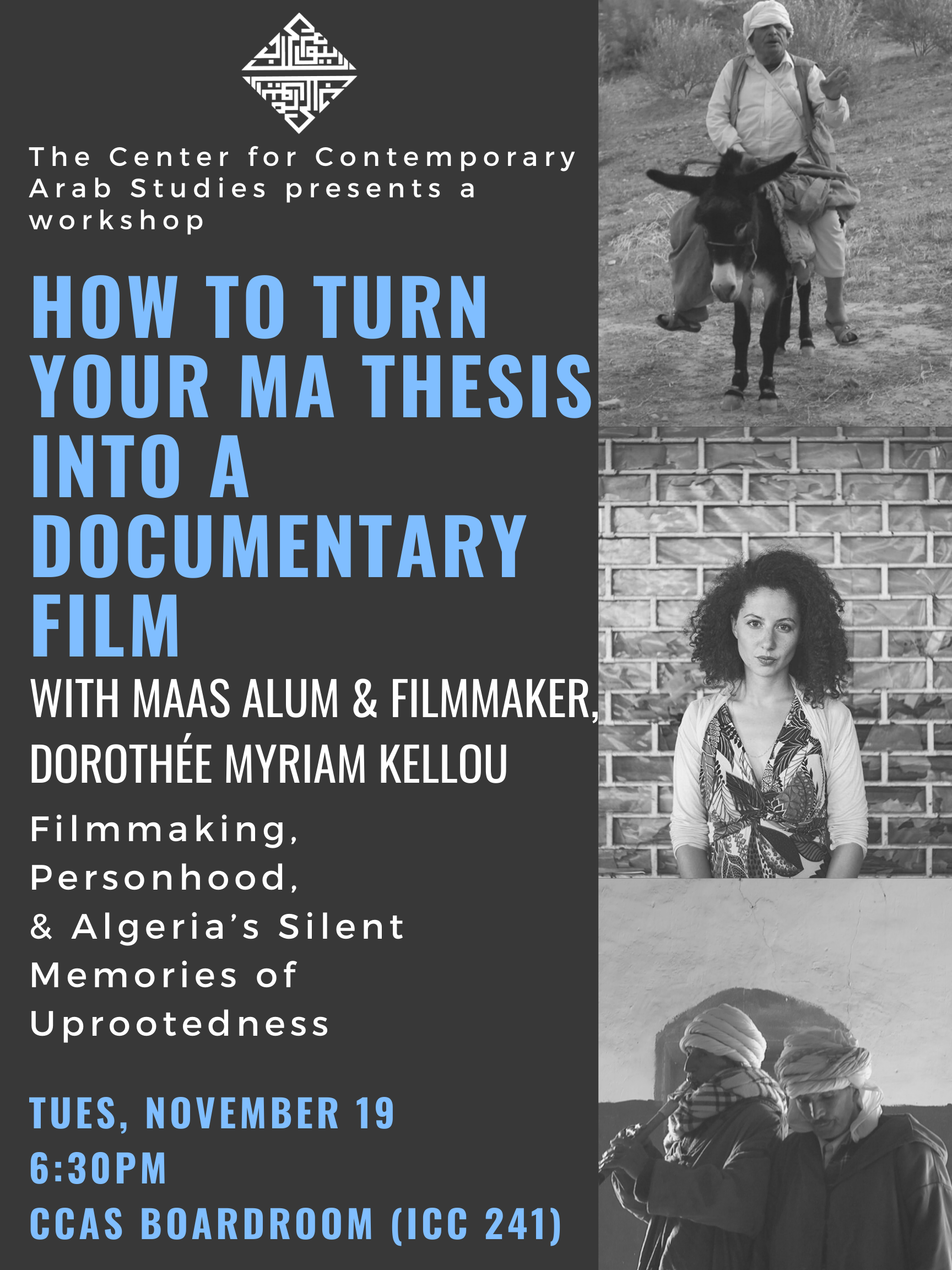
Flyer for "Filmmaking, Personhood, and Algeria’s Silent Memories of Uprootedness" Workshop
2019. CCAS Archive. 5.10.1.
In 2019, MAAS alum Dorothée-Myriam Kellou, an investigative journalist and award-winning filmmaker, returned to CCAS to present her documentary In Mansourah You Separated Us and lead a workshop for students and the public on filmmaking and personhood.
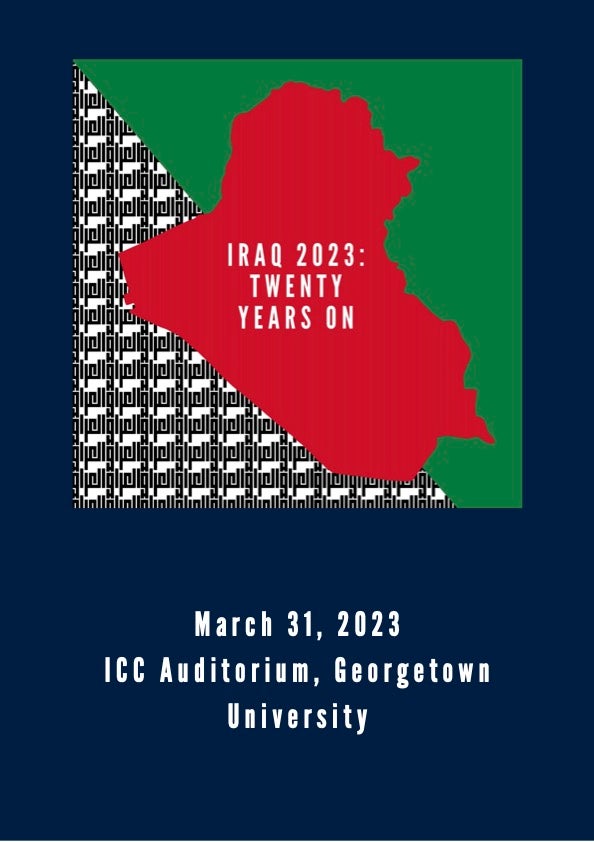
Program for Conference, “Iraq 2023: Twenty Years On”
2023. CCAS Archive. 5.17.1.
To mark the 20th anniversary of the 2003 U.S. invasion of Iraq, CCAS convened a day-long conference, “Iraq 2023: Twenty Years On,” which examined the invasion’s far-reaching economic, political, and cultural consequences. The conference brought together ten scholars for panel discussions and ended with a screening of the documentary About Baghdad, which was directed by several MAAS alums.
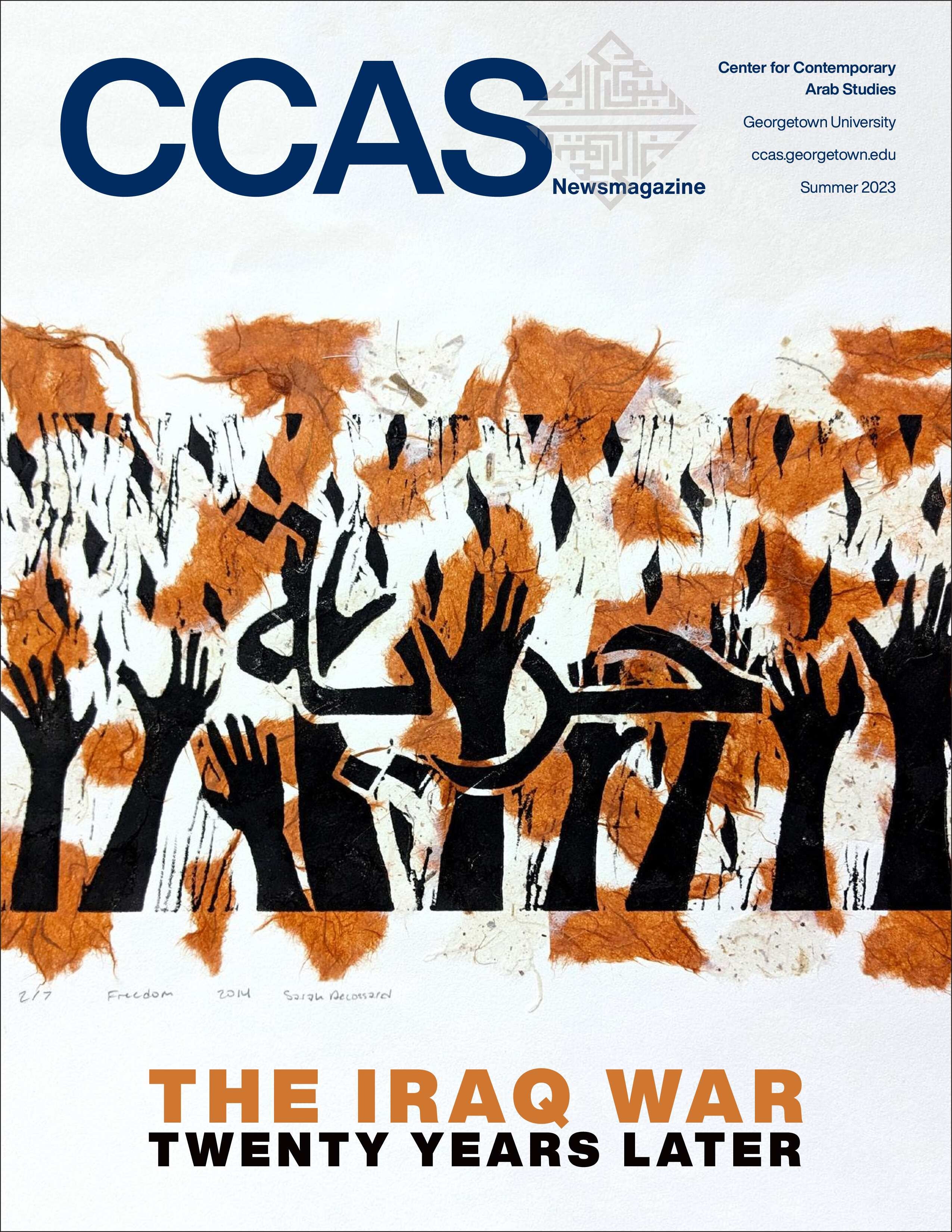
CCAS Newsmagazine Marks Iraq War Anniversary
CCAS Archive
The spring 2023 issue of the CCAS Newsmagazine that year explored work being done by the CCAS community to better understand the lasting impacts of the American war in Iraq.
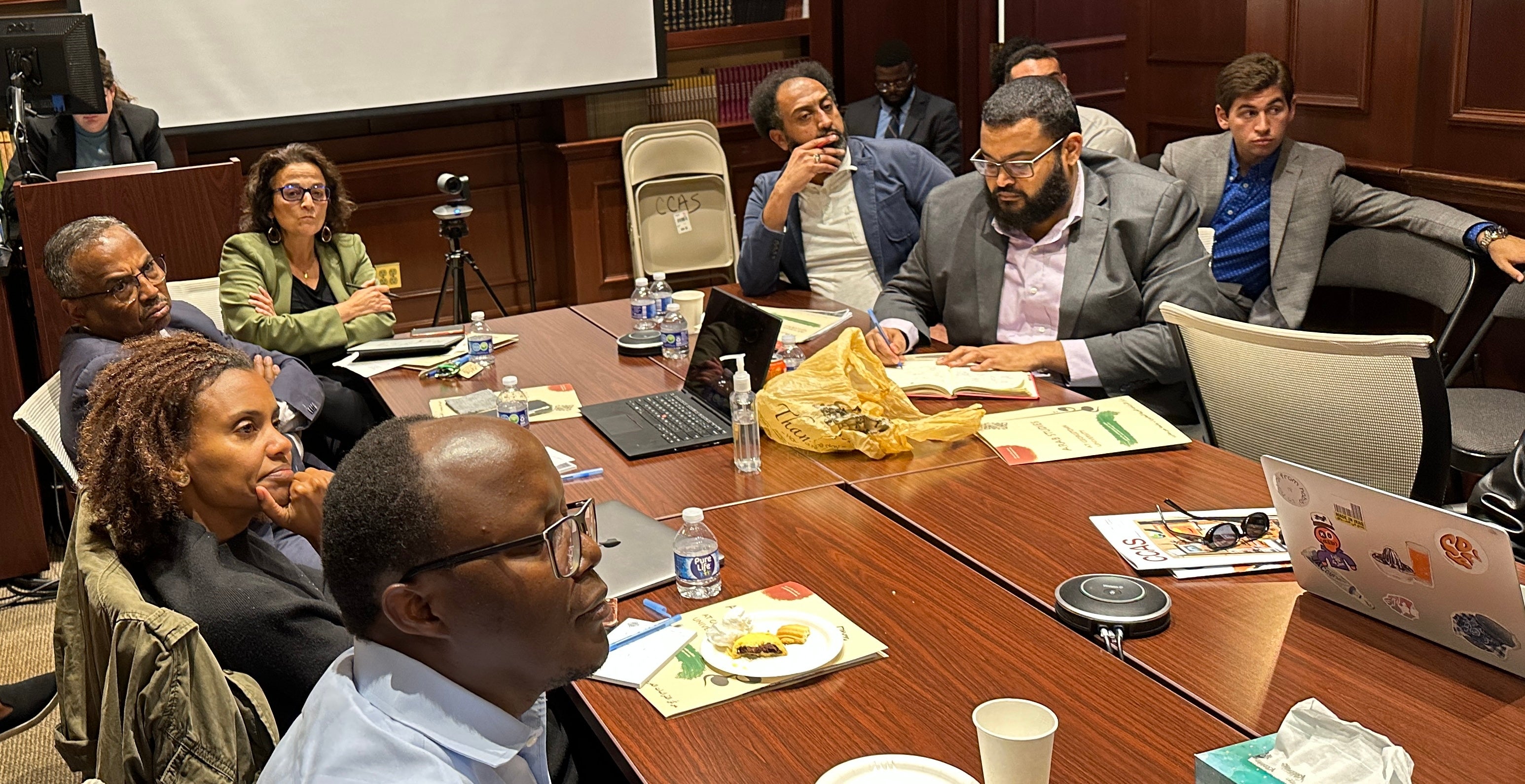
CCAS Hosts "Keep Eyes on Sudan" Series
2023. CCAS Archive. 5.18.2.
In response to Sudan's brutal civil war, which has killed thousands, displaced millions, and created one of the world’s most severe humanitarian crises, CCAS hosted a two-year "Keep Eyes on Sudan" lecture series to help audiences better understand the unfolding conflict. The first event, “Sudan: Insights Into the Current Crisis,” was held in September 2023 and featured Nisrin El Amin, Elobaid Elobaid, Ahmed Kodouda, and Isma’il Kushkush—all pictured here with CCAS Director Fida Adely.
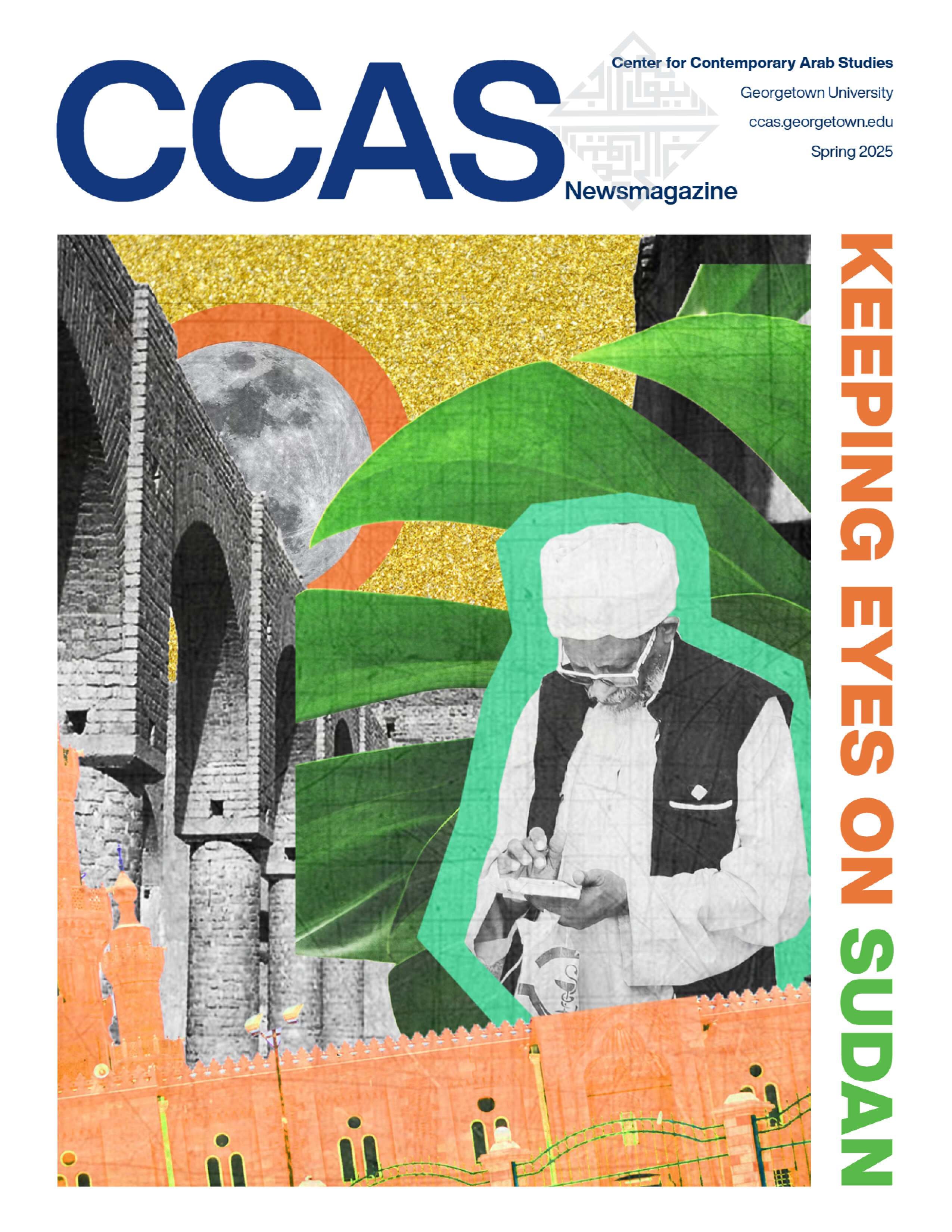
CCAS Newsmagazine Keeps Eyes on Sudan
CCAS Archive
In 2025, the CCAS Newsmagazine featured articles by CCAS faculty, alums, and students examining the war, its origins, and its widespread impact.
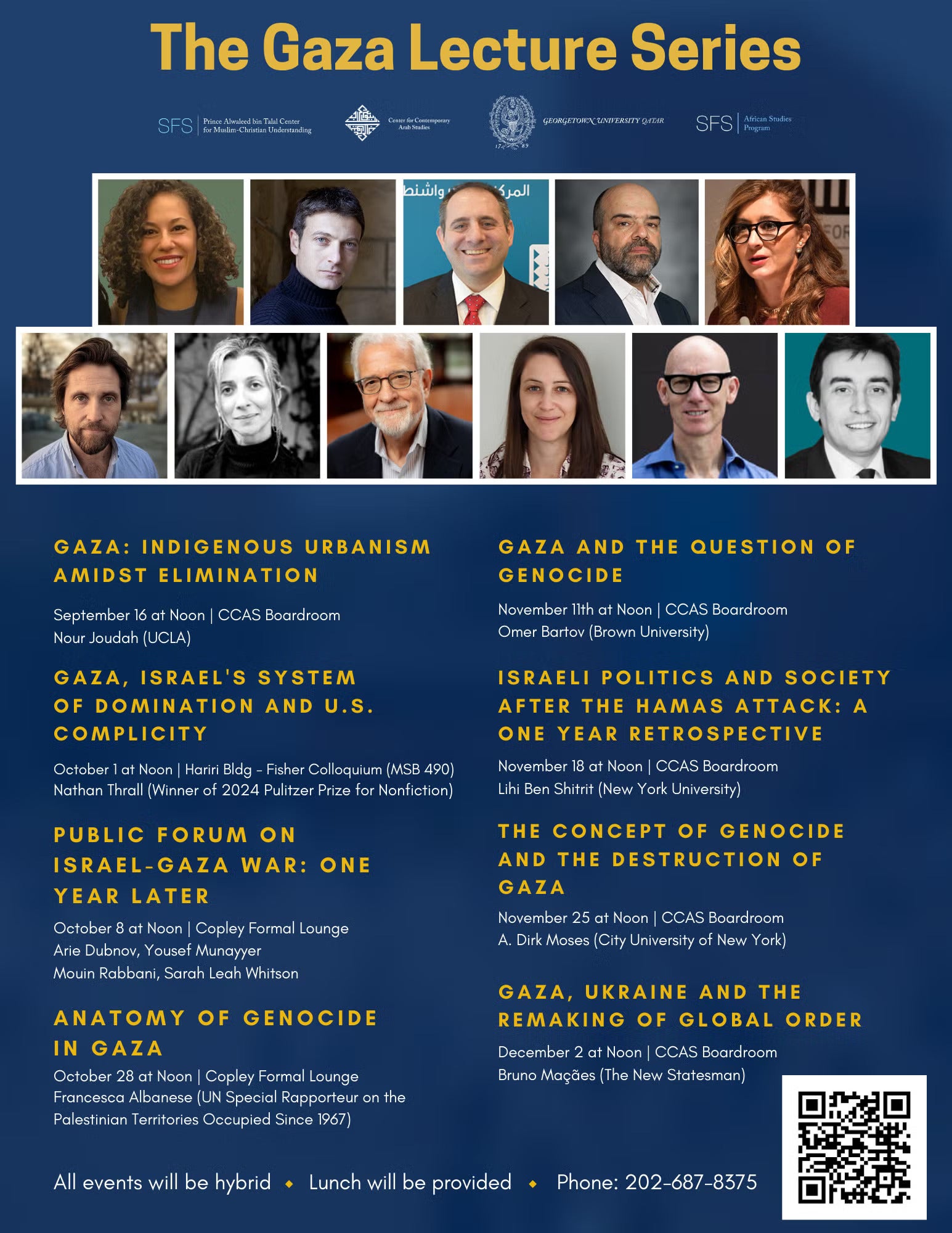
Gaza Lecture Series Flyer
2024. CCAS Archive. 5.19.1
Following the October 7, 2023 attack on Israel by Hamas and Islamic Jihad, Israel launched a full-scale war on Gaza’s 2.3 million residents, and within weeks human rights organizations warned that genocide was unfolding. In response, CCAS organized a series of public events, including the multi-year Gaza Lecture Series, to foster ethical and informed discussion at a time when such conversations were being censored or silenced elsewhere.
CCAS Welcomes MESA
2024. CCAS Archive. 5.20.1.
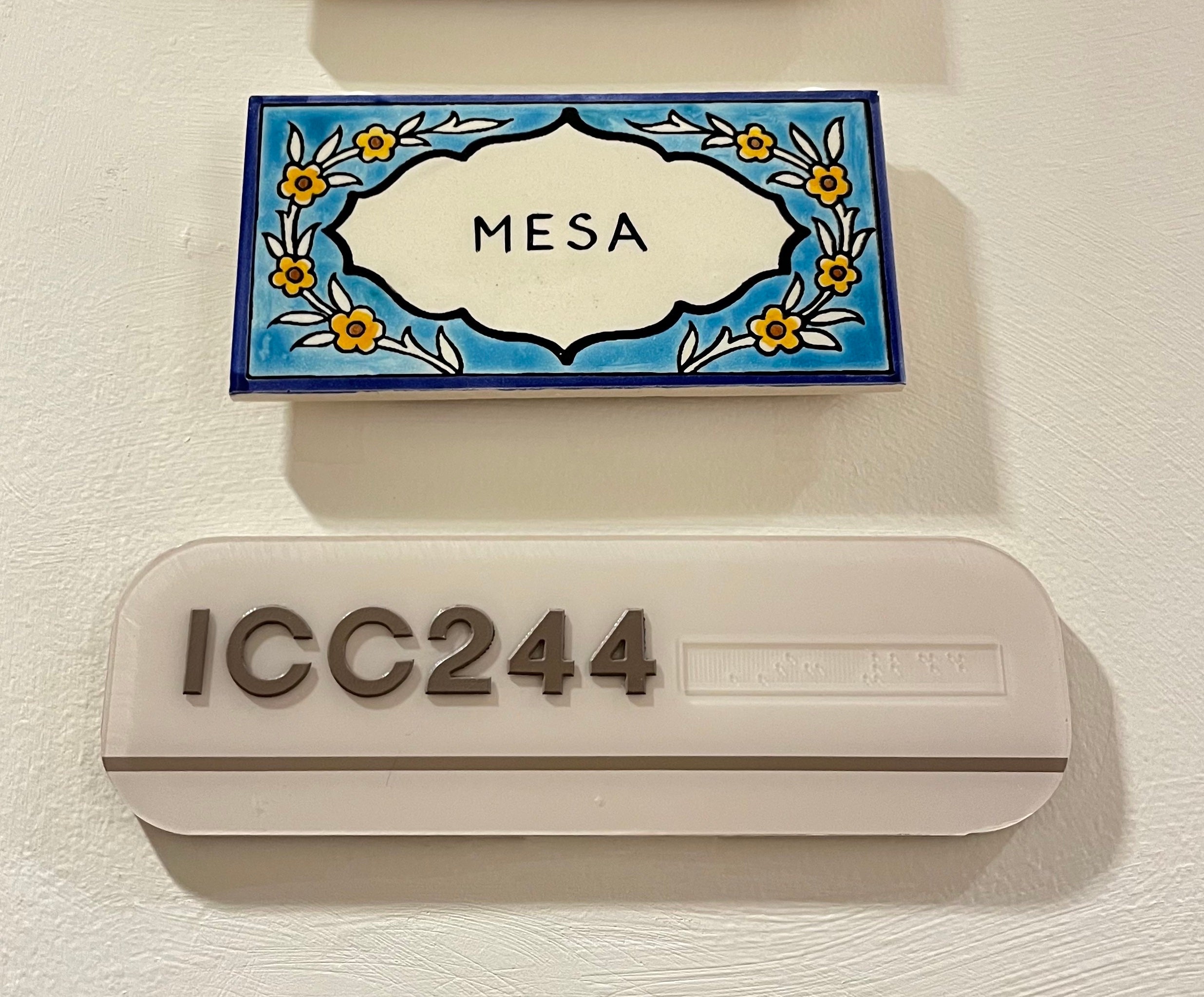
In 2024, CCAS announced that the Middle East Studies Association of North America (MESA)—the leading professional association for scholars and students of the Middle East and North Africa—was moving its headquarters to the Center. In keeping with a longstanding CCAS tradition of hand-painted office nameplates, MESA’s new office was marked by this tile, created by a Palestinian artist.
Rashid Khalidi Delivers Memorial Lecture, "100 Years' War on Palestine"
2024. CCAS Archive. 5.21.1.
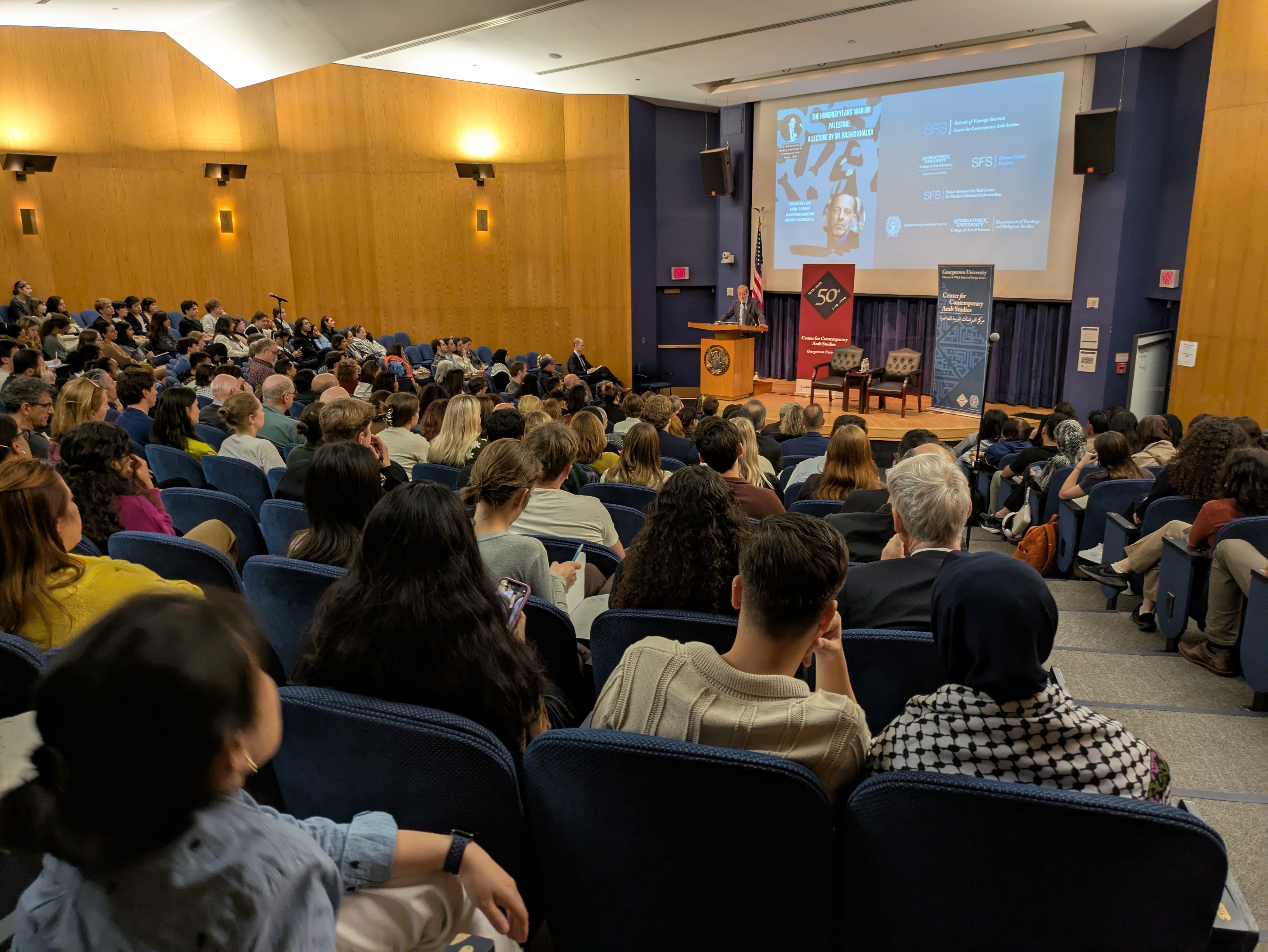
On October 9, 2025, CCAS hosted Professor Rashid Khalidi of Columbia University, as the 2025 Kareema Khoury Memorial Lecturer. Dr. Khalidi’s talk, entitled “The Hundred Years’ War on Palestine,” considered the past century of colonial violence against the indigenous Palestinian people and the historical resistance movements against it. The distinguished lecture series was endowed in 1988 in honor of the late Kareema Khoury.
MAAS Students Launch Shu Kaman? Podcast
CCAS Archive
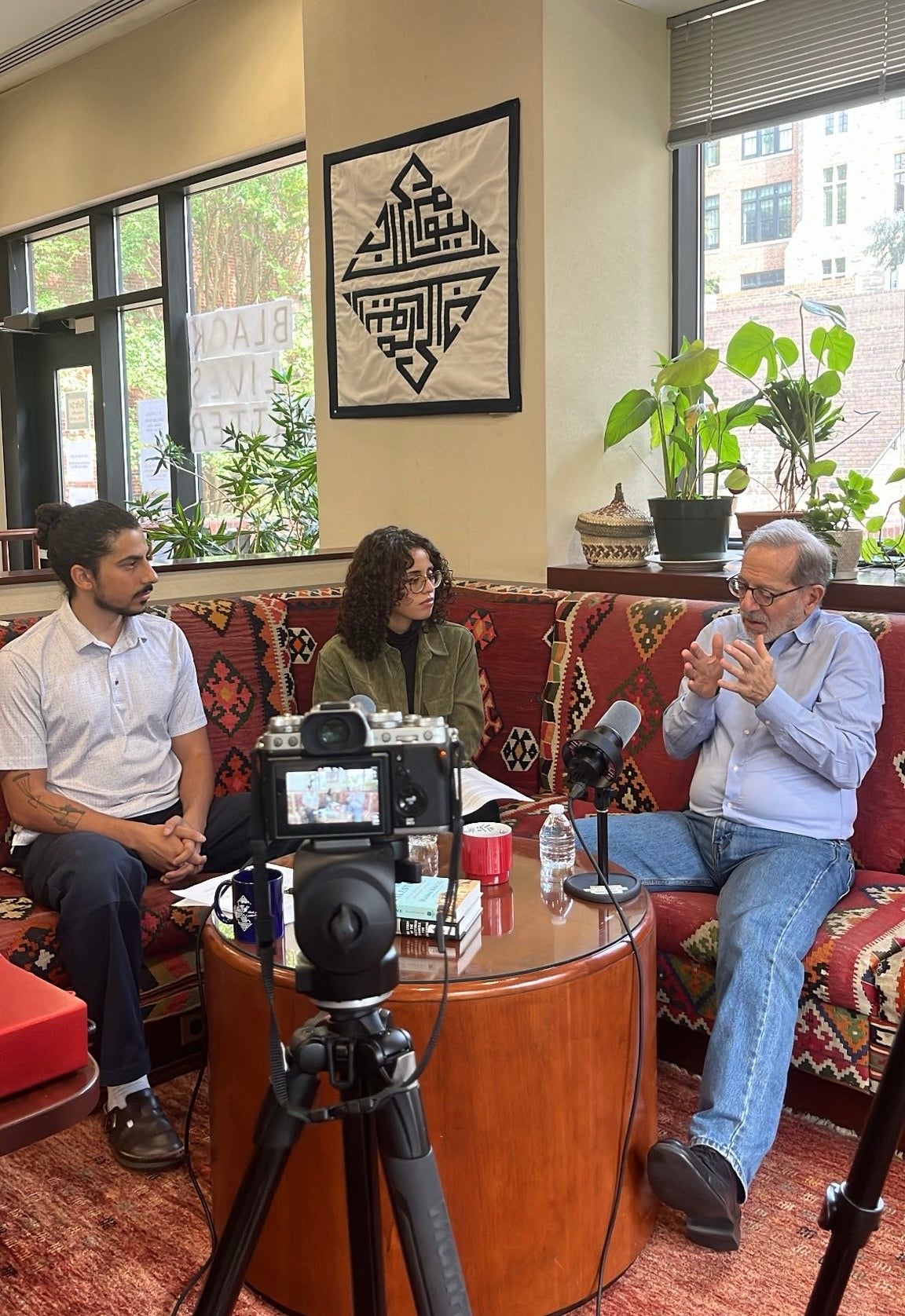
In 2024, MAAS students Amina Darabie, Hanane Idihoum, Layth Malhis, Michel Sindaha, and Lauren Burns, launched a new podcast to delve beyond the surface with scholars and students of the Arab world. The podcast's name, Shu Kaman?, means "what else?" in Arabic. Shu Kaman? hosts Sindaha and Idihoum are pictured here conducting an interview with Professor Rashid Khalidi.
CCAS Faculty Books
Major works produced by CCAS faculty between 2016 and 2025.