Exhibit Curated by Amjad Alqahtani, PhD Candidate in Physics at Georgetown University
What is light? This exhibition serves as an archival time machine, tracing humanity’s centuries-long quest to answer that fundamental question. Told through the rare books and historical documents housed in the Booth Family Center for Special Collections & the Georgetown library archives, the primary exhibit follows the evolution of our understanding of the nature of light from antiquity’s philosophical views to the complexities of modern quantum mechanics.
Visitors will follow a continuous thread from Aristotle’s foundational ideas, as echoed by Francisco de Toledo, past Ibn al-Haytham’s (Alhazen) 11th-century anatomical diagram of the eye. The journey then moves through Newton's corpuscular and Young's wave descriptions of light, shifts to Maxwell's formulation of light as an electromagnetic wave, and finally arrives at the modern understanding of wave-particle duality through the works of Einstein and Feynman. The exhibit also features a focused look at the legacy of physics and astronomy at Georgetown University, highlighting its own contributions to this universal endeavor—from the historic Heyden Observatory and Father Sestini's 1850 sunspot drawings, to the crucial dark matter observations of Vera Rubin.
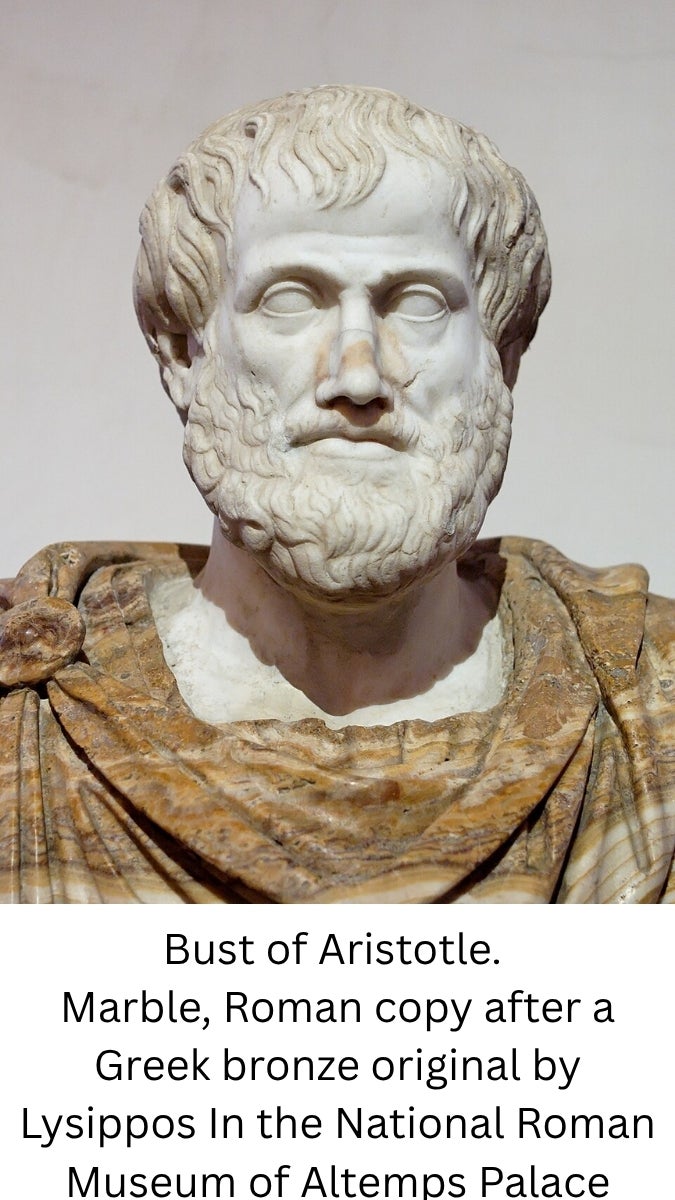
Corpus Aristotelicum (384 - 322 BCE)
Aristotle developed a framework for understanding the natural world across several treatises. In his Physics, he posited that a complete scientific explanation requires identifying the “four causes.” In On the Heavens, he distinguished terrestrial elements from the celestial.
His theory of light, however, appeared in De Anima (On the Soul), where he rejected the idea that light is a physical substance. He argued that light is “certainly not a body, for two bodies cannot be present in the same place,” defining it instead as the state of actual transparency.
Defining light as a state of a medium rather than a moving object seemed to provide an alternative to the existing geometric theories: extramission (visual rays emitted by the eye at infinite velocity) and intromission (a streaming substance emanating from a luminous source at a finite speed). However, to Aristotle—as laid out in Posterior Analytics—optics was a “middle science” excluded from natural philosophy.
This separation continued for centuries, evident in Francisco de Toledo’s Commentary on Aristotle (1575) (displayed here is the first page of Toledo’s commentary on Posterior Analytics, and chapter X.) Toledo comments on Aristotle’s classification of optics. He argues that while a physicist can observe the fact of a phenomenon, the “reason why” belongs to the mathematician. He defines optics as a middle ground that borrowed its proofs from geometry.
- BARNES, JONATHAN, ed. Complete Works of Aristotle, Volume 1: The Revised Oxford Translation. Princeton University Press, 1984. https://doi.org/10.2307/j.ctt5vjv4w.
Sambursky, S. “Philoponus’ Interpretation of Aristotle’s Theory of Light.” Osiris 13 (1958): 114–26. http://www.jstor.org/stable/301645.
~~~~~~~~~~~~~~~~~~~~~~~~~~~~~~~~~~~~~~~~
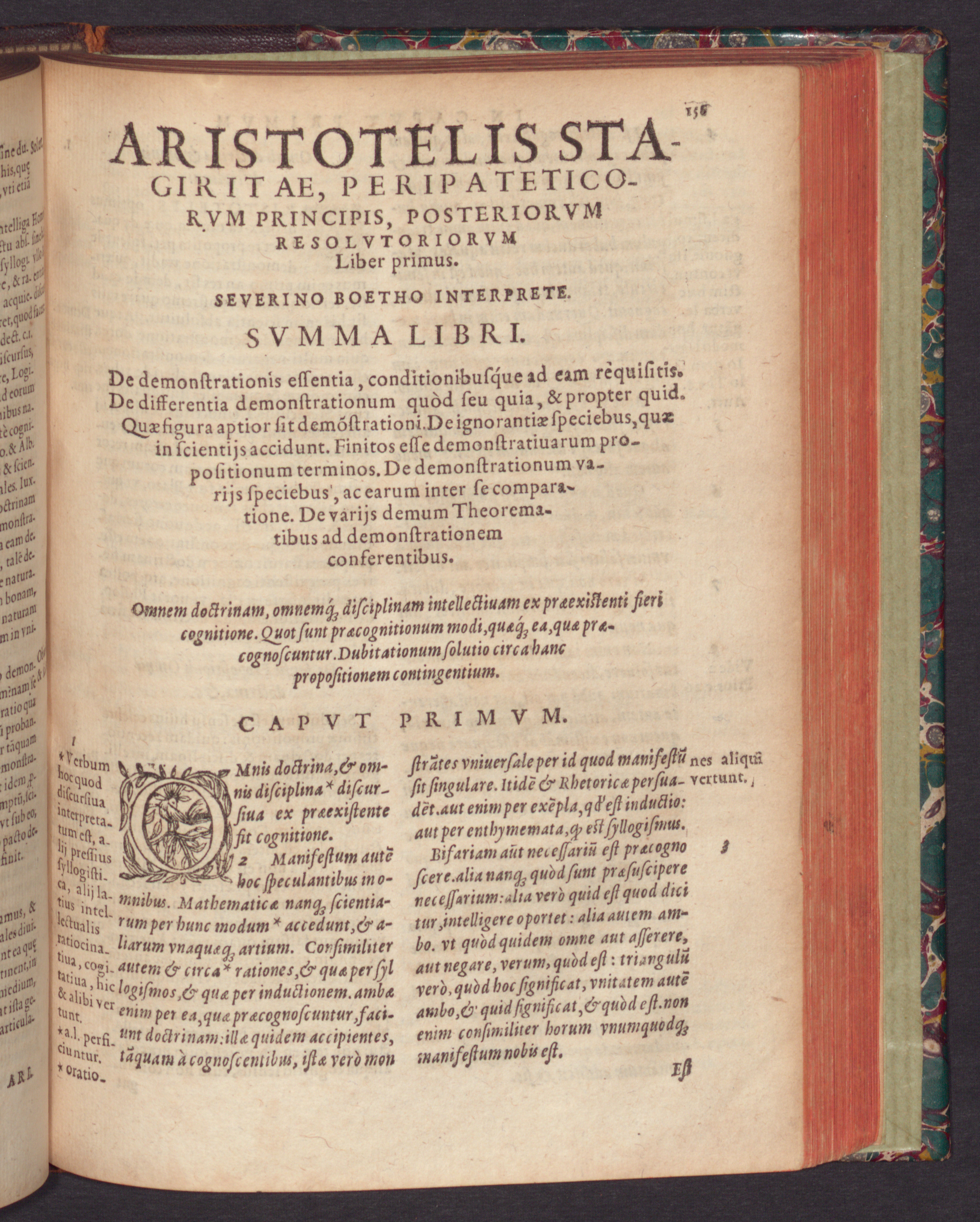
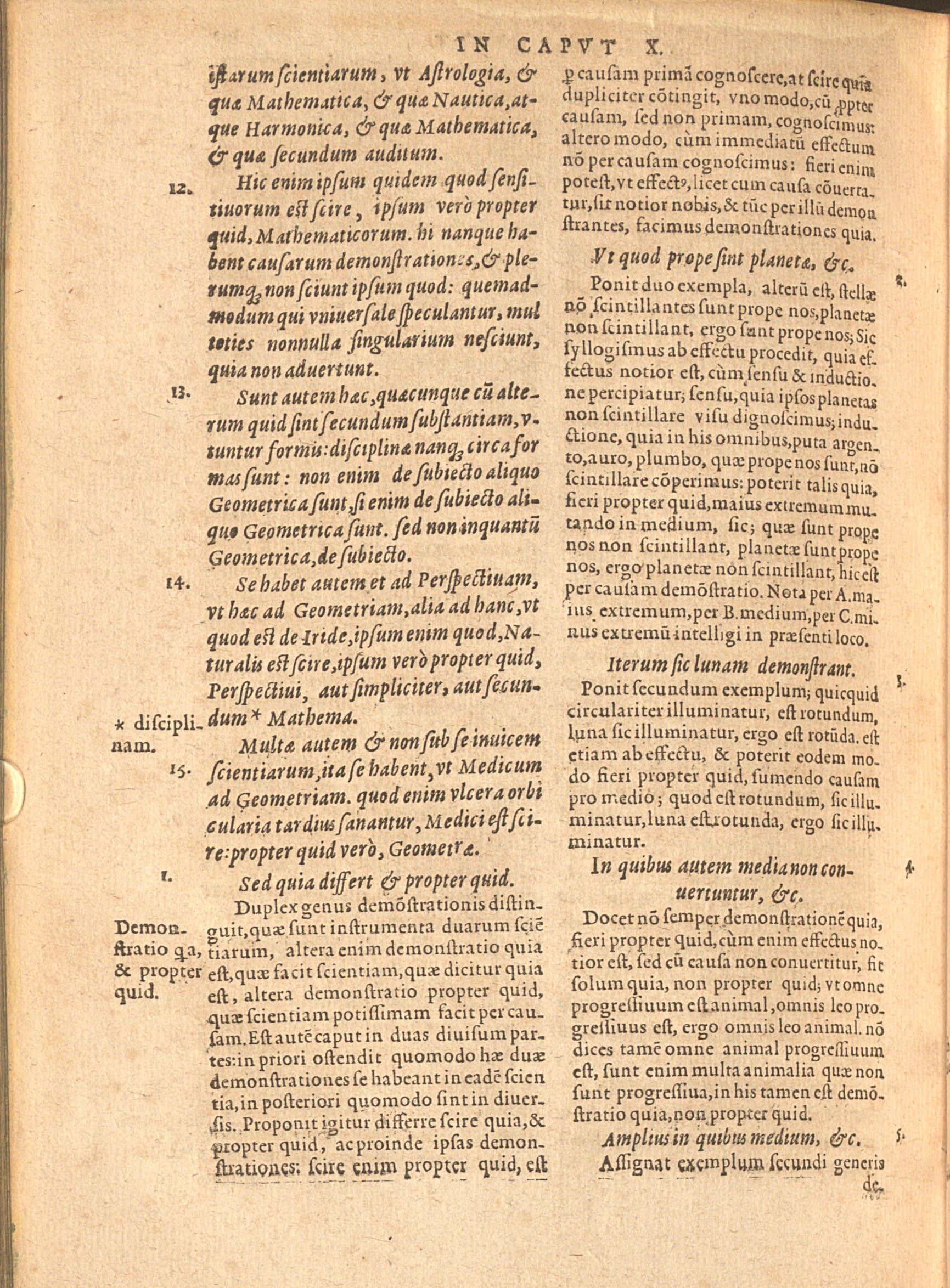
"Posterior Analytics" in Commentaria, vnà cum quaestionibus in universam Aristotelis logicam ~ 1575
Francisco de Toledo
Cologne: Apud haeredes Arnoldi Birckmanni, 1575
Booth Family Center for Special Collections, Woodstock Rare Book Collections
185.1 T575
~~~~~~~~~~~~~~~~~~~~~~~~~~~~~~~~~~~~~~~~~~~~~~~~~~~~~~~~~~~
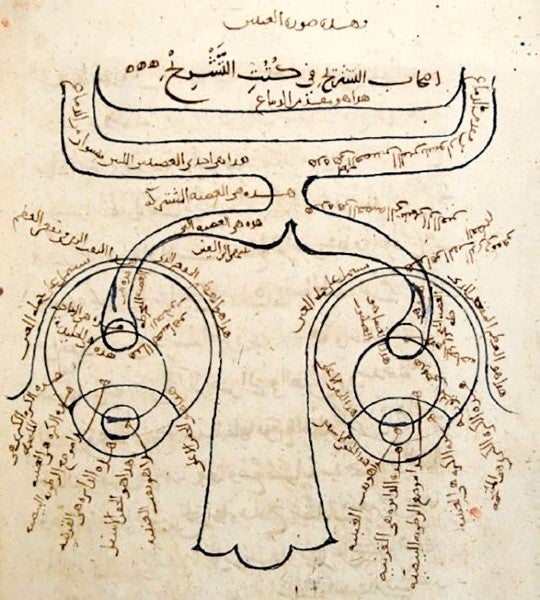
Kitab al-Manazir ~ circa 1015
Ibn al-Haytham (Alhazen)
Manuscript copied in Cairo, circa 1084
Istanbul. Süleymaniye Library
MS Fatih 3212, vol.1, fol. 81b
Note: This item is not in Georgetown's collections
Ibn al-Haytham’s Book of Optics (Kitab al-Manazir) redirected the study of light. He described light as streams of small particles traveling in straight lines at a large but finite velocity, which are reflected from objects into our eyes. Contrary to the ancient Greek belief that the eye emits a visual ray to sense objects, al-Haytham demonstrated that sight occurs only when light reflected from objects enters the eye.
To support this, he used a camera obscura (pinhole camera) to observe how light passing through a small aperture projects an inverted image onto a screen. He understood that refraction is caused by changes in velocity across different materials and studied how lenses and mirrors allow for magnification and focused images.
He wrote a chapter on the structure of the eye. In it, he provides an anatomical diagram shown here from the oldest extant manuscript of his work.
- Smith AM. A. I. Sabra. The Optics of Ibn al-Haytham. Books I, II, II: On Direct Vision. With Translation, Introduction, Commentary, Glossaries. London: The Warburg Institute, 1989. Pp. 735 (in two vols.). ISBN 0-85481-072-2. The British Journal for the History of Science. 1992;25(3):358-359. doi:10.1017/S0007087400029186
~~~~~~~~~~~~~~~~~~~~~~~~~~~~~~~~~~~~~~~~~~~~~~~~~~~~~~~~~~~
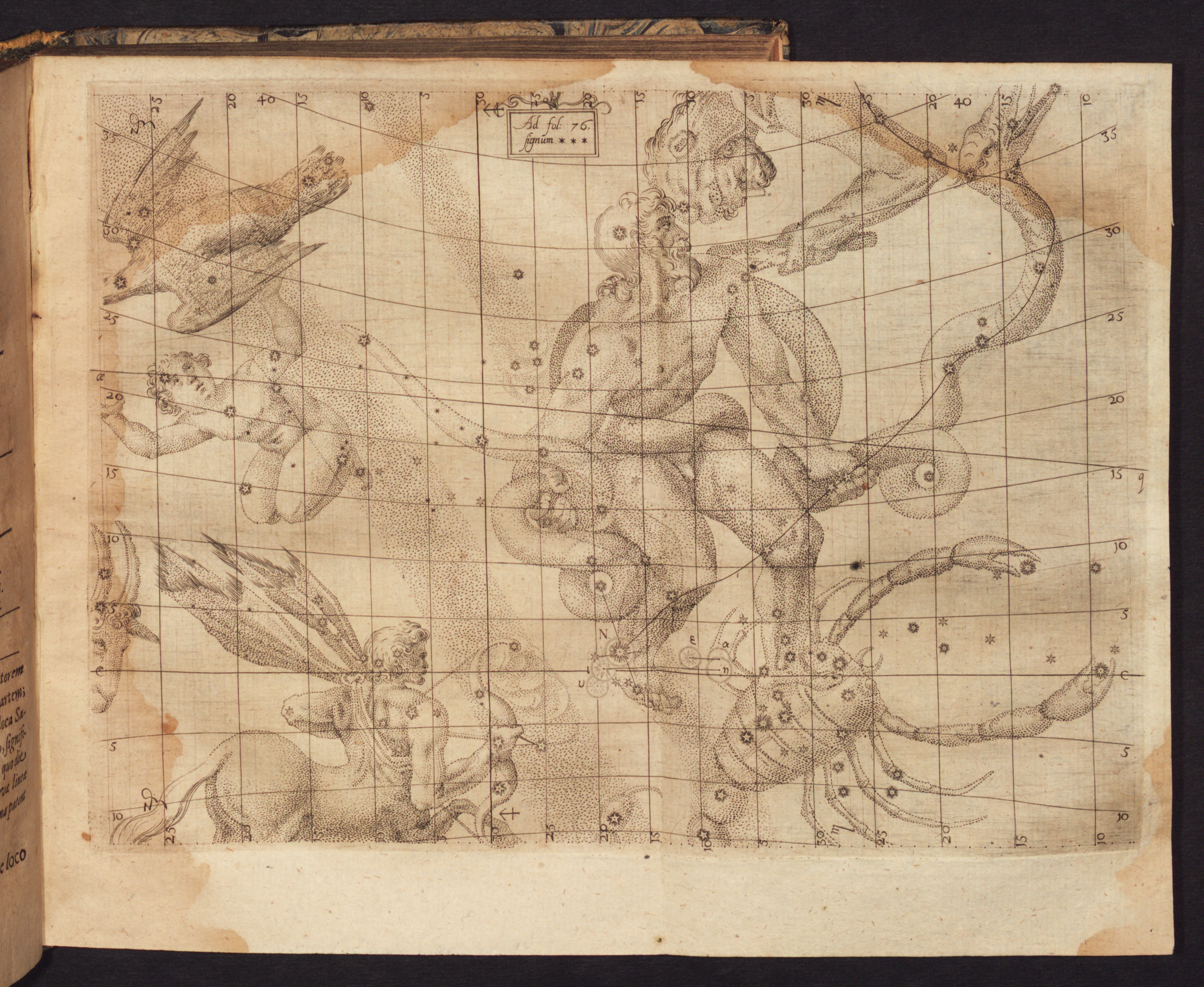
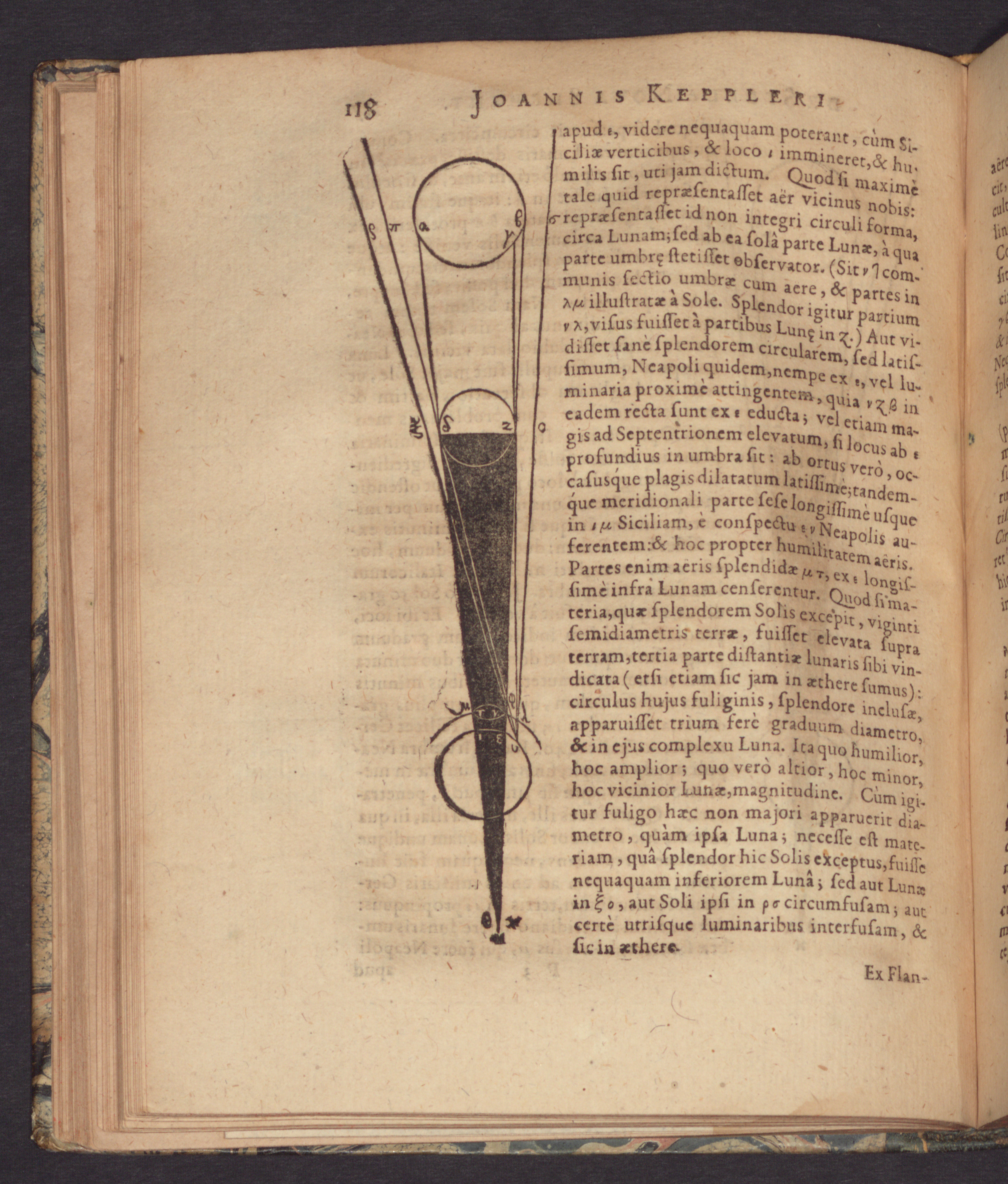
Mathematici De stella nova in pede Serpentarii ~ 1606
Johannes Kepler
Prague: Ex officina calcographica Pauli Sessii, 1606
Booth Family Center for Special Collections, Rare Book Collection
QB841.K4 1606
Kepler wrote De Stella Nova to document the sudden appearance of the supernova of 1604, which he called a “New Star”.
He provided a star map showing the supernova, marked with an N, in the right foot of the constellation Ophiuchus (the Serpent Bearer). Kepler used this map to show the star’s alignment with a great conjunction of Mars, Jupiter, and Saturn, and to investigate whether these planetary movements were physically linked to the star's birth.
The diagram on page 118 illustrates a solar eclipse, tracing light rays from the Sun through the Moon toward a human eye. Kepler used the geometry of the Moon's shadow cone to investigate the solar corona. He demonstrated that the Earth's atmosphere cannot be the source of scattered sunlight as it is completely shadowed by the moon during totality, and proposed that the light must be scattering off a diffuse material located higher in space.
Kepler wrote the book on modern optics, Astronomiae Pars Optica, and his methodical work in observational astronomy guided the lead figures of the scientific revolution.
~~~~~~~~~~~~~~~~~~~~~~~~~~~~~~~~~~~~~~~~~~~~~~~~~~~~~~~~~~~
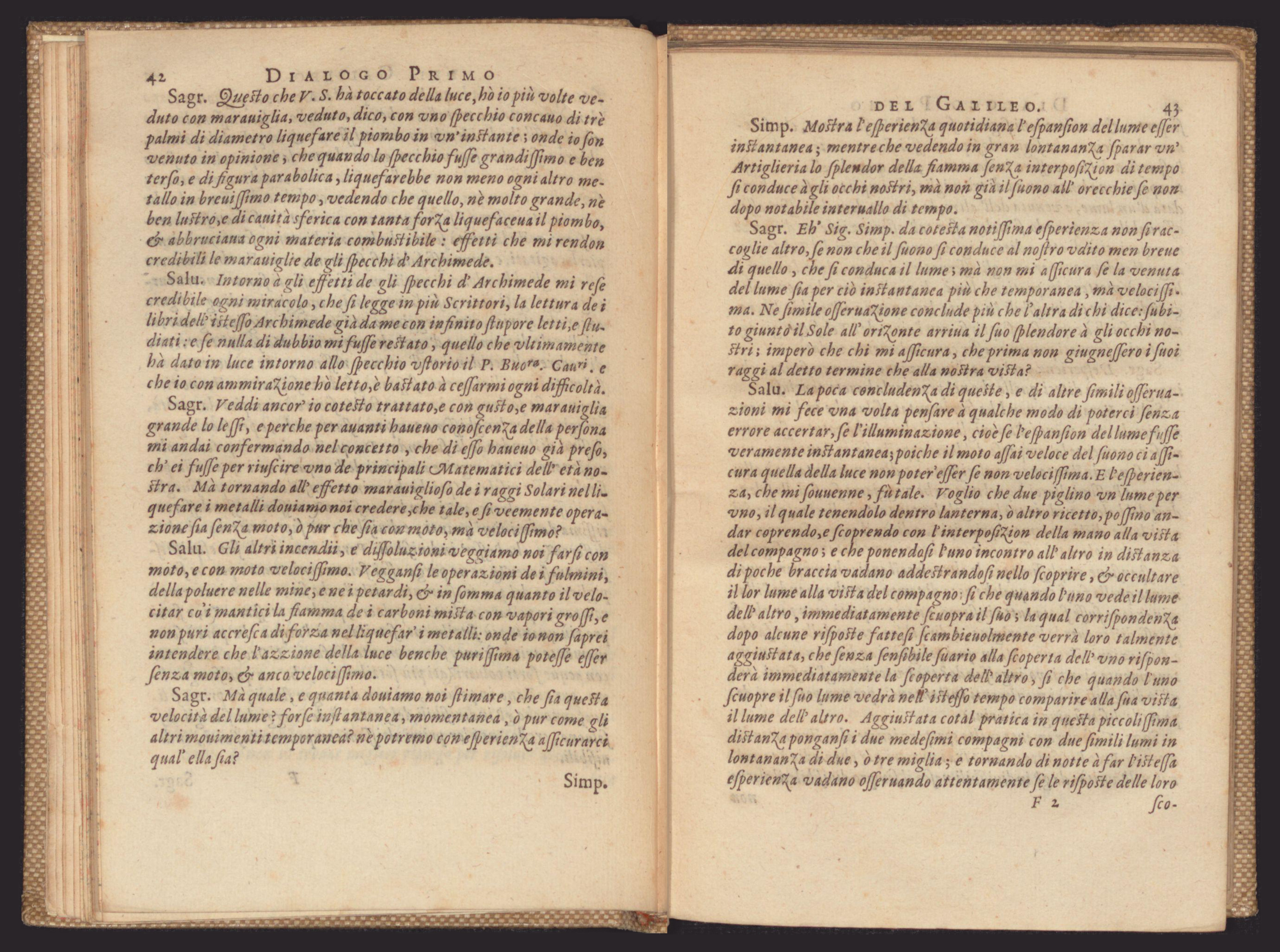
Two New Sciences by Galileo Galilei ~1638
Galileo Galilei
Leiden: Appresso gli Elseuirii, 1638
Booth Family Center for Special Collections, Vault
QA33.G28 1638
This text is from Galileo’s final work, Discorsi e dimostrazioni matematiche intorno a due nuove scienze (Discourses and Mathematical Demonstrations Relating to Two New Sciences). Within these pages (42–43), Galileo stages a debate that represents both his views on the nature of light and his broader push to derive natural laws through experiment.
Galileo presents his argument through a conversational clash between three fictional personas:
Simplicio (The Aristotelian): He argues from a place of tradition, stating that “daily experience shows the expansion of light to be instantaneous,” as we see the flash of a distant cannon at the very moment it fires.
Salviati (The Galilian): Acting as Galileo’s own voice, he rejects the idea of instantaneous states. He treats light as a physical operation that must involve “motion, and even very fast motion,” comparing it to the rapid expansion of lightning or gunpowder. For Salviati, if light is a physical power that can melt lead, it must have a physical velocity.
Sagredo (The intelligent Layman): He bridges the gap by demanding a testable proof: “Could we not assure ourselves by experiment which it might be?” He refuses to accept daily experience as a final answer and instead seeks a measurable quantity.
The exchange culminates in a two-lantern experiment, where Salviati proposes placing two observers on distant hills to time the signal and response of light.
By shifting the focus from what Aristotle wrote to what a person can measure with a lantern and a clock, Galileo articulated the philosophy that ignited a scientific revolution: the laws of nature must be interrogated through experiment.
~~~~~~~~~~~~~~~~~~~~~~~~~~~~~~~~~~~~~~~~~~~~~~~~~~~~~~~~~~~
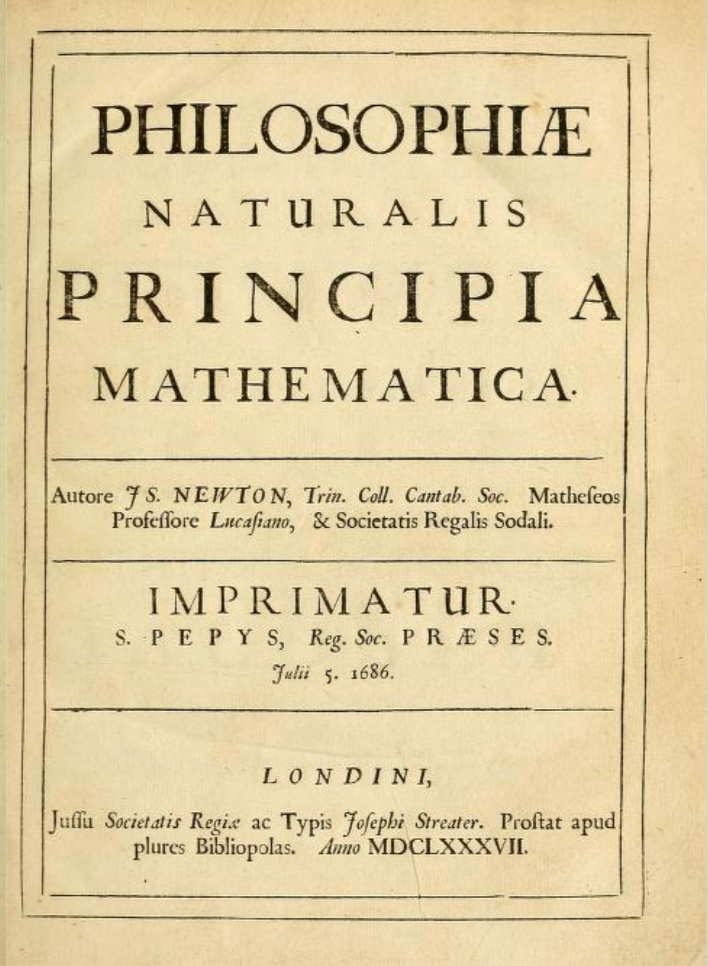
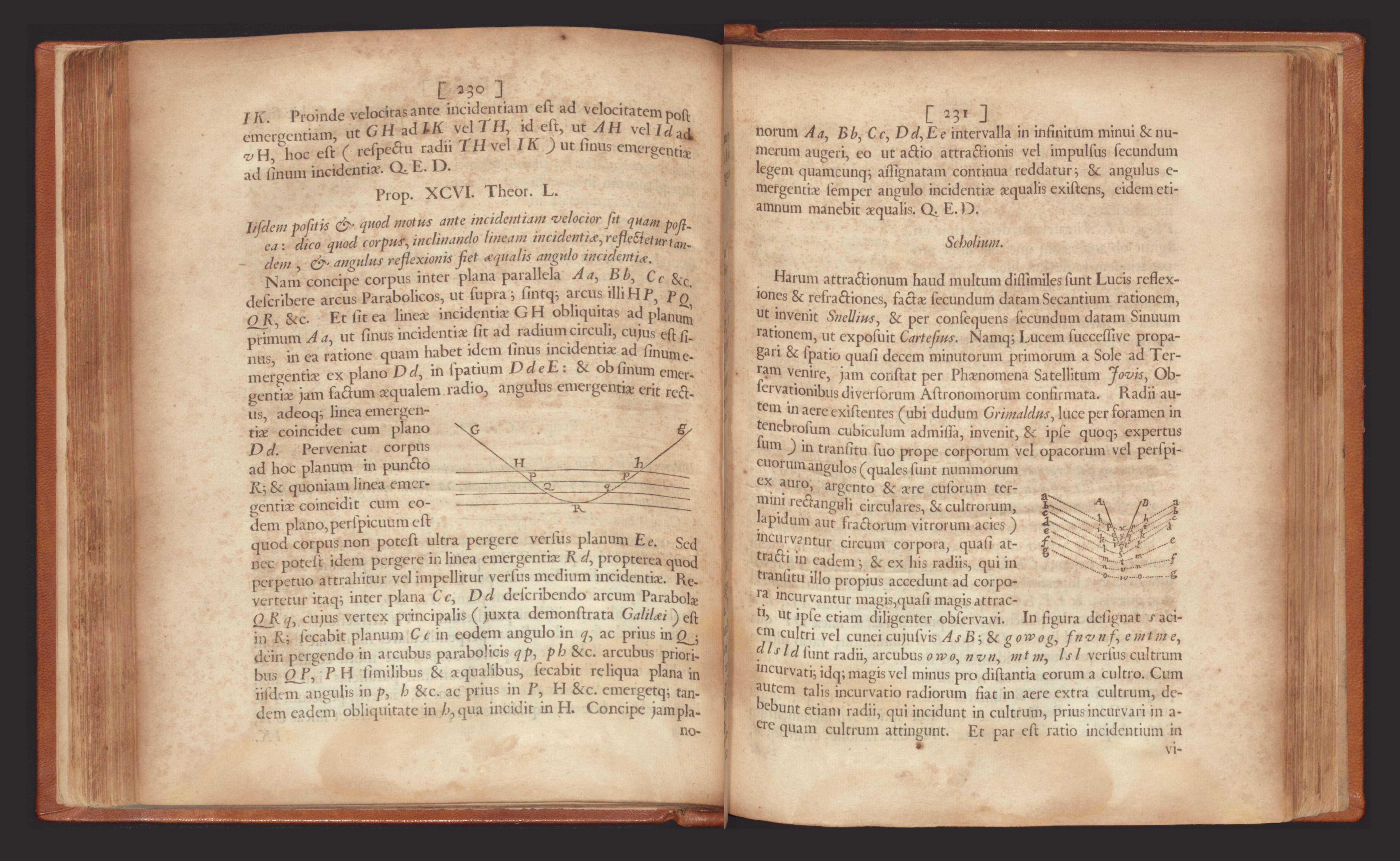
Philosophia naturalis principia mathematica ~ 1687
Isaac Newton
London: Jussu Societatis Regiae ac typis Iosephi Streater, 1687
Booth Family Center for Special Collections, Rare Book Collection
QA803.A2 1687
Sir Isaac Newton (1642–1727) proposed a physical framework with his 1687 text, Philosophiae Naturalis Principia Mathematica, which he revised and republished in two subsequent editions in 1713 and 1726. He structured the work into three books, progressing from laws of motion to fluid dynamics, and finally to a universal law of gravitation. While the vast majority of the text is dedicated to mechanics and gravity, Newton dedicates a brief section to the physics of light.
The displayed pages (230–231) illustrate his attempt to treat optics as a branch of mechanical physics. In Proposition XCVI, Newton models a light particle passing through parallel planes of force. By referencing Galileo’s earlier work on parabolic trajectories, he demonstrates how a particle's path might curve and reflect at a boundary, offering a mechanical rationale for why the angle of incidence must equal the angle of reflection.
In the accompanying Scholium, Newton connects the theoretical description to the emerging empirical data of his era, noting that light is a traveling physical entity with a finite speed:
“For that Light is propagated successively and requires about ten minutes to come from the Sun to the Earth, is now certain from the phenomena of the Satellites of Jupiter, confirmed by the observations of various Astronomers.”
It wasn't until 1704 that Newton formally published his extensive theory of light and color with the publication of his book, Opticks. In it, Newton hypothesized a corpuscular theory, where light consists of a stream of small discrete particles traveling at high velocities. In this model, light corpuscles are subject to the same mechanical forces of attraction and impulse as ordinary matter.
- Newton, I. (1729). Sir Isaac Newton's Mathematical Principles of Natural Philosophy and His System of the World. Translated by A. Motte. London: Printed for Benjamin Motte. As cited in the edition edited by Florian Cajori, University of California Press, 1946.
- Cohen, I. Bernard, and Richard S. Westfall, eds. Newton: Texts, Backgrounds, Commentaries. New York: W. W. Norton & Company, 1995.
~~~~~~~~~~~~~~~~~~~~~~~~~~~~~~~~~~~~~~~~~~~~~~~~~~~~~~~~~~~
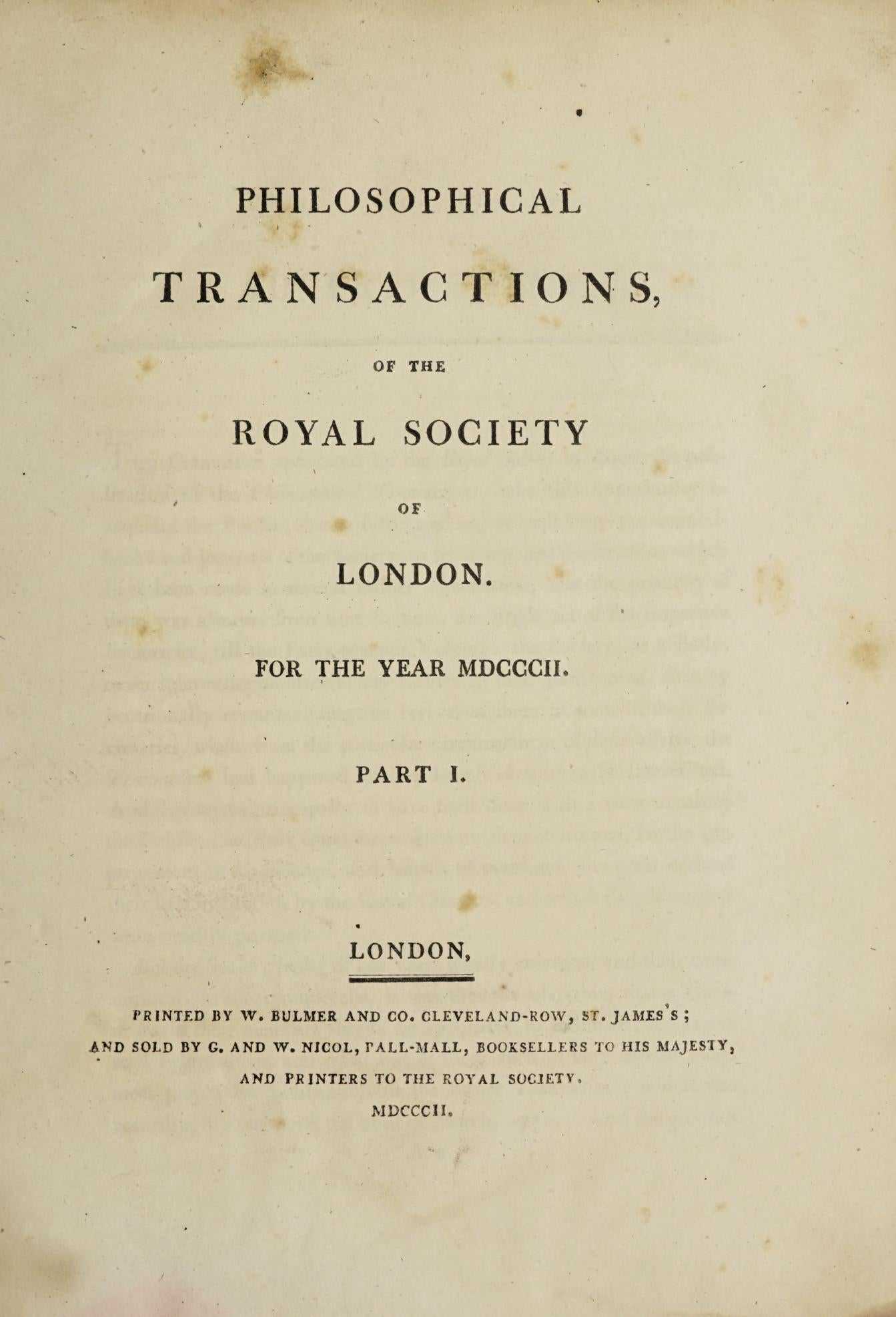
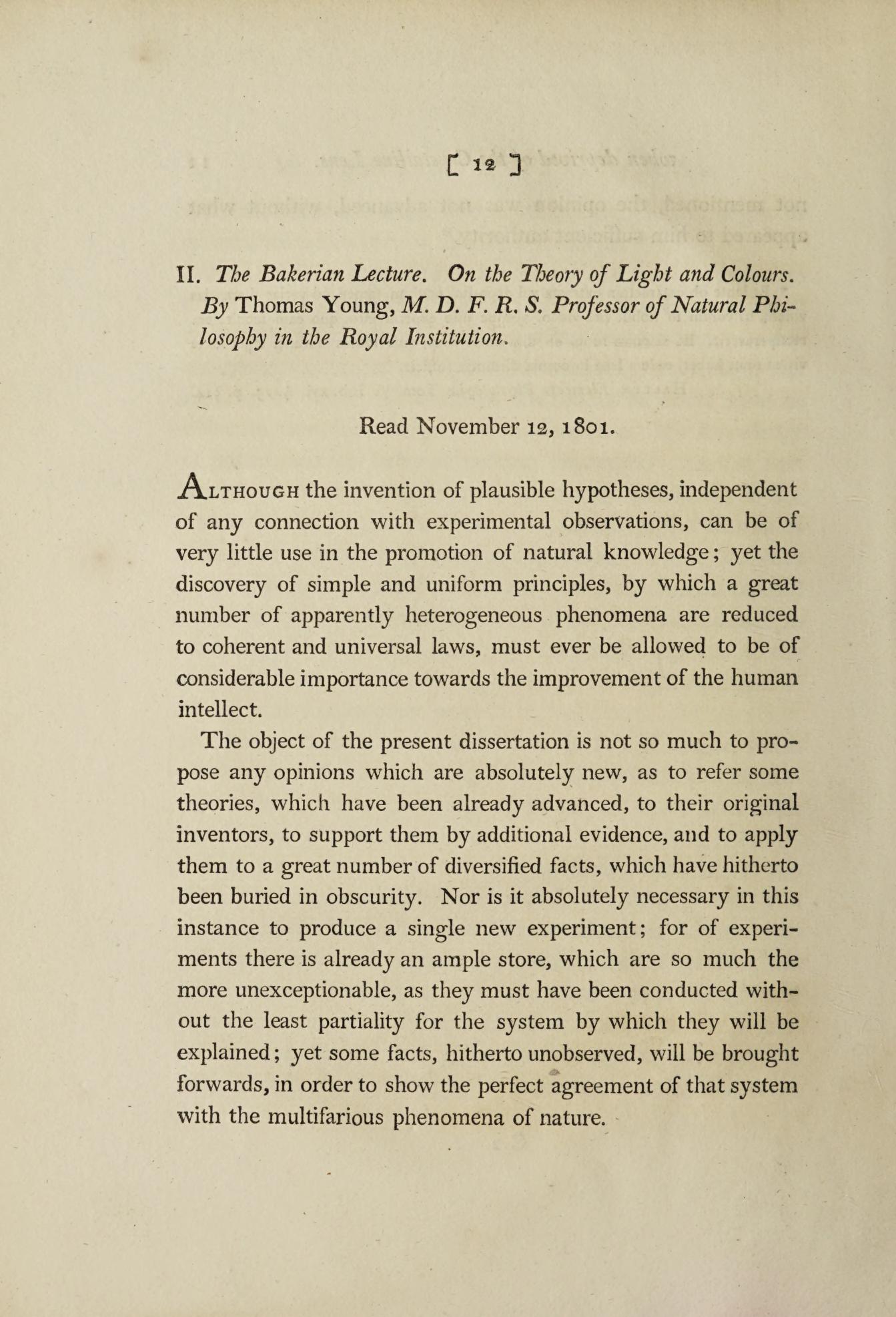
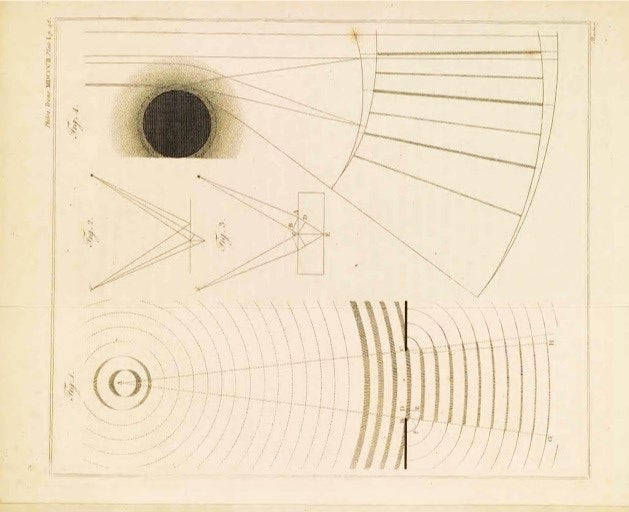
The Double Slit Experiment by Thomas Young (1801)
The Bakerian Lecture. On the Theory of Light and Colours ~ 1801
Thomas Young
Lecture delivered to the Royal Society of London in 1801.
Philosophical Transactions of the Royal Society of London
92 (1802), 12-48.
By this time, Newton’s corpuscular theory of light was widely accepted in the scientific community, overshadowing wave theories by the likes of Hooke and Huygens.
This consensus was challenged by experiments carried out by Thomas Young. He observed that by passing a point source of light through closely spaced pinholes (later slits), a pattern of alternating light and dark bands was formed on a screen placed behind the pinholes (slits). The results were presented to the Royal Society in 1801. Displayed here is his paper, published in 1802, where he proposed that these interference fringes could be explained if light propagated as a wave.
Young also hypothesized that different colors correspond to distinct wavelengths, which dictate their degree of refraction and diffraction. He used Newton’s existing experimental data to calculate the wavelengths of specific colors.
~~~~~~~~~~~~~~~~~~~~~~~~~~~~~~~~~~~~~~~~~~~~~~~~~~~~~~~~~~~
A Treatise on Electricity and Magnetism ~ 1873
James Clerk Maxwell
2nd Edition. Oxford: Clarendon Press, 1881
Lauinger Library, Off-Campus Shelving
QC518.M465 v.2
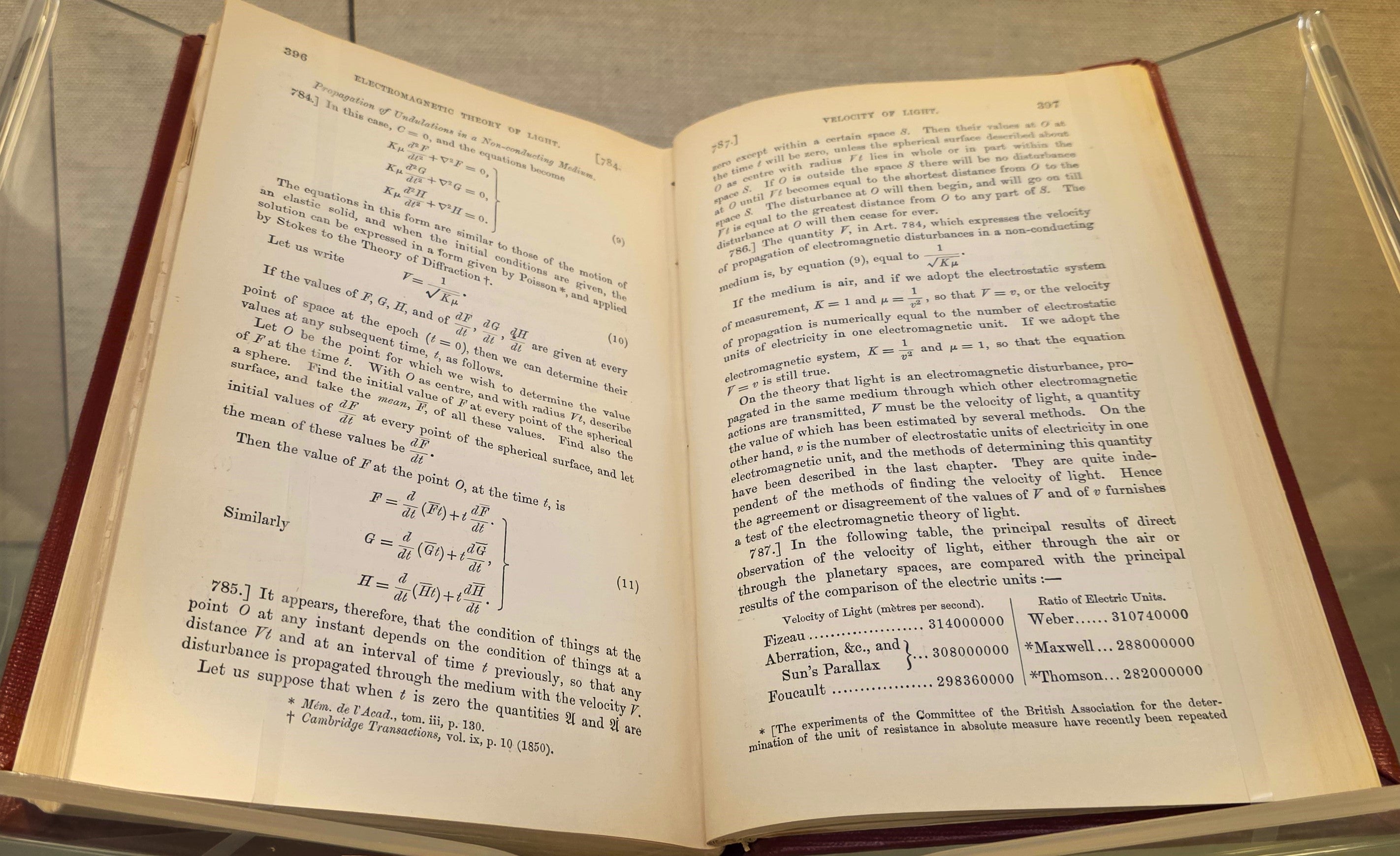
In 1873, James Clerk Maxwell published the first edition of A Treatise on Electricity and Magnetism, a two-volume work spanning nearly a thousand pages.
Shown here in the 1881 edition, open to the chapter “Electromagnetic Theory of Light,” the text formulates a cohesive wave theory that irrevocably unified the previously separate fields of electricity and magnetism in a set of equations. (Those equations were later reformulated by Oliver Heaviside into the four equations familiar to us today.) On these pages, Maxwell calculates the theoretical velocity of these newly discovered electromagnetic waves and compares it against the experimentally measured speed of light.
Finding that the two velocities matched almost perfectly, Maxwell derived a definitive conclusion: “We shall have strong reasons for believing that light is an electromagnetic phenomenon.”
Maxwell's work transformed physics, so much so that Max Planck called it “one of the greatest triumphs of human intellectual endeavor.”
~~~~~~~~~~~~~~~~~~~~~~~~~~~~~~~~~~~~~~~~~~~~~~~~~~~~~~~~~~~
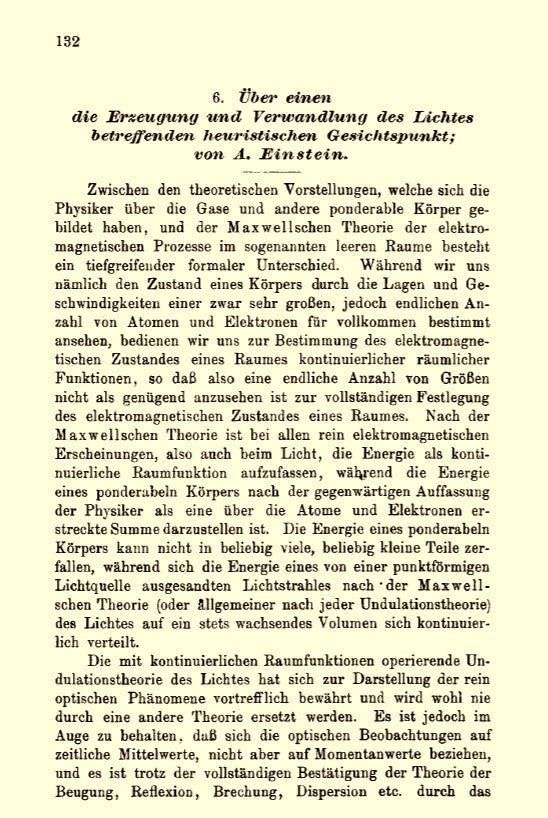
Max Planck’s Quanta (1901) & Albert Einstein’s Photon and Special Relativity (1905)
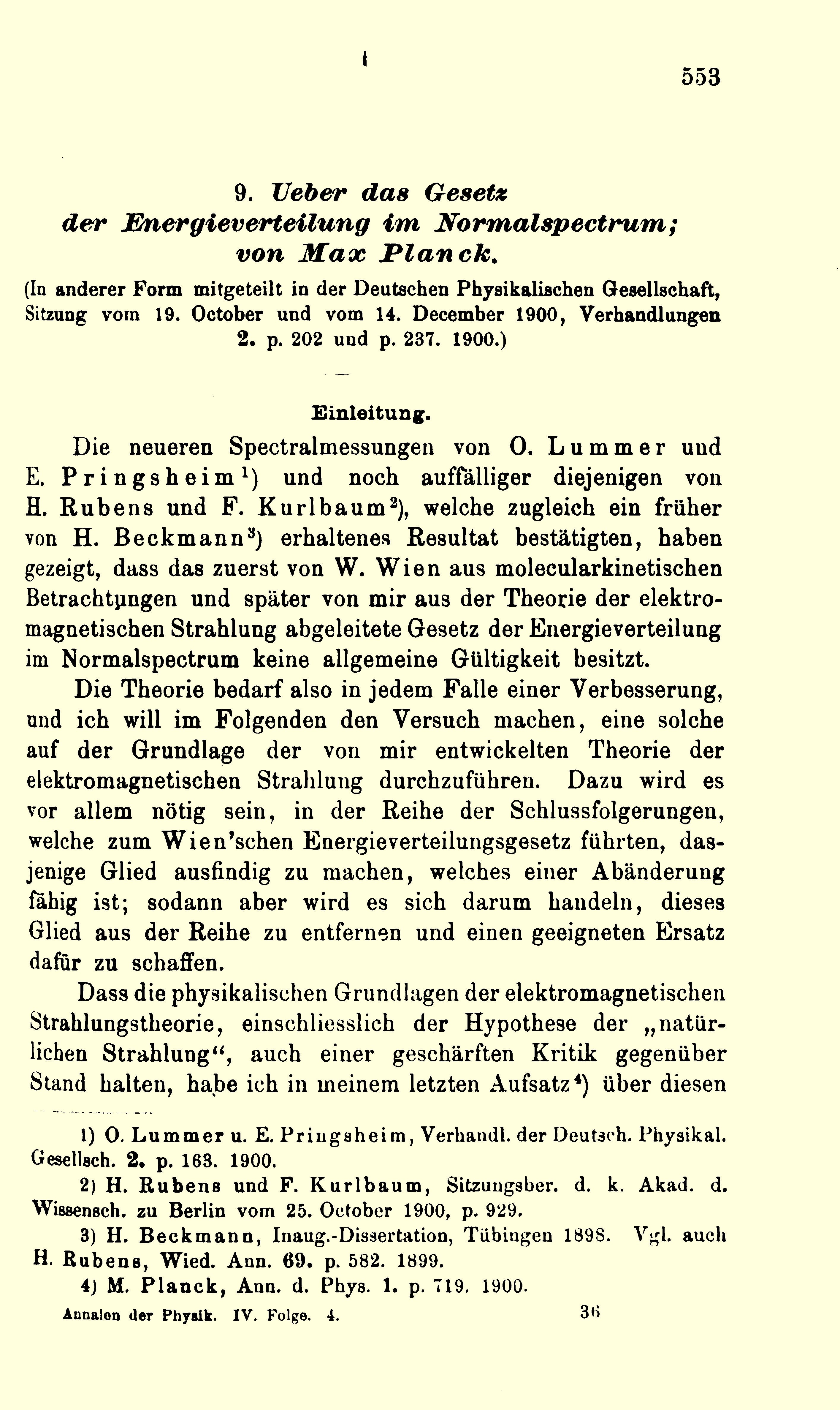
By the late 19th century, Maxwell’s wave theory provided a highly successful model of light, with a few persisting experimental anomalies. The theory couldn’t explain the radiation trend of heated objects or how light ejects electrons from metal surfaces. Furthermore, an experiment by Michelson & Morley had failed to detect the presumed medium for light waves, aether.
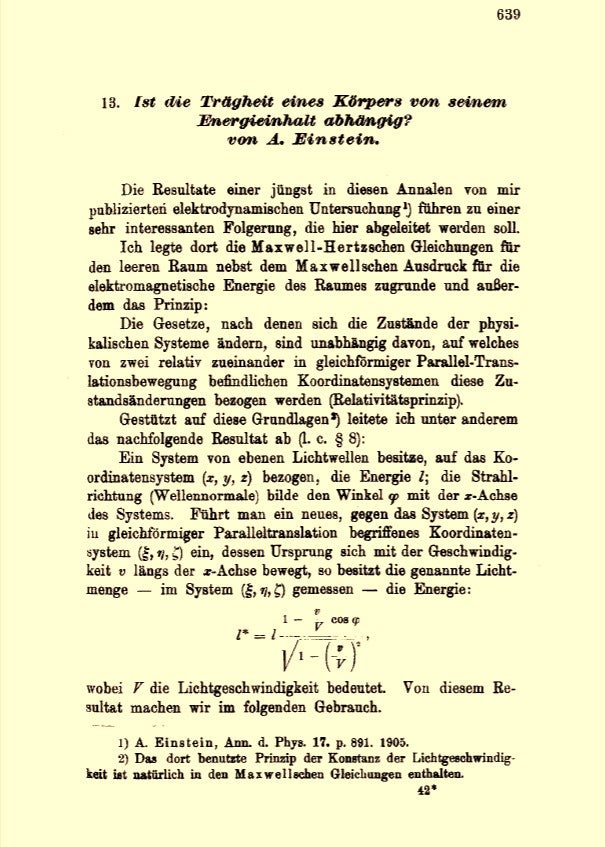
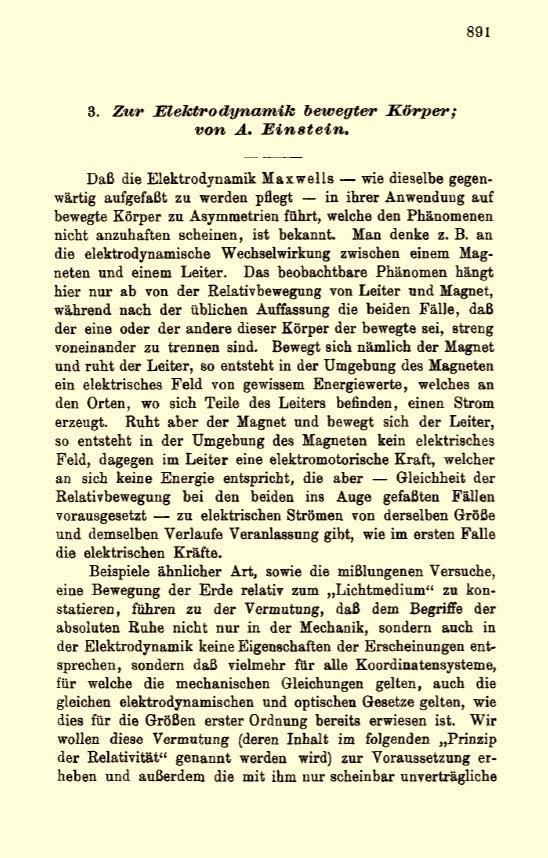
The four papers displayed here resolved these crises. In 1901, Max Planck solved the blackbody radiation problem by proposing that electromagnetic energy is emitted in discrete, indivisible units called “quanta.” In 1905, Albert Einstein applied this concept to the photoelectric effect, arguing that light itself consists of these localized energy packets (later called photons by Gilbert Lewis).
That same year, Einstein addressed the constant speed of light finding in the Michelson-Morley experiment with his theory of Special Relativity. The theory postulated that the speed of light is absolute and proved that space and time themselves must be relative. In the third paper shown here, Einstein derived the famous mass-energy equivalence E=mc2.
The result of these papers is a new interpretation of light that is both a wave and a particle. What seemed at the time like minor problems in an otherwise complete theory were, in fact, irreconcilable flaws, making inevitable the emergence of two new branches of physics: Quantum Mechanics and Relativity.
- Zettili, N. (2009). Quantum Mechanics: Concepts and Applications (2nd ed.). John Wiley & Sons, Ltd
- Planck, M. (1901). Über das Gesetz der Energieverteilung im Normalspektrum. Annalen der Physik, 309(3), 553–563.
- Einstein, Albert. (1905). "Über einen die Erzeugung und Verwandlung des Lichtes betreffenden heuristischen Gesichtspunkt" [On a Heuristic Point of View about the Creation and Conversion of Light]. Annalen der Physik. 17 (6): 132–148.
- Einstein, Albert. (1905). "Zur Elektrodynamik bewegter Körper" [On the Electrodynamics of Moving Bodies]. Annalen der Physik. 17 (10): 891–921.
- Einstein, Albert. (1905). "Ist die Trägheit eines Körpers von seinem Energieinhalt abhängig?" [Does the Inertia of a Body Depend Upon Its Energy Content?]. Annalen der Physik. 18 (13): 639–641.
~~~~~~~~~~~~~~~~~~~~~~~~~~~~~~~~~~~~~~~~~~~~~~~~~~~~~~~~~~~
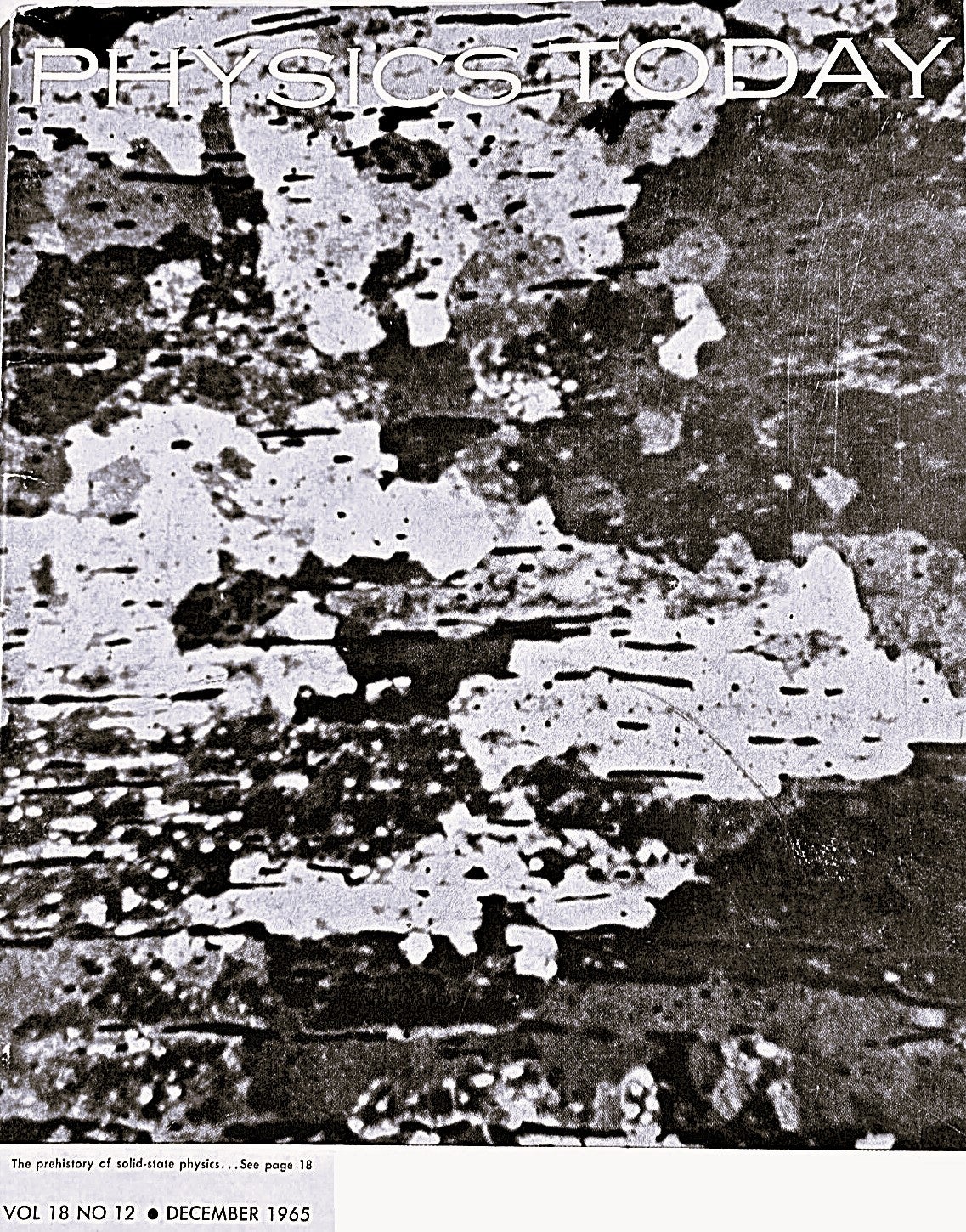
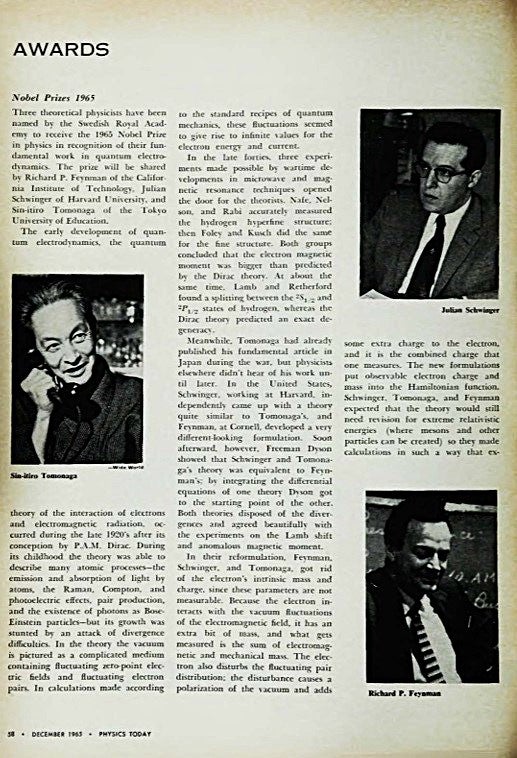
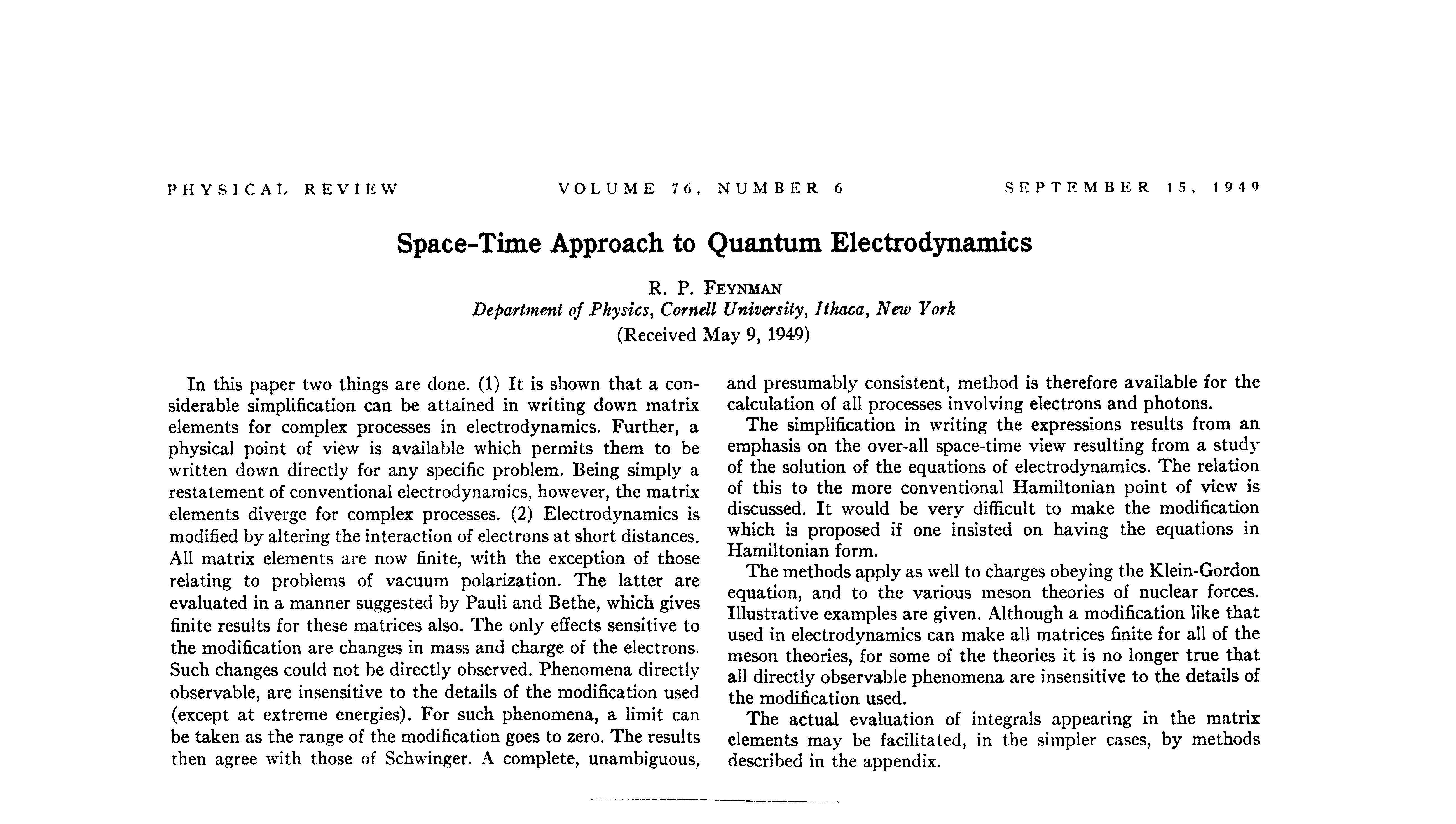
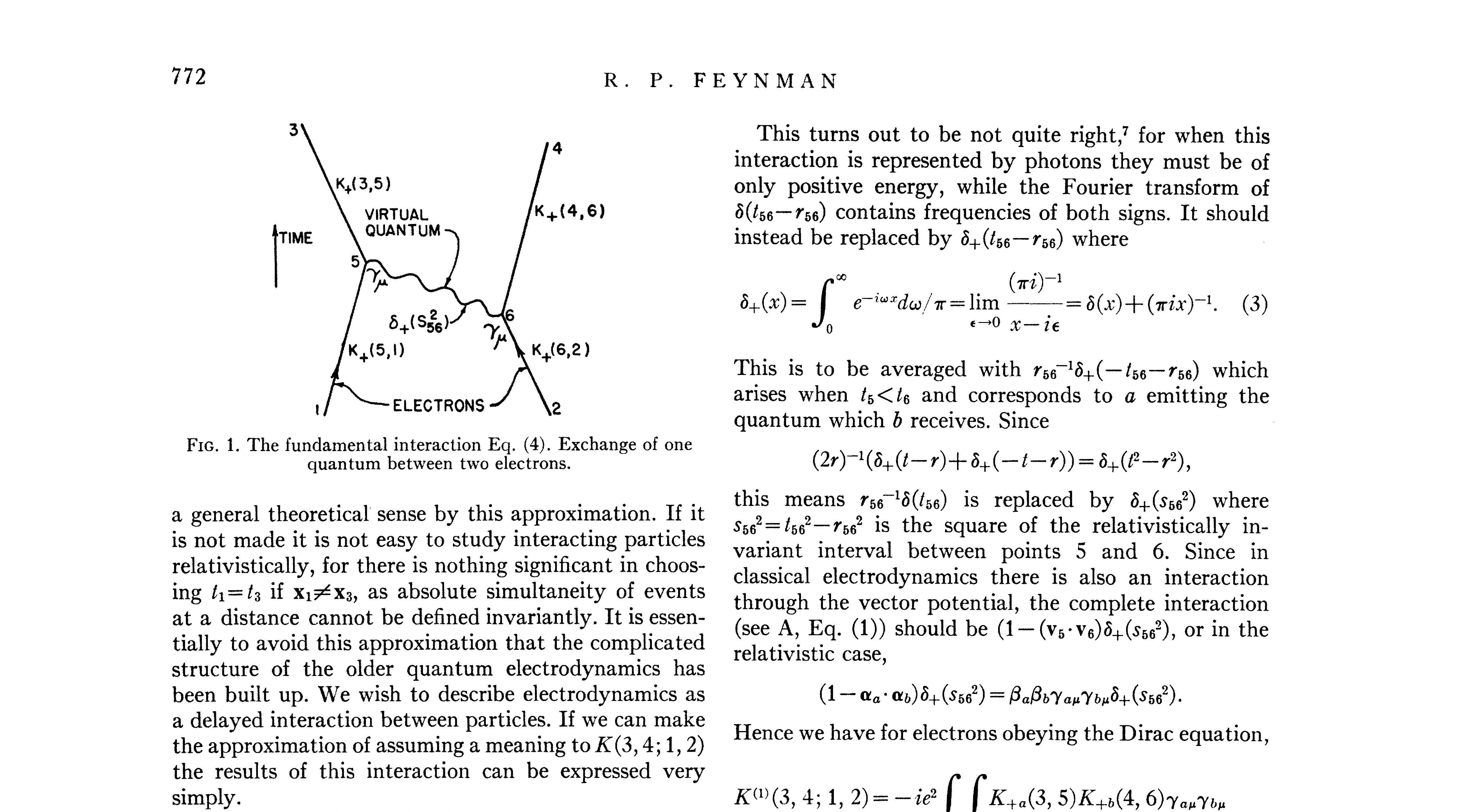
Richard Feynman on Quantum Electrodynamics ~ 1949
By the mid-20th century, quantum mechanics had been established and widely accepted. Efforts to connect this new theory to electrodynamics led to the emergence of the new field of quantum electrodynamics (QED).
The excerpt displayed here from Physics Today details the 1965 Nobel Prize awarded jointly to Shinichiro (Sin-Itiro) Tomonaga, Julian Schwinger, and Richard Feynman. Working independently in the late 1940s, these three physicists developed a mathematical procedure called renormalization, successfully establishing QED as a complete, working theory.
While Tomonaga and Schwinger achieved this using the established mathematical framework of quantum mechanics, Feynman implemented an entirely new approach known as the path integral. Shown here is his 1949 paper, “Space-Time Approach to Quantum Electrodynamics.” The paper introduces his visual shorthand for calculating these complex path integrals—now known as Feynman diagrams. QED models electromagnetic interactions as an energy exchange between particles mediated by photons.
- “Awards: Nobel Prize 1965.” (1965, December). Physics Today, 18(12),58.
- Feynman, R. P. (1949). "Space-Time Approach to Quantum Electrodynamics". Physical Review, 76(6), 769–789.
~~~~~~~~~~~~~~~~~~~~~~~~~~~~~~~~~~~~~~~~~~~~~~~~~~~~~~~~~~~
History of Physics & Astronomy at Georgetown University ~ 1843 - present
Since its founding in 1797, Georgetown has maintained a tradition of teaching physics, originally through the disciplines of astronomy and natural philosophy. This tradition expanded in the mid-nineteenth century with the founding of the Georgetown Observatory in 1843. Father James Curley, S.J., served as the observatory's first director while also teaching. His 1849 lecture notes, displayed here, document the university's early physics curriculum.
In the 1850s, Father Benedict Sestini, S.J., used the observatory to track solar activity. The original plates of Sestini's sunspot drawings displayed here are a direct record of this visual data collection, marking Georgetown’s early contributions to the study of solar dynamics.
A century later, in 1954, Vera Rubin earned her Ph.D. in astronomy from Georgetown. Her dissertation, displayed here, analyzed the kinematic distribution of galaxies. This research laid the groundwork for her subsequent measurements, which provided the foundational evidence for the existence of dark matter.
The drive to capture light remains a part of Georgetown physics today, extending to the current research of this exhibit's curator, Amjad Alqahtani, who utilizes nanoscale graphene devices to detect the terahertz frequencies of the electromagnetic spectrum.
~~~~~~~~~~~~~~~~~~~~~~~~~~~~~~~~~~~~~~~~~~~~~~~~~~~~~~~~~~~
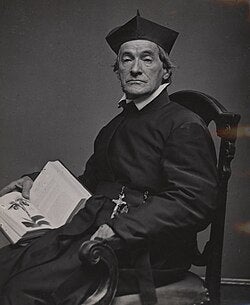
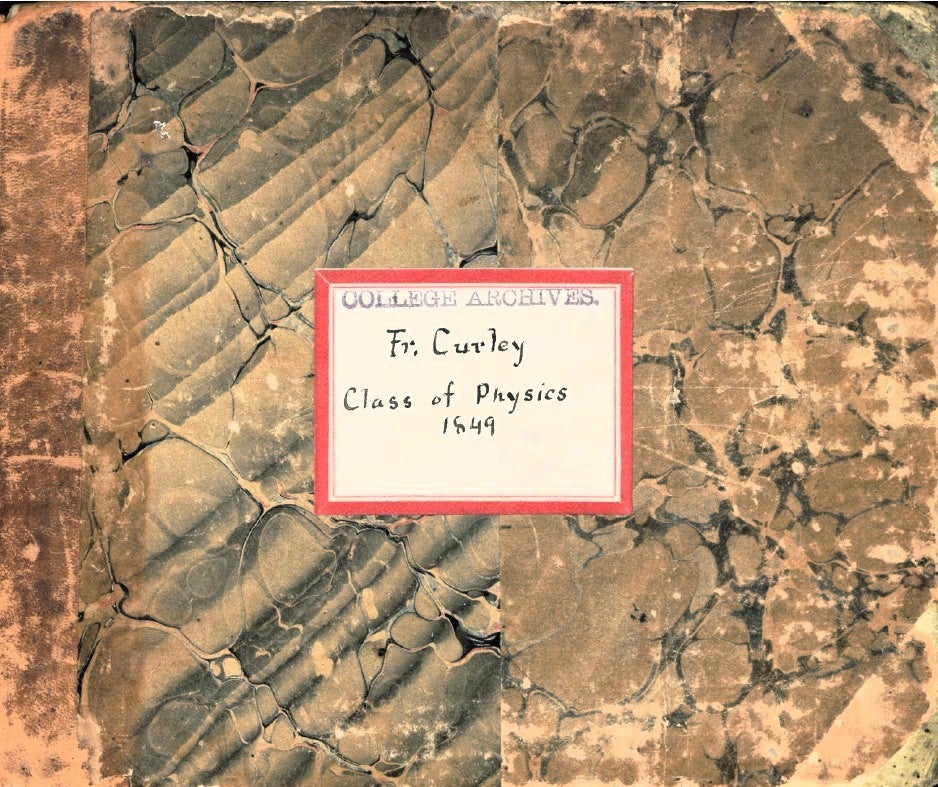
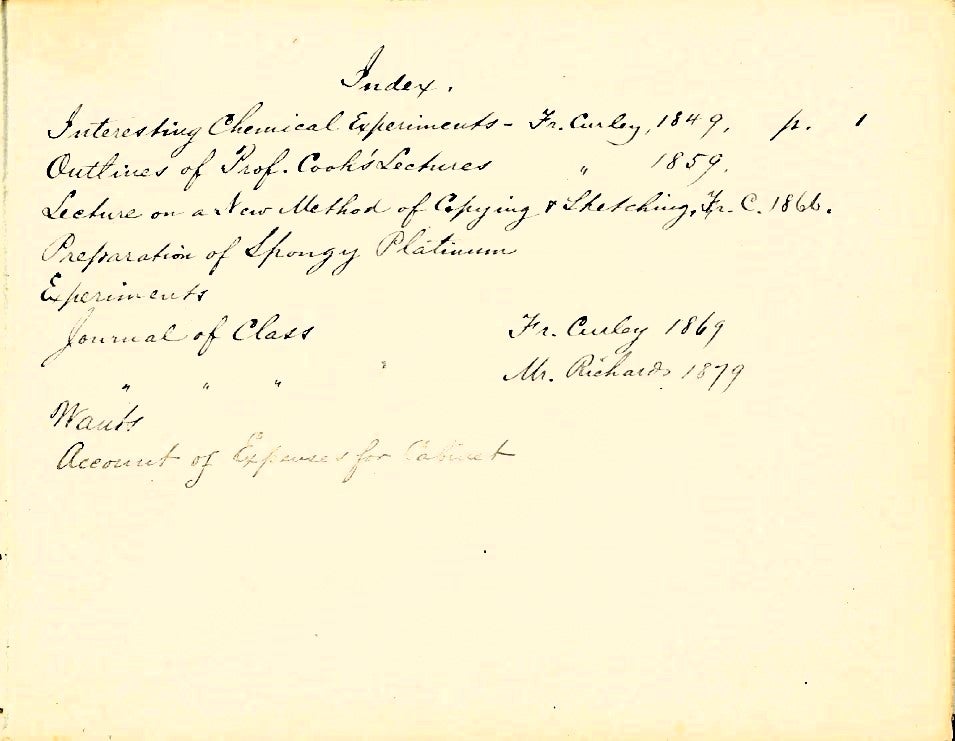
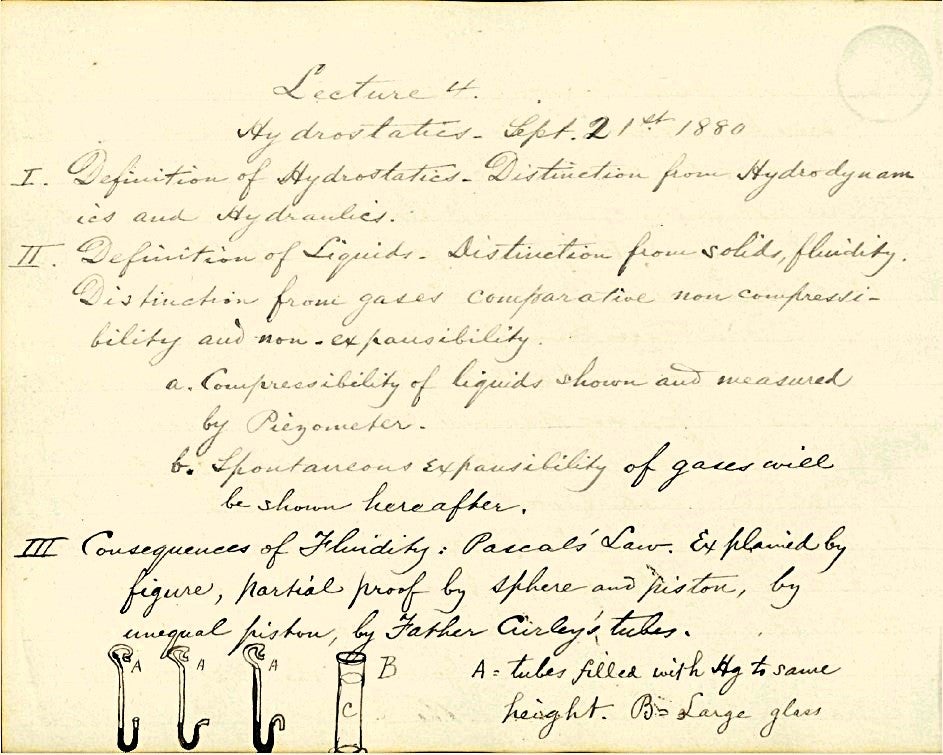
Father Curley, S.J. & His 1849 Physics Lab Notebook
Photo: Father James Curley, S. J.
Pages from Father Curley's Physics Class Journal 1849
~~~~~~~~~~~~~~~~~~~~~~~~~~~~~~~~~~~~~~~~~~~~~~~~~~~~~~~~~~~
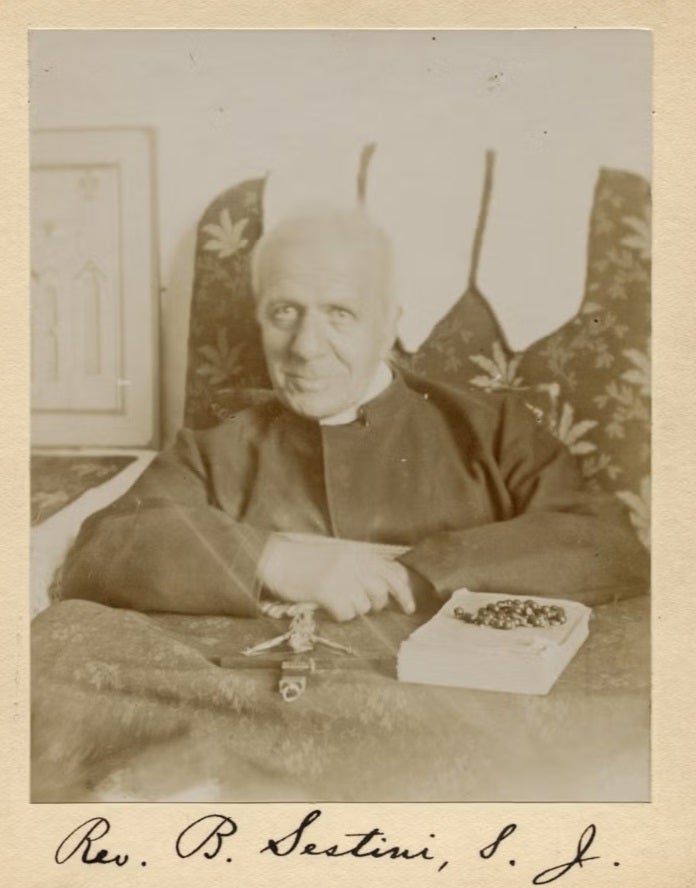
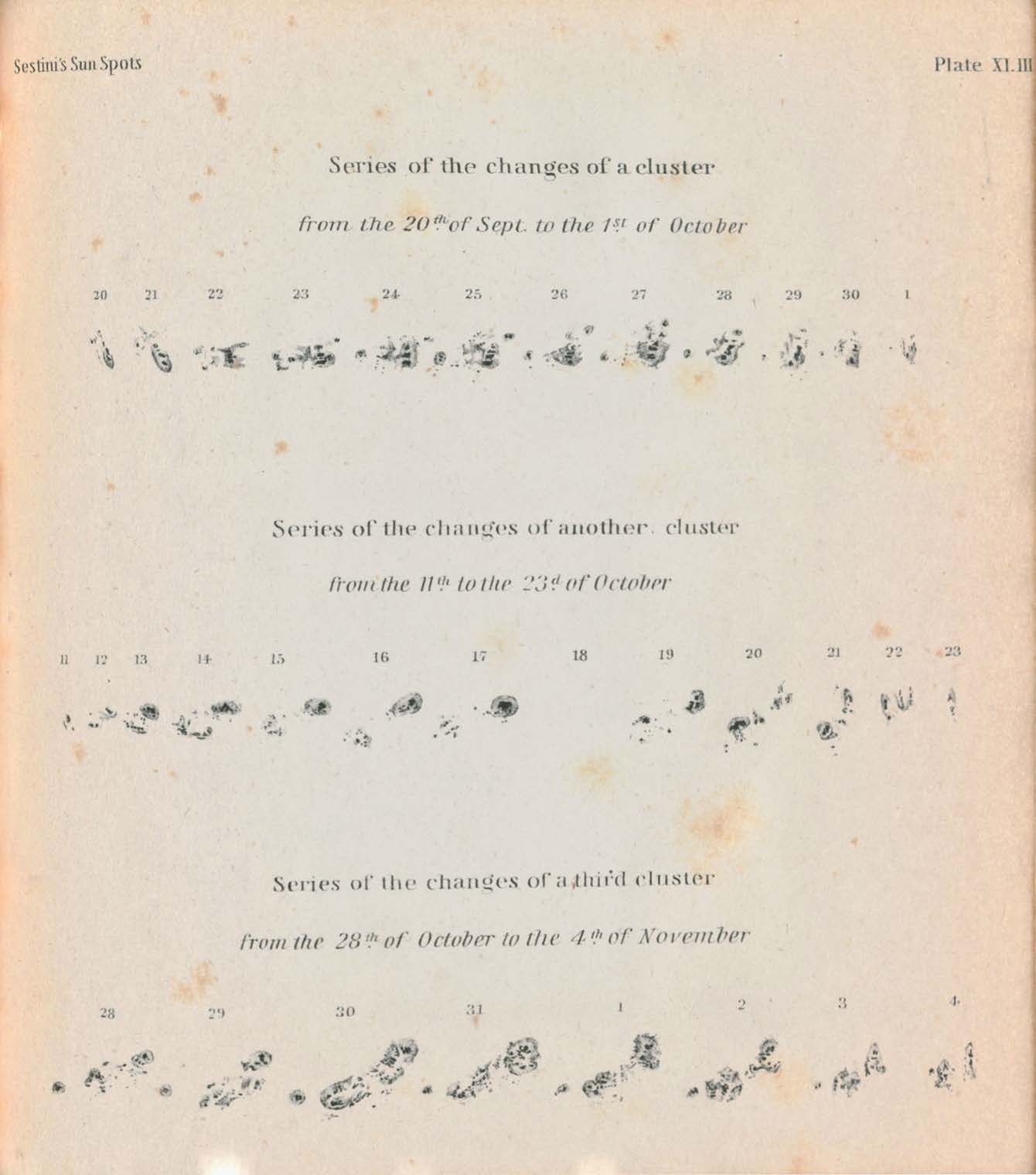
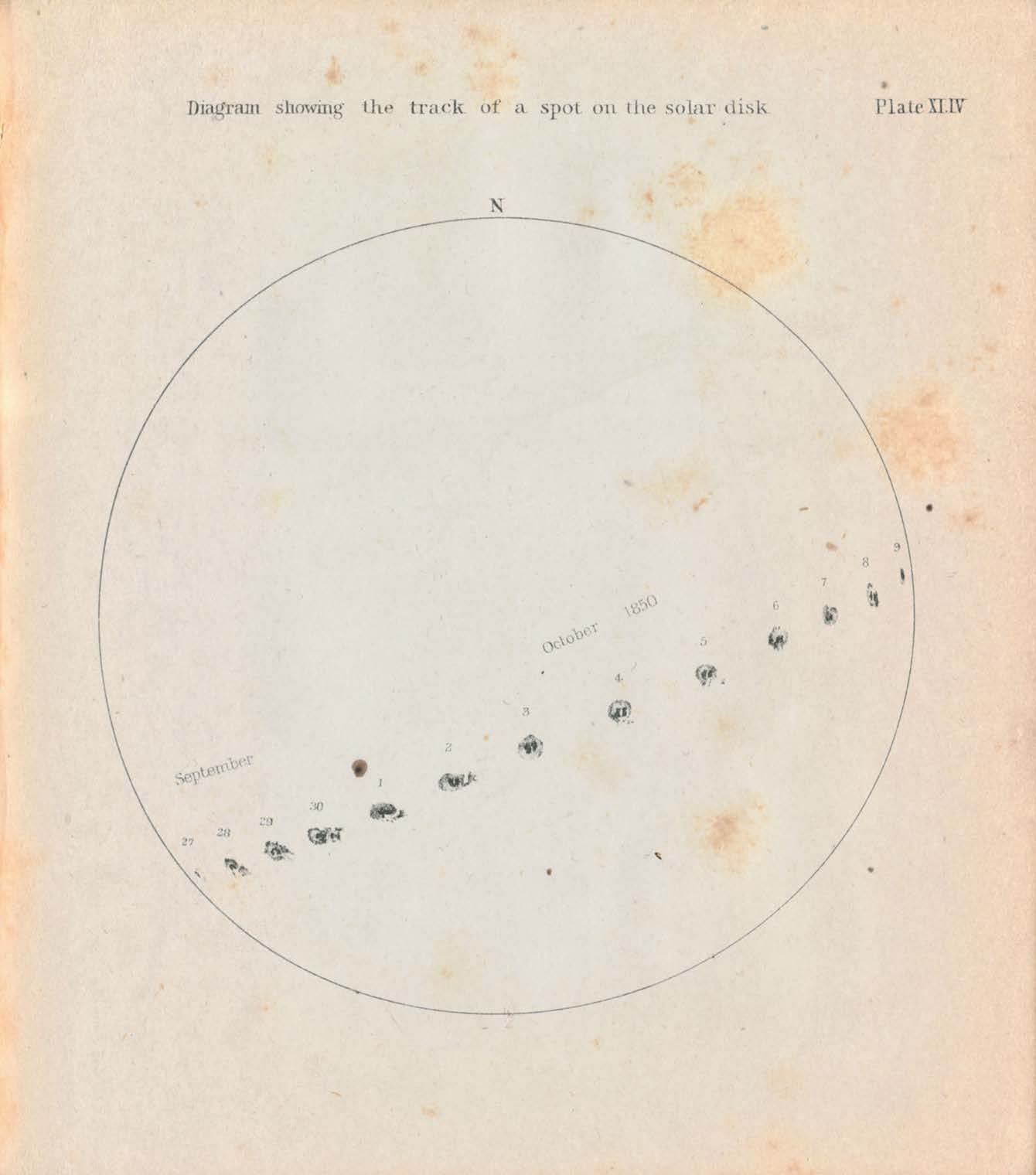
Father Benedict Sestini, S.J. & His Sun Spot Observations
Sestini, Benedict J. Sestini’s Sun Spots. Georgetown College Observatory, 1898.
~~~~~~~~~~~~~~~~~~~~~~~~~~~~~~~~~~~~~~~~~~~~~~~~~~~~~~~~~~~
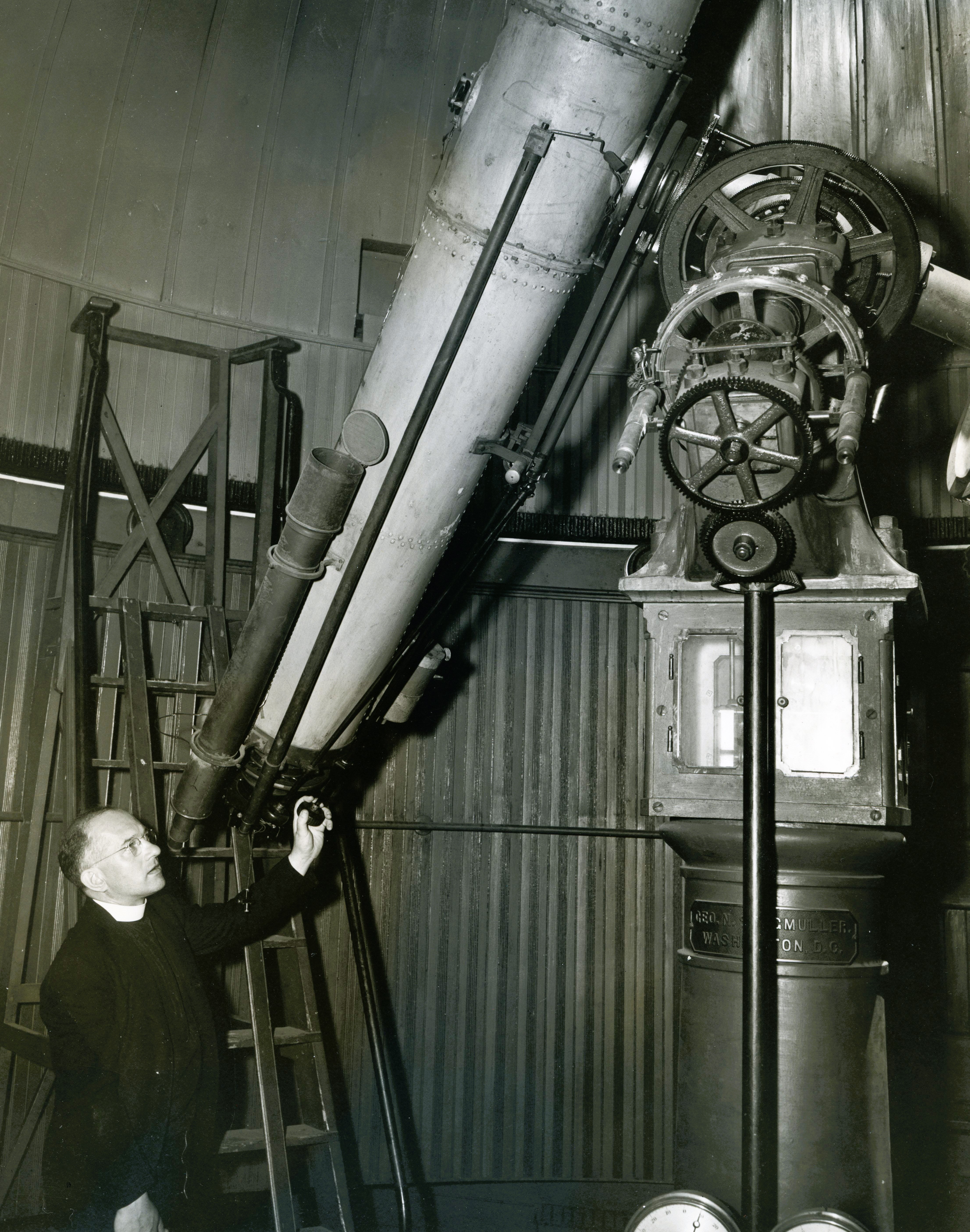
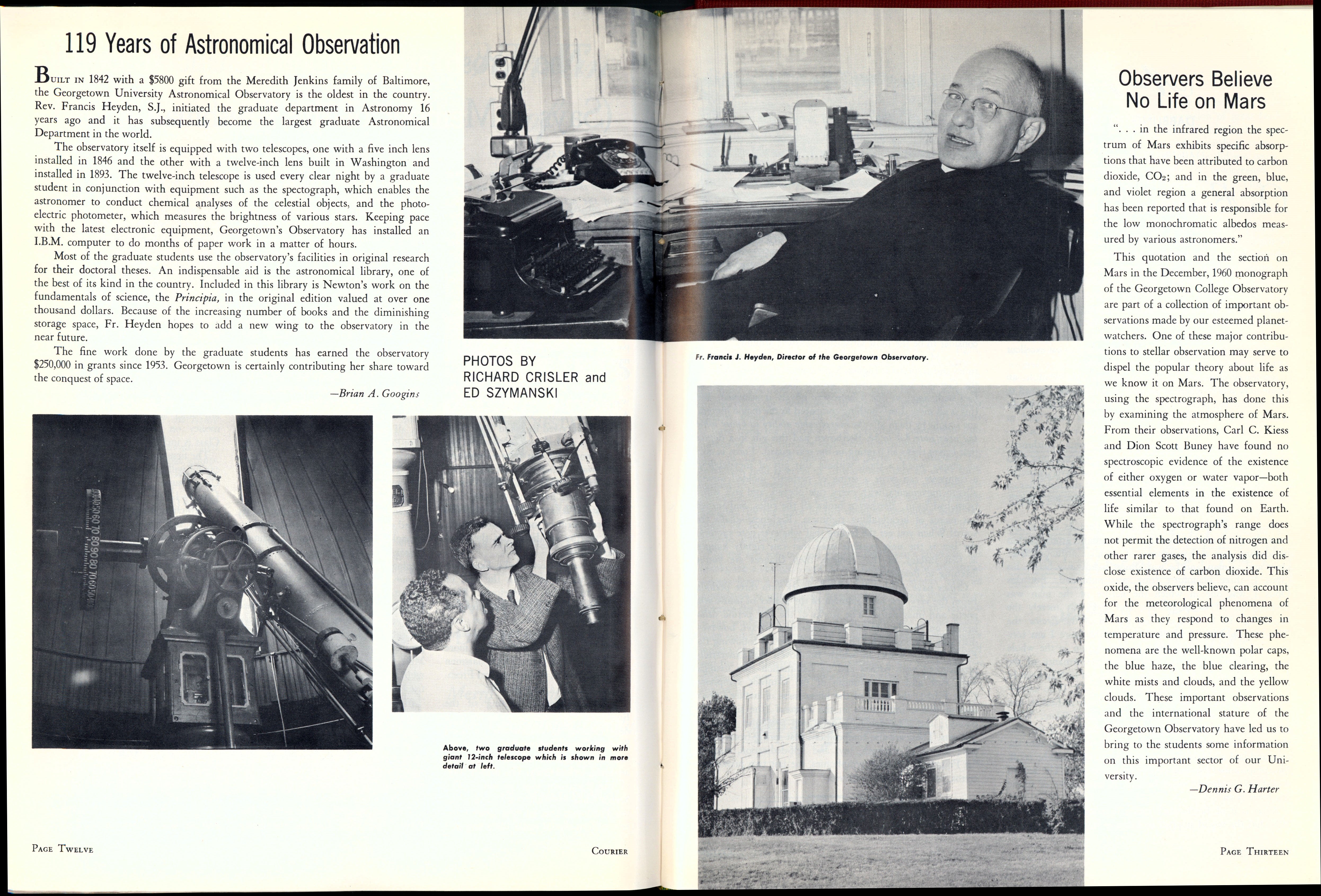
Father Francis Heyden, S.J. & The Georgetown Observatory
Father Heyden pictured in 1948 with the telescope Georgetown's Observatory
An Article from Georgetown's publication The Courier in 1961 featuring Father Heyden & the Observatory.
Googins, Brian & Dennis G. Harter. (1961). "119 Years of
Astronomical Observations." Photos by Richard Crisler & Ed Szymanski. The Courier, pp.12-13.
~~~~~~~~~~~~~~~~~~~~~~~~~~~~~~~~~~~~~~~~~~~~~~~~~~~~~~~~~~~
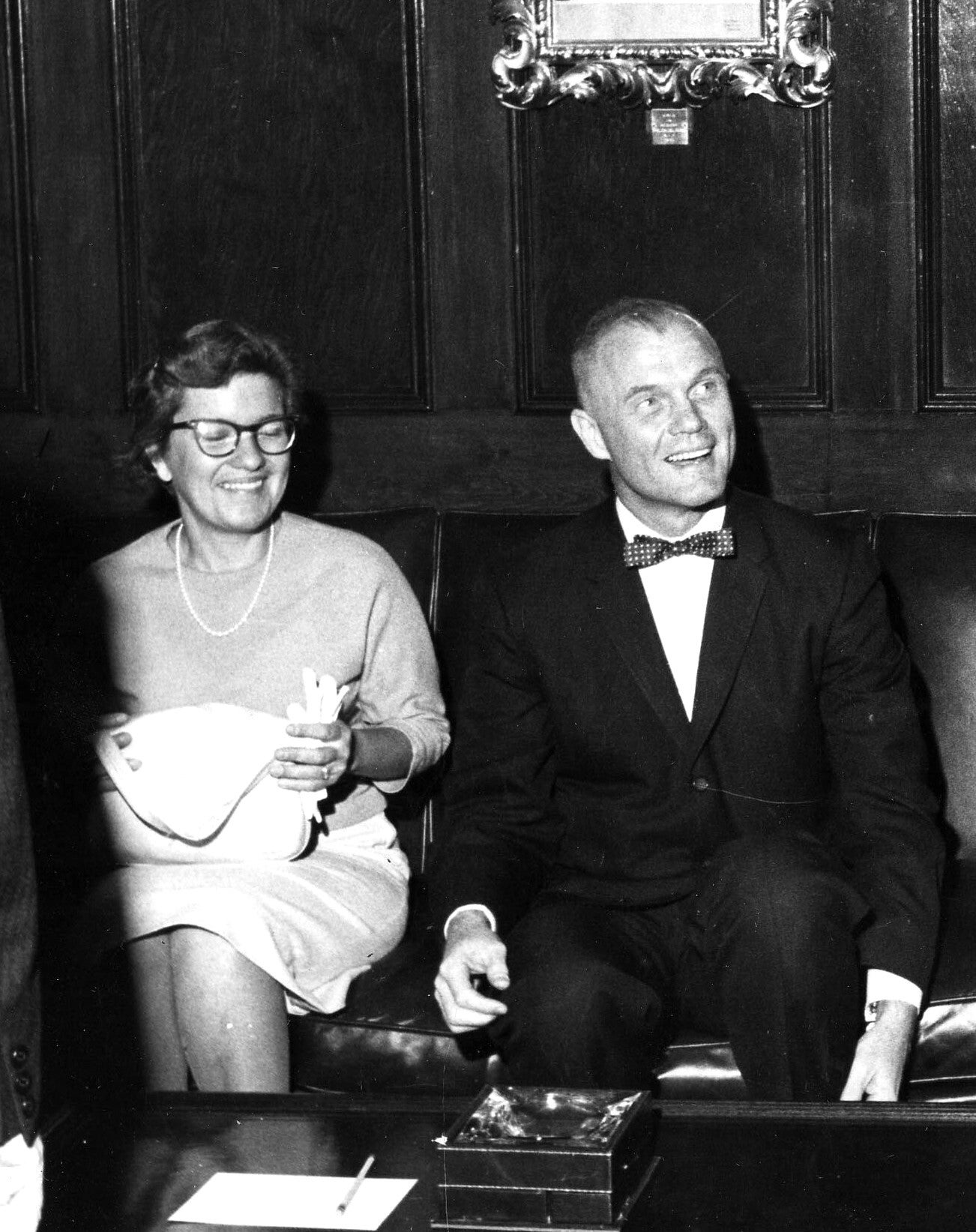
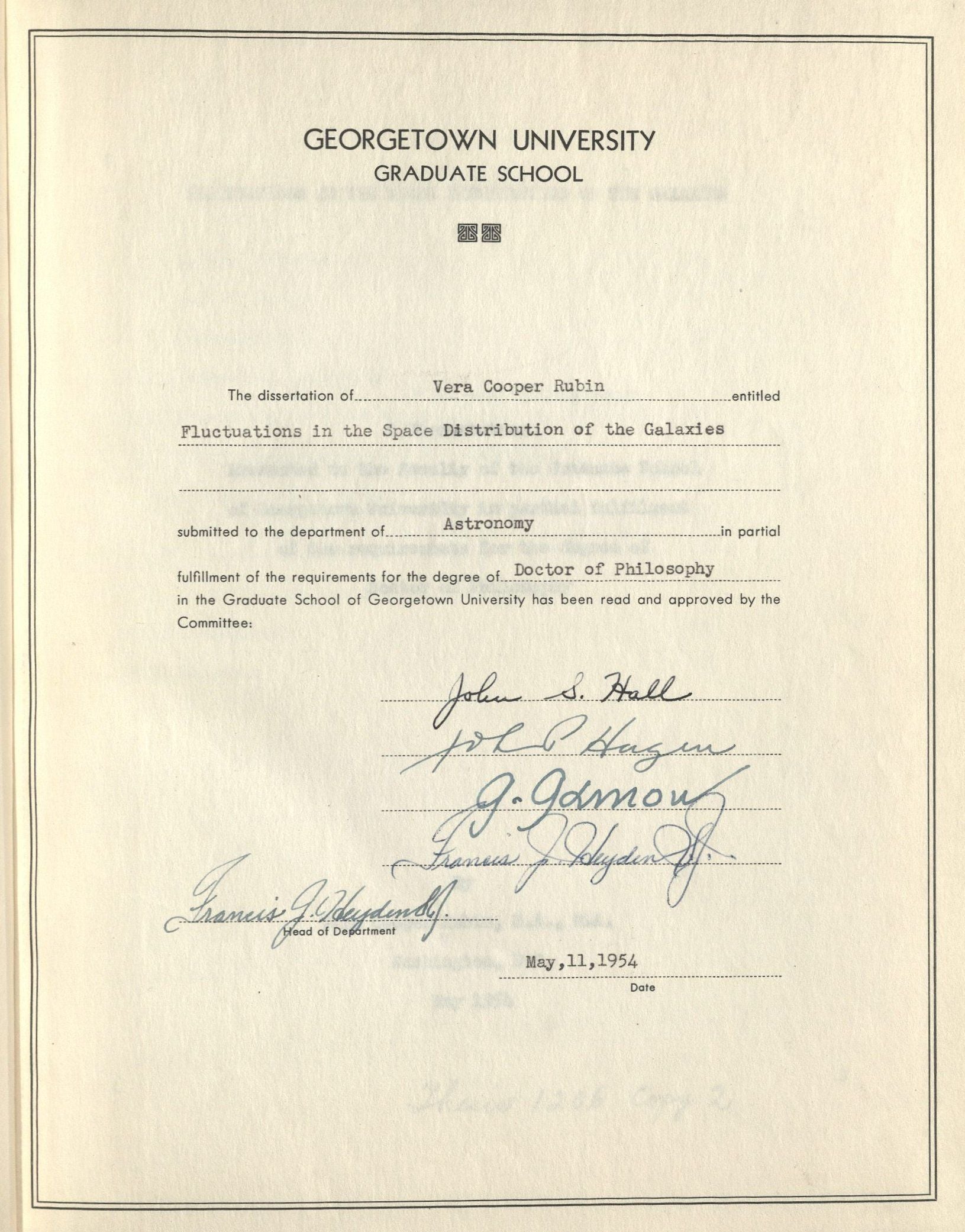
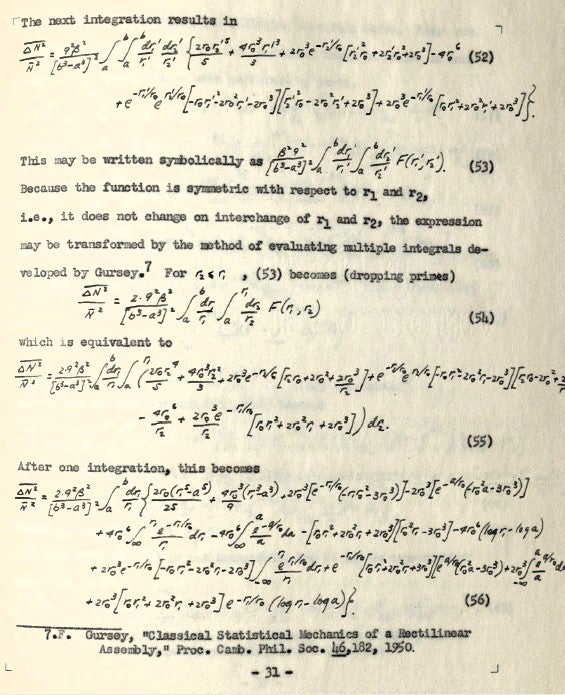
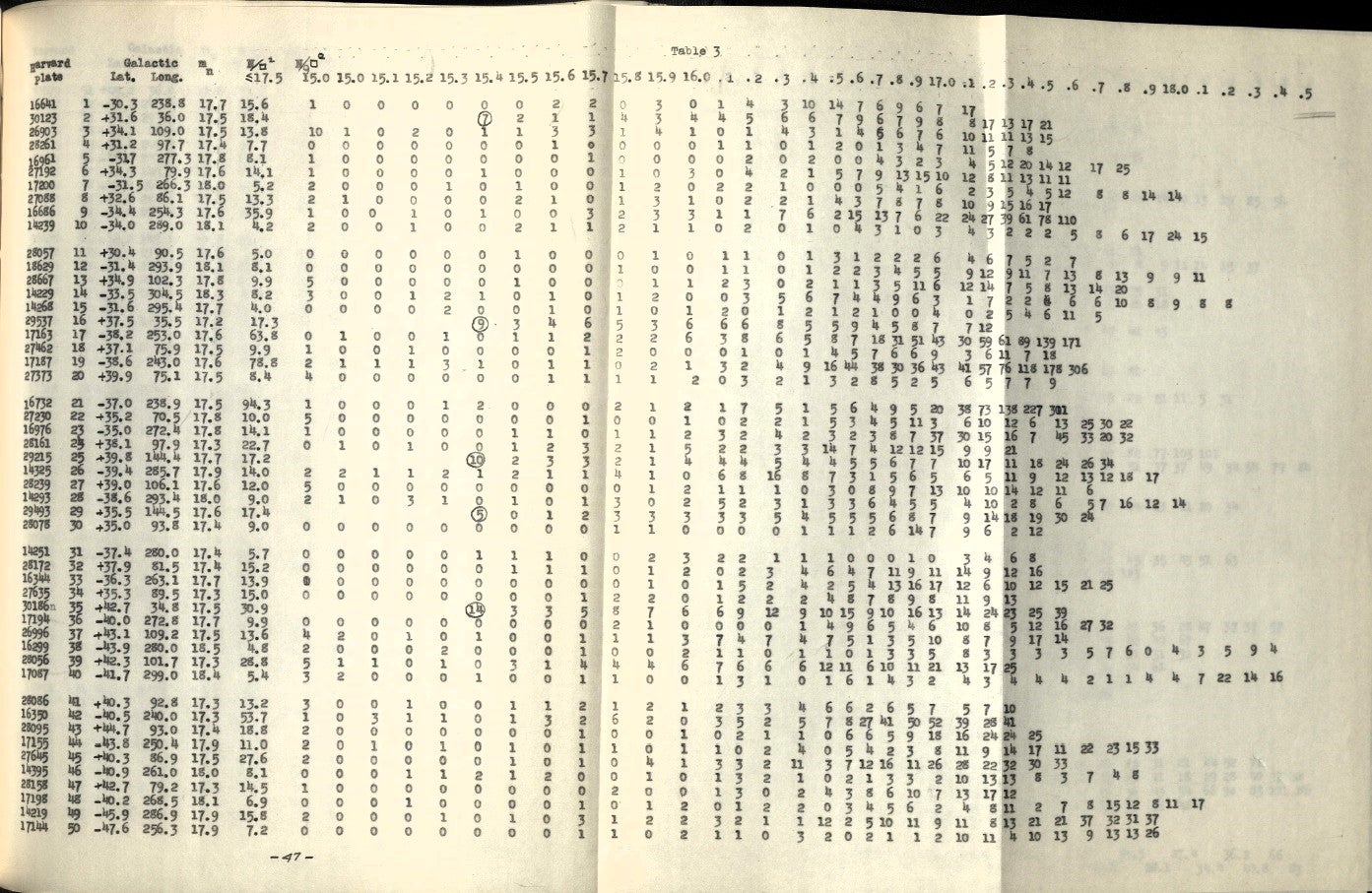
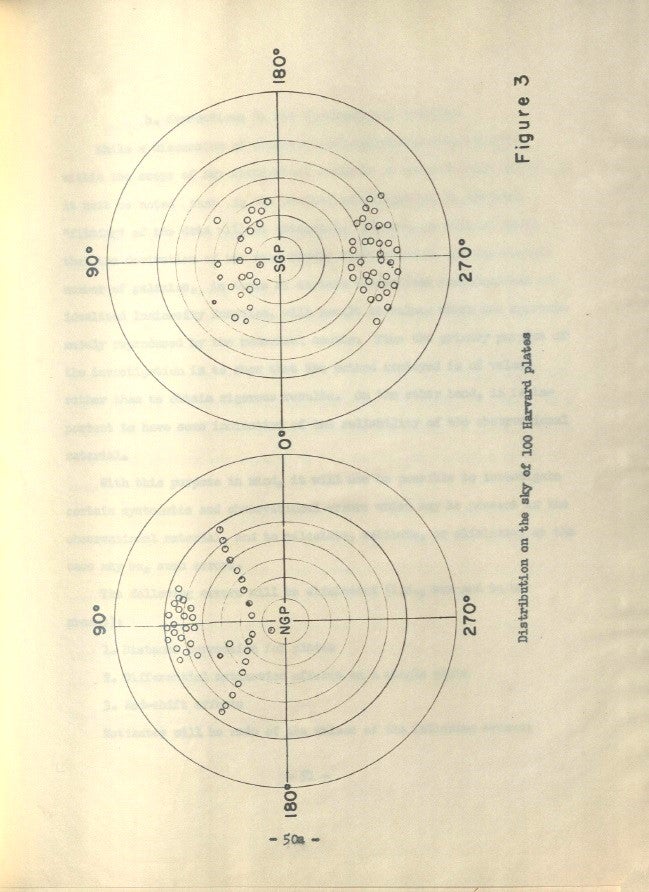
Vera Rubin ~ 1928-2016. PhD Physics Georgetown University, 1954
Photo: Vera Rubin & John Glenn at Georgetown in 1963.
Select pages from Vera Rubin's Dissertation : Rubin, Vera. (1954). “Fluctuations in the space distribution of the galaxies.” PhD Dissertation, Georgetown University.
~~~~~~~~~~~~~~~~~~~~~~~~~~~~~~~~~~~~~~~~~~~~~~~~~~~~~~~~~~~
Spotlight Case ~ The Evolution of Scientific Inquiry
Here we highlight several of the library's oldest and rarest holdings, including original editions of Thomas Aquinas’s Summa Theologica (1478), Francisco de Toledo’s Commentary on Aristotle (1575), and Isaac Newton’s Principia (1687). Beyond showcasing these rare artifacts, this auxiliary exhibit documents the historical evolution of scientific inquiry—charting the trajectory from the deductive reasoning of classical and medieval natural philosophers to the empirical and mathematical approach defined by Newton's Hypotheses non fingo "I frame no hypotheses" dictum.
Images from these texts can be viewed here in the Online Exhibit. Starting May 1st, the books themselves will be displayed in the Spotlight Case in the Booth Family Center for Special Collections on the 5th floor of Lauinger Library
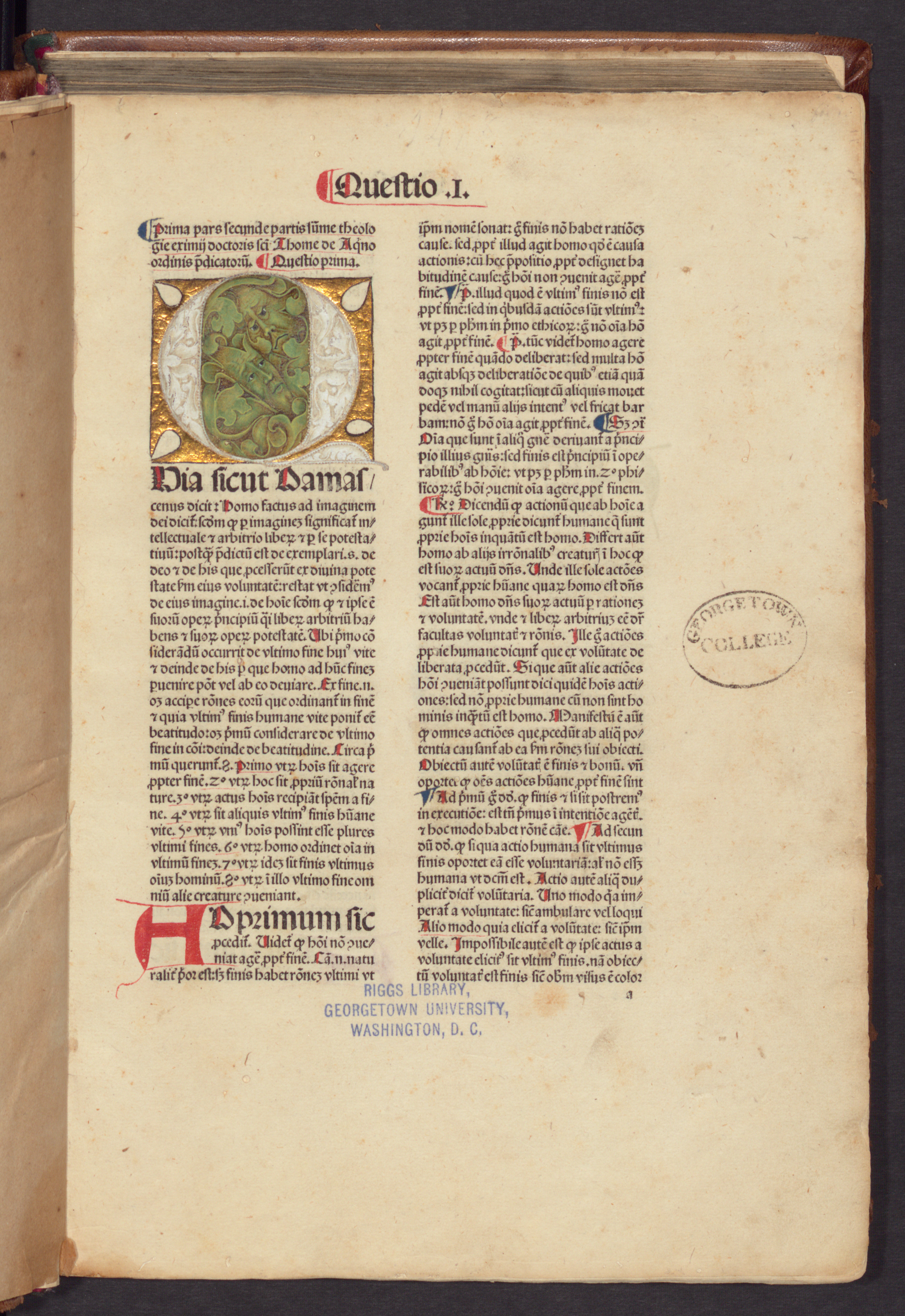
Summa Theologica
Thomas Aquinas
Venice: Per Franciscum de Hailbrun et Petrum de Bartua, 1478
Booth Family Center for Special Collections, Rare Book Collection
1478.T5 Vault
Thomas Aquinas validates his own work by explicitly adopting Aristotelian scientific methodology—defining a science as the systematic deduction of logical conclusions from established first principles.
~~~~~~~~~~~~~~~~~~~~~~~~~~~~~~~~~~~~~~~~~~~~~~~~~~~~~~~~~~~
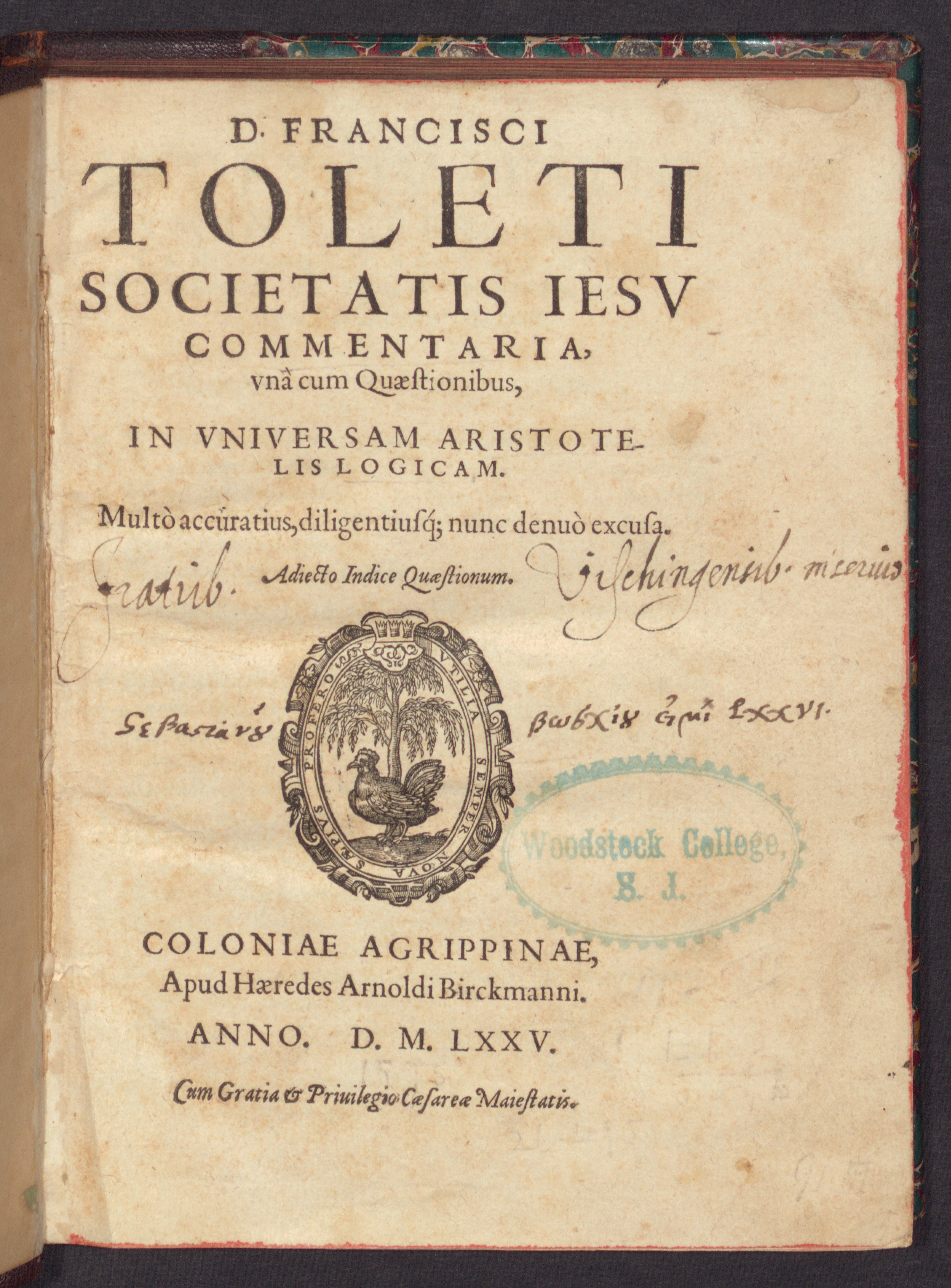
Commentaria, vnà cum quaestionibus in universam Aristotelis logicam ~ 1575
Francisco de Toledo
Cologne: Apud haeredes Arnoldi Birckmanni, 1575
Booth Family Center for Special Collections, Woodstock Rare Book Collections
185.1 T575
Francisco de Toledo builds upon Aristotle’s foundational logic by relying on the writings of Ibn Rushd (Averroes). He uses them to justify the regressus—a rigorous logical process of working backward from an observable effect to definitively prove its hidden cause.
~~~~~~~~~~~~~~~~~~~~~~~~~~~~~~~~~~~~~~~~~~~~~~~~~~~~~~~~~~~
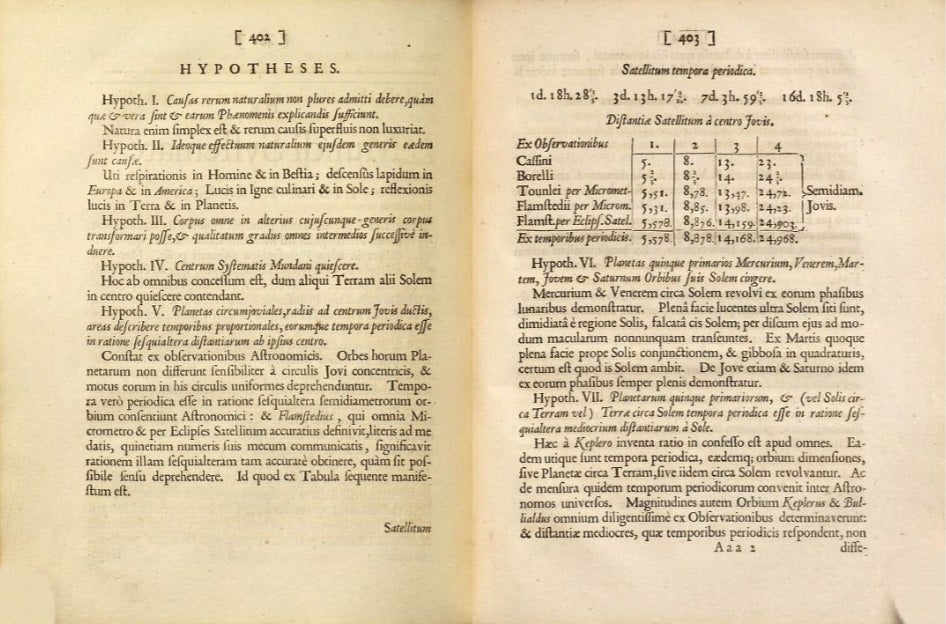
Philosophia naturalis principia mathematica
Isaac Newton
London: Jussu Societatis Regiae ac typis Iosephi Streater, 1687
Booth Family Center for Special Collections, Rare Book Collection
QA803.A2 1687
Isaac Newton fundamentally altered the course of scientific inquiry with his principle of Hypotheses non fingo, "I feign no hypotheses," refusing to speculate on causes that could not be observed and measured. He insisted that the laws of nature be derived from empirical data. His “Rules of Reasoning” —including scientific induction—are outlined directly on this open page.
~~~~~~~~~~~~~~~~~~~~~~~~~~~~~~~~~~~~~~~~~~~~~~~~~~~~~~~~~~~
Exhibition Bibliography & Further Reading
- Heidegger, Martin. "Modern Science, Metaphysics, and Mathematics." In Basic Writings, edited by David Farrell Krell, 267–305. New York: HarperCollins, 1993.
- Russell, Bertrand. The Problems of Philosophy. New York: Oxford University Press, 1962.
- Cohen, I. Bernard, and Richard S. Westfall, eds. Newton: Texts, Backgrounds, Commentaries. New York: W. W. Norton & Company, 1995.
- Huggett, Nick, ed. Space from Zeno to Einstein: Classic Readings with a Contemporary Commentary. Cambridge, MA: MIT Press, 1999.
- Lange, Marc. Natural Laws in Scientific Practice. Oxford: Oxford University Press, 2000.
- Popper, Karl R. Realism and the Aim of Science. Edited by W. W. Bartley III. Totowa, NJ: Rowman and Littlefield, 1983. (See especially Chapter 1, "Induction").
- Wilson, Mark. "What Can Theory Tell Us about Observation?" In Images of Science: Essays on Realism and Empiricism, edited by Paul M. Churchland and Clifford A. Hooker, 222–44. Chicago: University of Chicago Press, 1985.
- van Fraassen, Bas C. "Empiricism in the Philosophy of Science." In Images of Science: Essays on Realism and Empiricism, edited by Paul M. Churchland and Clifford A. Hooker, 245–308. Chicago: University of Chicago Press, 1985.
- Spencer, Herbert. First Principles. New York: P. F. Collier and Son, 1902.
- Einstein, Albert. "On the Method of Theoretical Physics." Philosophy of Science 1, no. 2 (April 1934): 163–69.
- Einstein, Albert. Relativity. Translated by Robert W. Lawson. New York: Barnes & Noble, 2004.
- Feynman, Richard. The Character of Physical Law. London: British Broadcasting Corporation, 1965.
The Library is grateful to Amjad Alqahtani, Sharon Clayton, Lynn Conway, Steve Fernie, Rachel Jacobson, Ted Mallison, Beth Marhanka, Christen Runge, Jay Sylvestre, and LuLen Walker for their invaluable work in researching, curating, and producing this exhibition.