When Robert Francis Prevost chose Leo XIV for his papal name, he was making a statement about the future direction of his pontificate by invoking the legacy of Pope Leo XIII. To better understand our current pope and how he envisions the specific challenges and opportunities facing the Church, it is worth looking back at the papacy of Pope Leo XIII.
Pope Leo XIII’s pontificate confronted a world in turmoil. At the start of his pontificate in 1878, the Industrial Revolution in the Western world had led to a growing chasm of inequality between rich and poor, with rampant child labor, poor pay, long hours, horrific working conditions, and little safety net for the most vulnerable. These conditions fueled growing skepticism toward capitalism, aristocracy, traditional government, and the Church itself, with new ideologies such as Socialism and Anarchism sharply critiquing existing power structures. Against this backdrop, Leo issued a series of encyclicals–open letters to the Church–that became known as the Church’s Social Teachings. In the most influential of these encyclicals, Rerum Novarum(1891), Leo addressed “the relative rights and the mutual duties of the wealthy and the poor,” affirming the right to private property for both owners and workers, the right to fair wages, the formation of labor organizations, and the need to ameliorate the working conditions of women and children. It was Rerum Novarum that Leo XIV cited as key in choosing the name of his predecessor.
In addition to his encyclicals, Leo XIII was enormously influential in reviving the thought of St. Thomas Aquinas. Having been trained in Thomistic philosophy alongside his Jesuit brother, a Thomist scholar, Leo saw “The Angelic Doctor” as a thinker capable of helping the church navigate the complex relationship between faith and reason especially in light of modern challenges to belief such as scientific discovery, historical criticism, and modern philosophical trends. Leo’s endorsement led to the launch of what is now known as the Leonine Edition of the complete works of Thomas Aquinas. Though reclaiming the thought of a thirteenth-century theologian may appear to be a retreat from modernity, it could also be seen as a renewed engagement–one that accepts Reason in its place, while affording the Faith of the Church a privileged purview in matters of the soul.
Leo XIII’s engagement with modernity extended beyond his social encyclicals. By the late nineteenth century, the Church–with its history of scientific suppression (e.g. of Galileo)--was perceived as being in direct conflict with science, whose findings in the areas of human origins challenged traditional biblical worldviews. Leo sought to move beyond the simple binary of faith versus science and established the Vatican Astronomical Observatory in 1891, stating that “the Church and her Pastors are not opposed to true and solid science, whether human or divine, but that they embrace it, encourage it, and promote it with the fullest possible dedication.” Leo’s cautious embrace of scientific inquiry was mirrored by his support of modern historical approaches to Scripture. In issuing the encyclical Providentissimus Deus in 1891, and instituting the Pontifical Biblical Commission in 1902, Leo emphasized both the inspired and inerrant character of the Bible and the mediating role of Church tradition, while encouraging the use of new scholarly methods.
Leo sought to chart a course for the Church that was neither a wholesale rejection nor acceptance of modernity, but rather a path of careful discernment rooted in tradition and open to new possibilities.
Curated by Adrian Vaagenes

Admission tickets to St. Peter's Church, Rome, on the occasion of the 25th anniversary of Pope Leo XIII, 1903
Byington Family Papers
Georgetown University Manuscripts Collections
GTM-GAMMS209
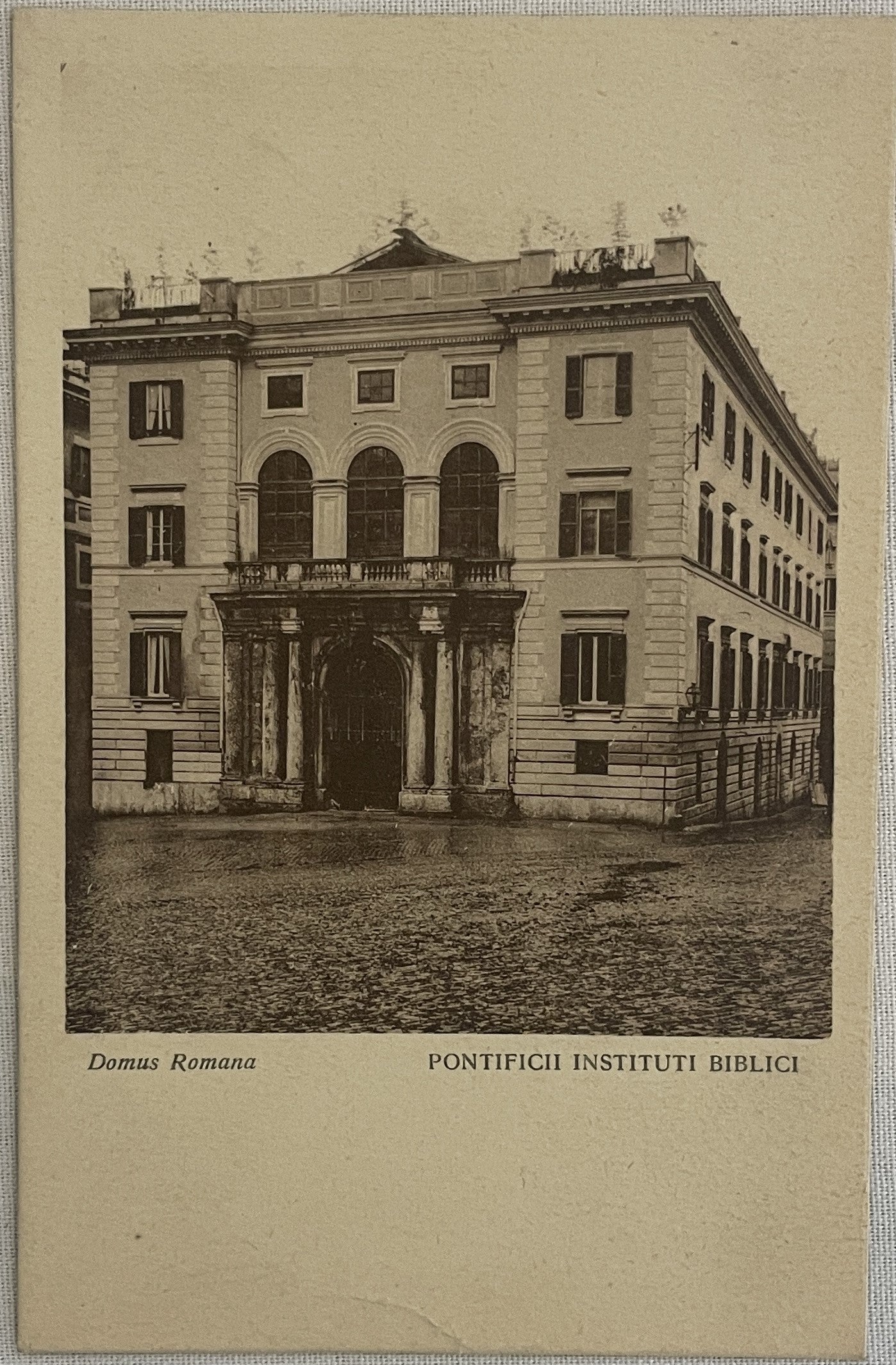
Pontifical Biblical Institute, 19th century
Woodstock College Archives Photograph Collection
WTL-0010
In instituting the Pontifical Biblical Institute, Pope Leo XIII sought to embrace new historical methods of scriptural scholarship though within the bounds set by the Church.
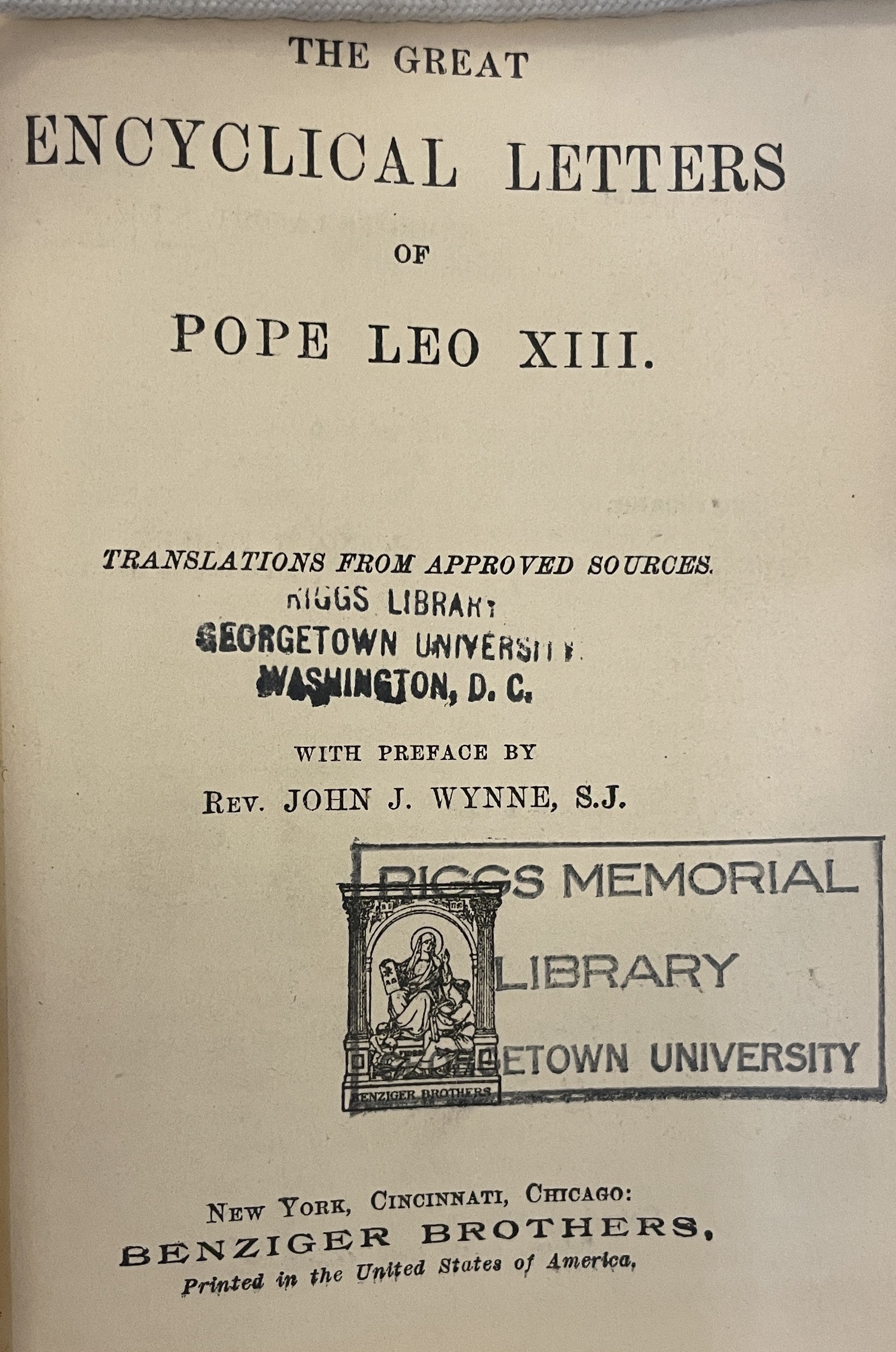
Rerum Novarum, The Conditions of Labor: The Encyclical of His Holiness Pope Leo XIII 1891; Satis Cognitum, The Unity of the Church: The Encyclical of His Holiness Pope Leo XIII 1896
Rare Books Collection HD6338 .C26 1891b;
Rare Books Collection
Adelman Ephemera Collection
Unlike any Pope before him, Pope Leo utilized the power of the encyclical to reach a mass audience, authoring more than 80 during his pontificate, with two shown here. Rerum Novarum is deservedly his most famous, addressing the social situation in the wake of the industrial revolution. Satis Cognitum defines the unity of the Church, and the authority of the Pope.
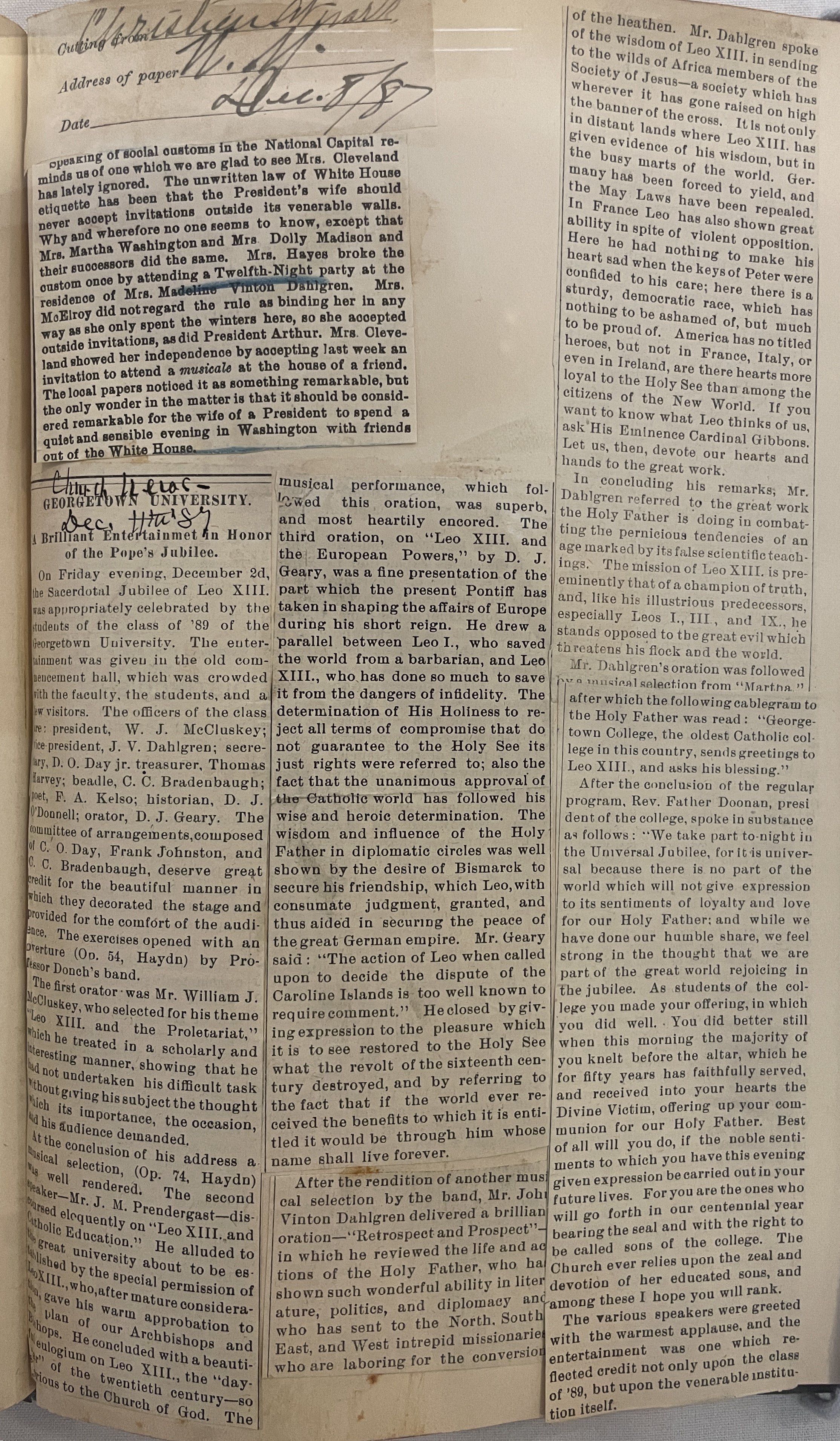
Georgetown University Celebration of Pope Leo XIII’s Sacerdotal Jubilee, Georgetown College Journal December 1887
Madeline Vinton Dahlgren Papers
Georgetown University Archives
GTM-GAMMS122