Tuesday, September 11, 2001, began as a typical early fall day on campus. It was the 14th day of the semester and the 73rd day of President John J. DeGioia’s tenure. There were crystal blue skies with temperatures around 70°F at 8:45 a.m.
The North Tower of the World Trade Center was hit by American Airlines Flight 11 at 8:46 a.m. The South Tower was struck 17 minutes later by United Airlines Flight 175. And at 9:37 a.m., American Airlines Flight 77 crashed into the Pentagon. The Georgetown University community, like the rest of the nation, was profoundly stunned by these terrorist attacks.
Within an hour of the attack on the Pentagon, a team of Georgetown administrators, faculty, and staff convened to coordinate the University’s emergency response. Ryan DuBose (C’2002) and Brian Walsh (C’2002), President and Vice President of the Georgetown University Student Association (GUSA), were quickly integrated into these planning discussions. Beyond ensuring the safety and security of all campuses, the team focused throughout the following week on addressing the immediate emotional, psychological, and spiritual needs of students, faculty, and staff. Central to this effort was fostering connection and creating opportunities for the community to come together for support, shared dialogue, and prayer.
Drawing on emails, official University statements, photographs, and other documentation from the Georgetown University Archives, this online exhibition chronicles the immediate reaction on campus to the tragic events of September 11—from the initial emergency response and the cancellation of classes to the series of vigils, prayer services, and dialogues that followed. Collectively, these documents illustrate a community coming together, seeking to mourn, to understand, and to support one another during a period of profound uncertainty.
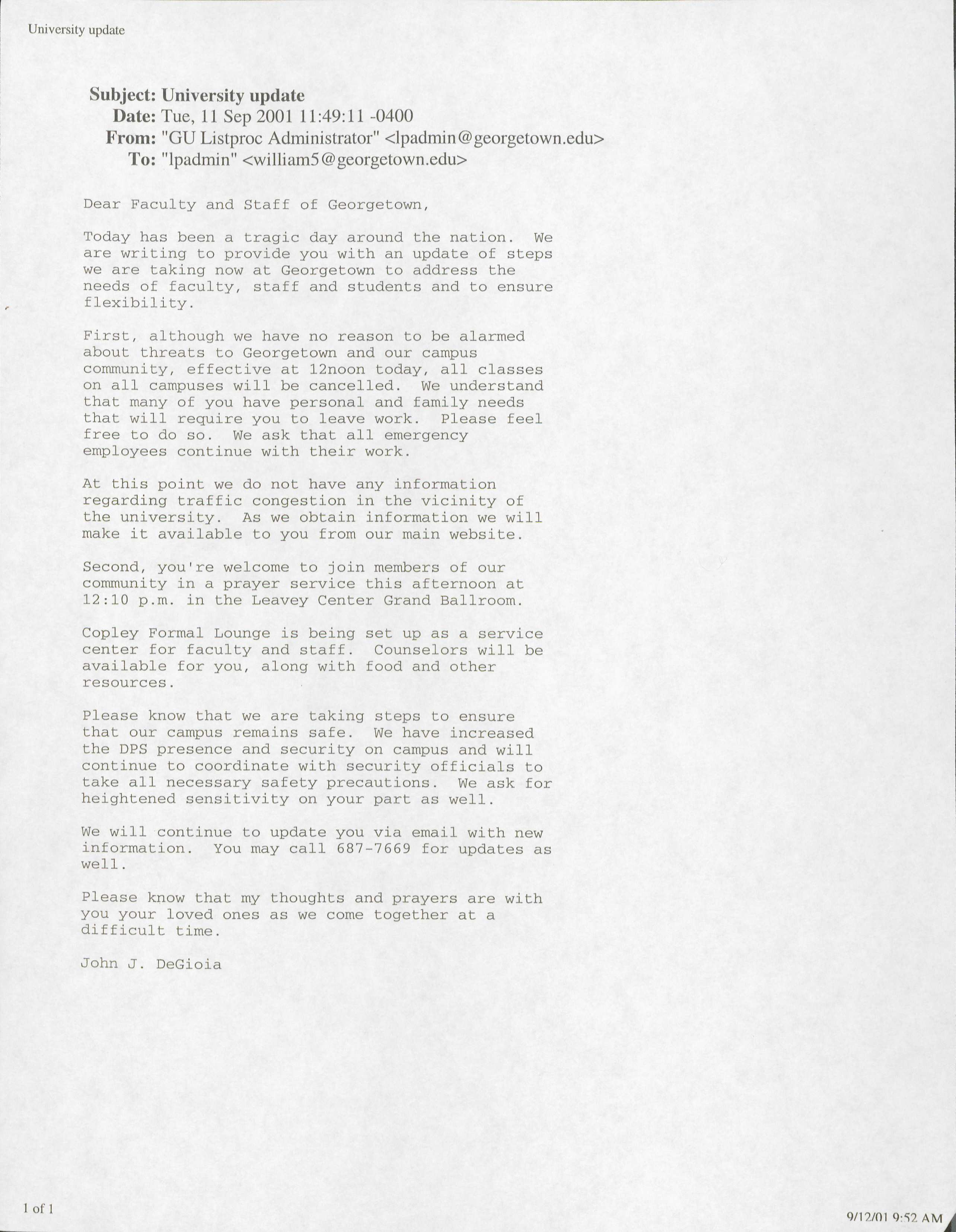
“University Update.” Email from President John J. DeGioia to Faculty and Staff of Georgetown, 11:49 a.m., September 11, 2001
The first communication to faculty and staff after the attacks conveyed that classes would be cancelled at noon; non-essential staff were encouraged to leave later that afternoon, although emergency personnel were asked to stay. Many of those leaving campus chose to walk in order to avoid public transportation.
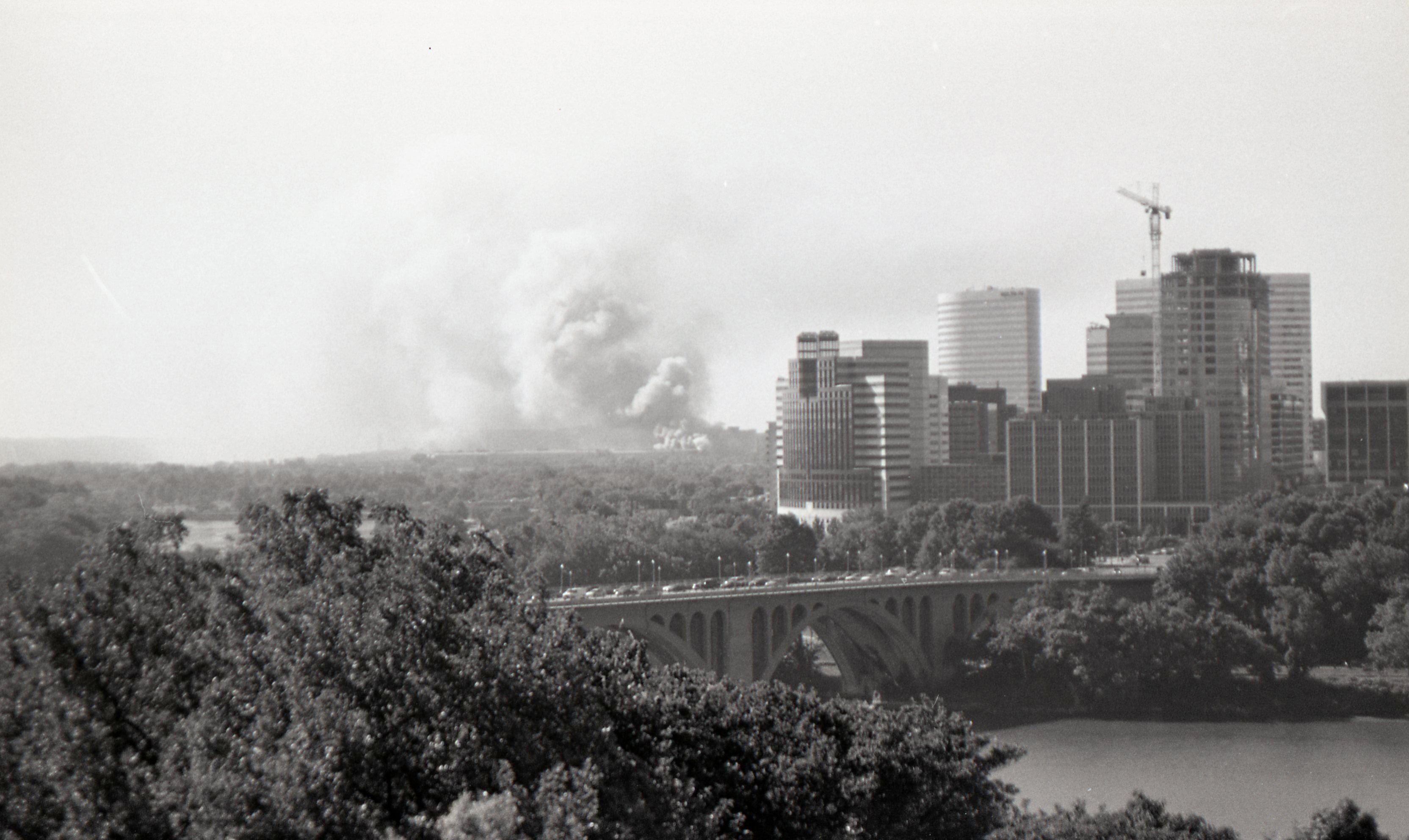
View toward the Pentagon from the Murray Room on the 5th floor of Lauinger Library, September 11, 2001. Photograph by David Hagen
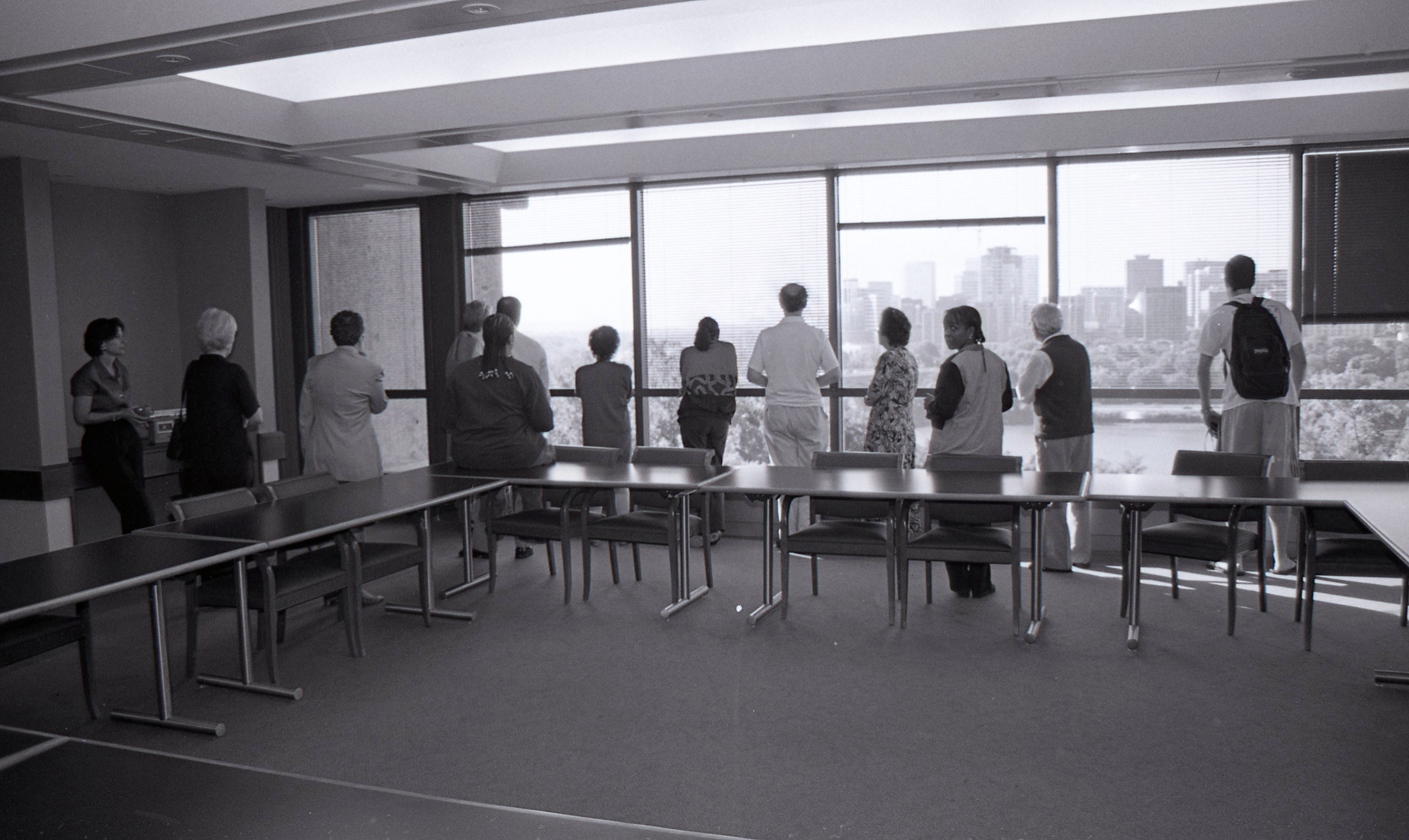
Library staff watch smoke from the Pentagon in the Murray Room on the 5th floor of Lauinger Library, September 11, 2001. Photograph by David Hagen
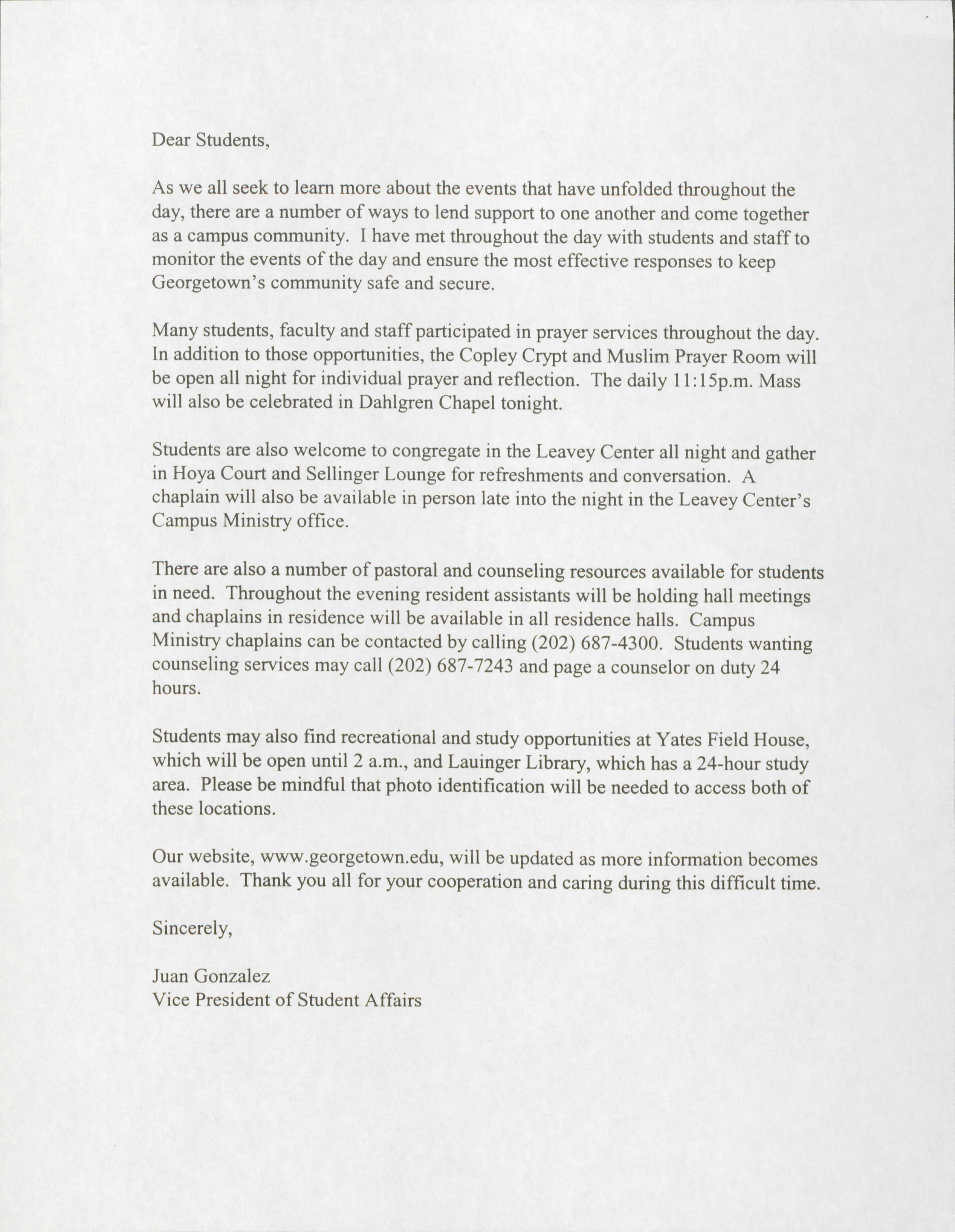
Communication to students from Vice President of Student Affairs Juan Gonzalez, September 11, 2001
Vice President Juan Gonzalez was speaking at a staff meeting when he was informed of the attacks; Associate Director of Georgetown's Department of Public Safety Darryl Harrison took him aside to relay the news.
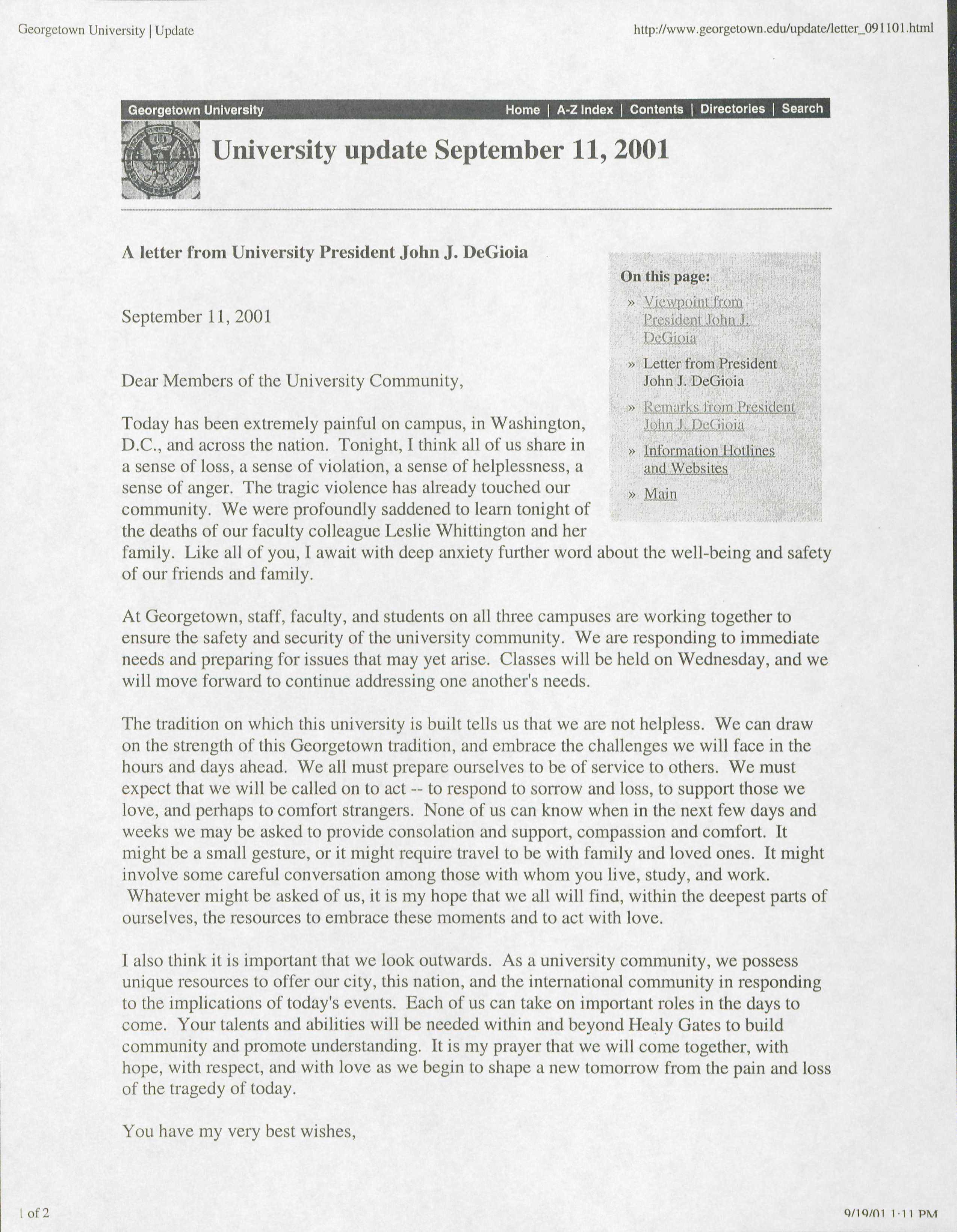
Letter from University President John J. DeGioia, September 11, 2001
This letter reports the death of Professor Leslie A. Whittington. An Associate Professor of Public Policy and an Associate Dean at Georgetown University's Public Policy Institute (now the McCourt School of Public Policy), she was leaving for a sabbatical in Australia and was on Flight 77, along with her husband and daughters.
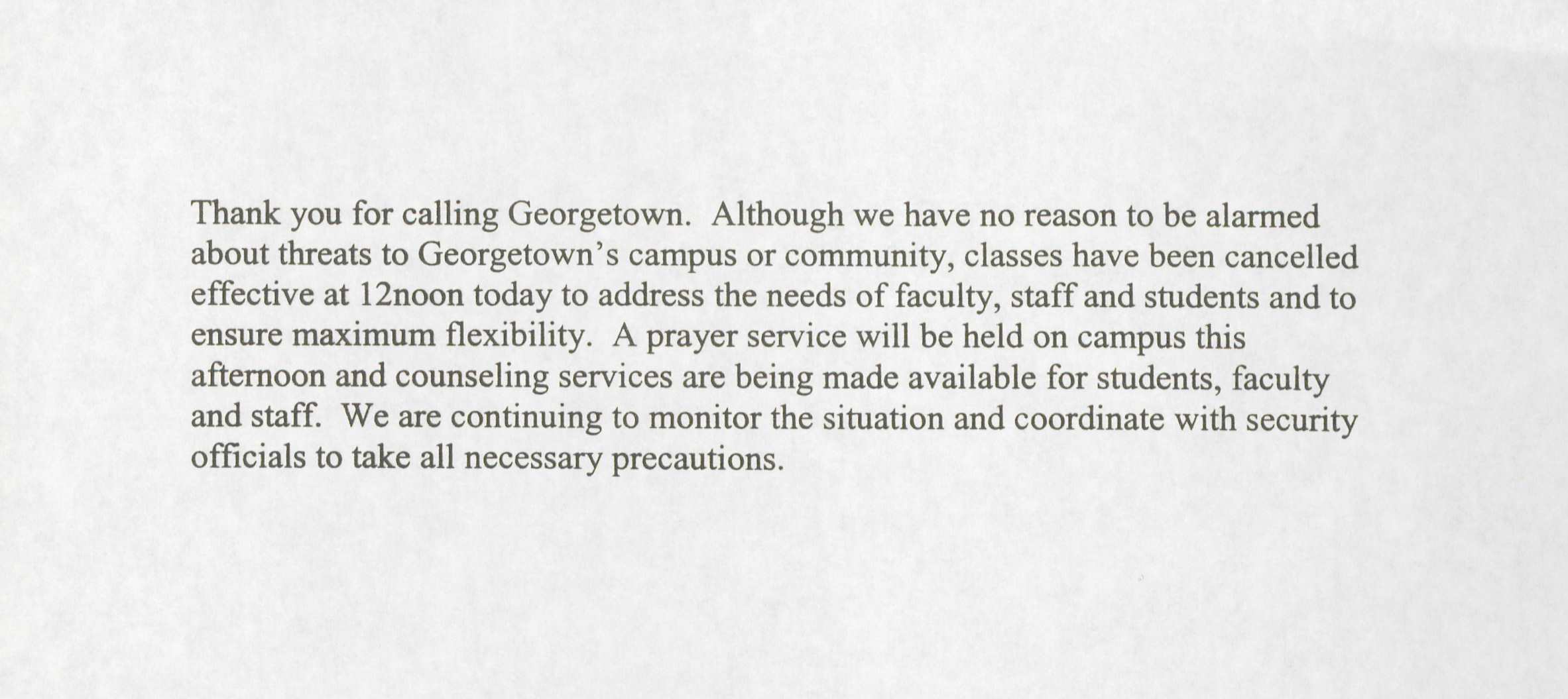
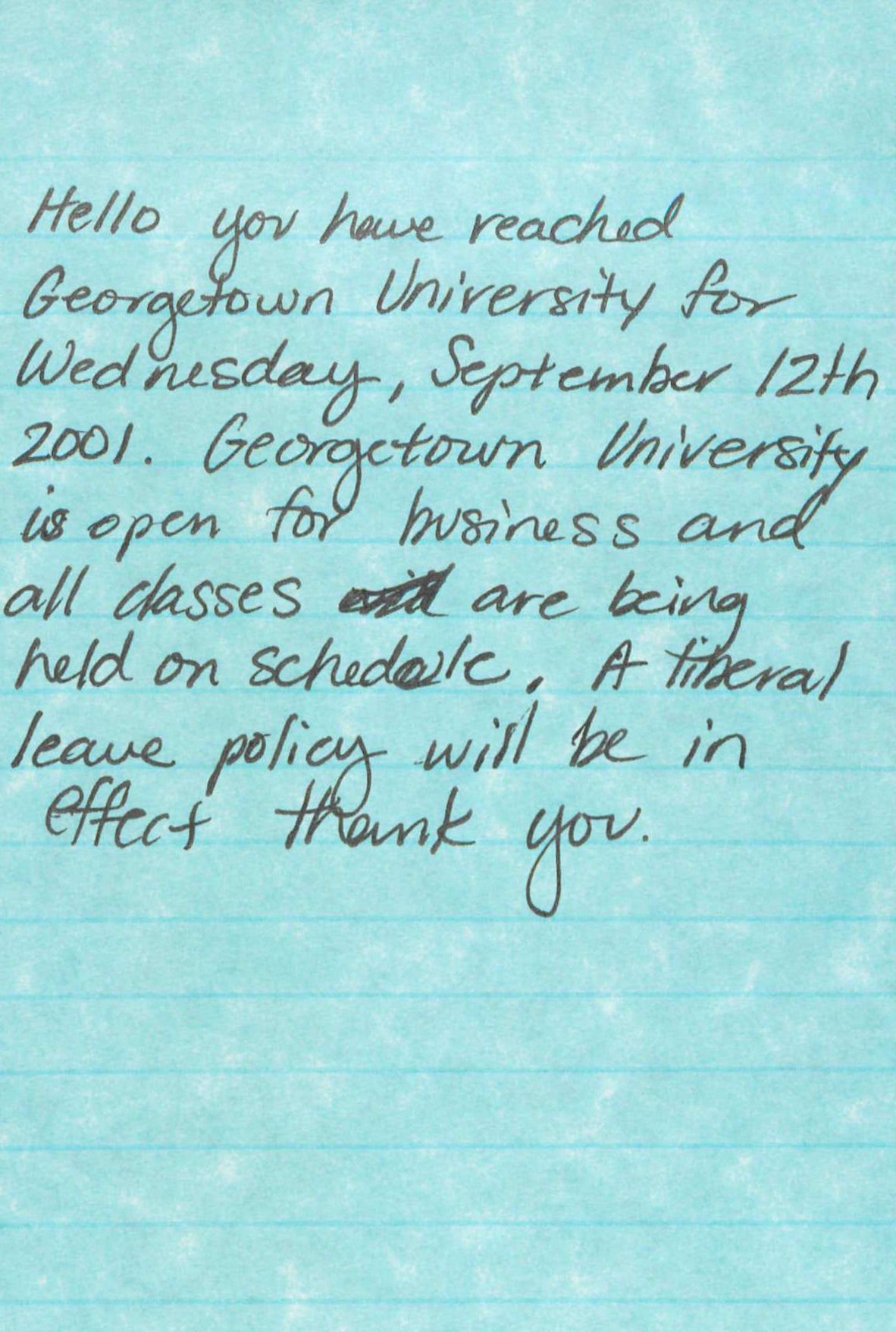
Text of the recorded message on the University’s telephone information line, September 11 and September 12, 2001
On September 12, classes were resumed as University administrators wanted to offer students structure and their normal routine. Students were, however, assured in an email from Provost Dorothy Brown that faculty and academic deans would be supportive of any who wished to go home to be with their families or who needed to miss classes to attend to personal needs and responsibilities.
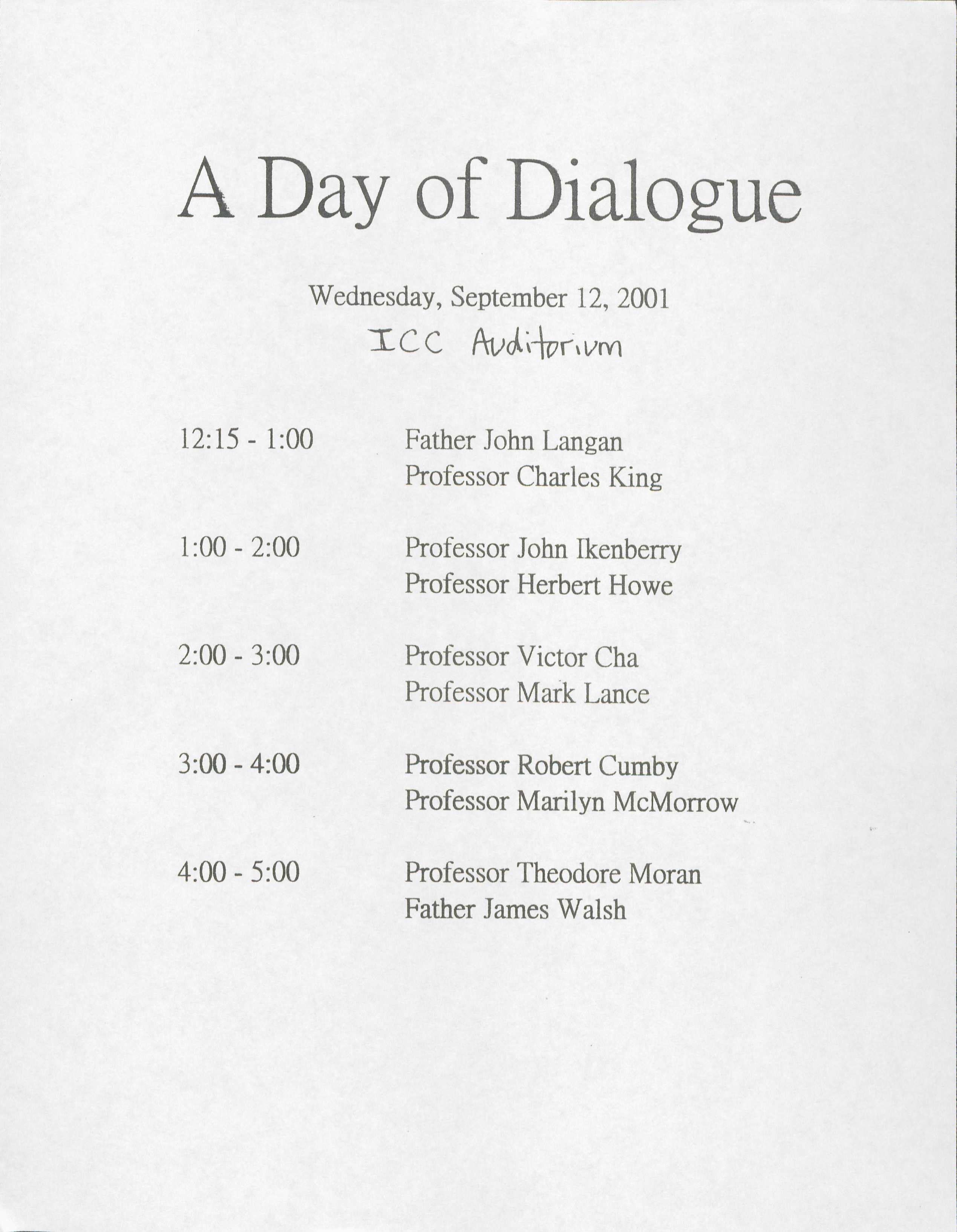
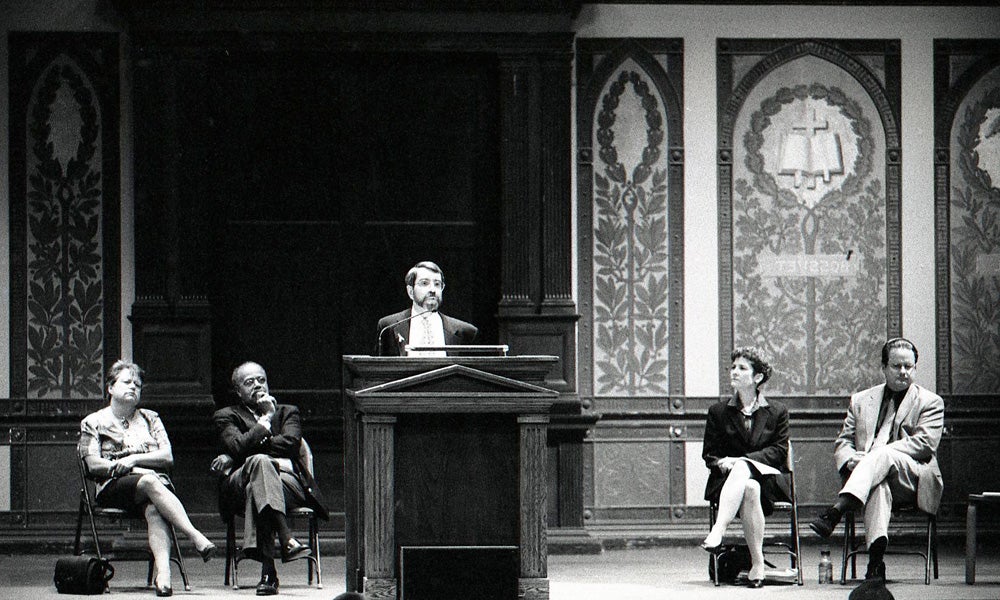
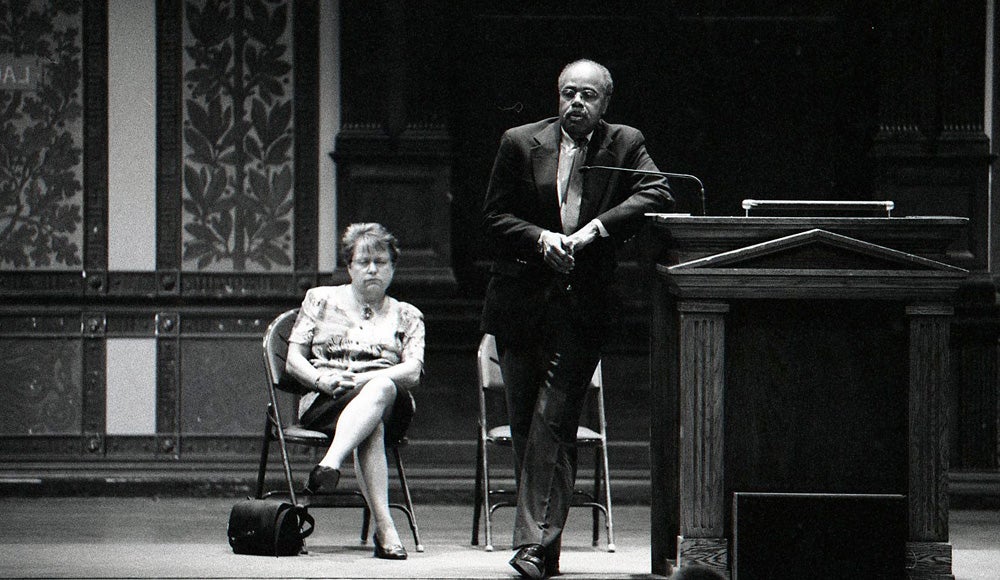
Day of Dialogue schedule and photographs, September 12, 2001
Students and faculty were invited to discussions held in the ICC auditorium on September 12 about the events of the previous day. Faculty from the College of Arts and Sciences and the School of Foreign Service offered responses and initiated dialogue. The event extended into the evening with a 7:30-9:30 p.m. event in Gaston Hall led by faculty members including former U.N. Ambassador Donald McHenry, Professors Michael Brown and Audrey Cronin from the Center for Peace and Security Studies, and Carol Lancaster, Director of the Master of Science in Foreign Service program.
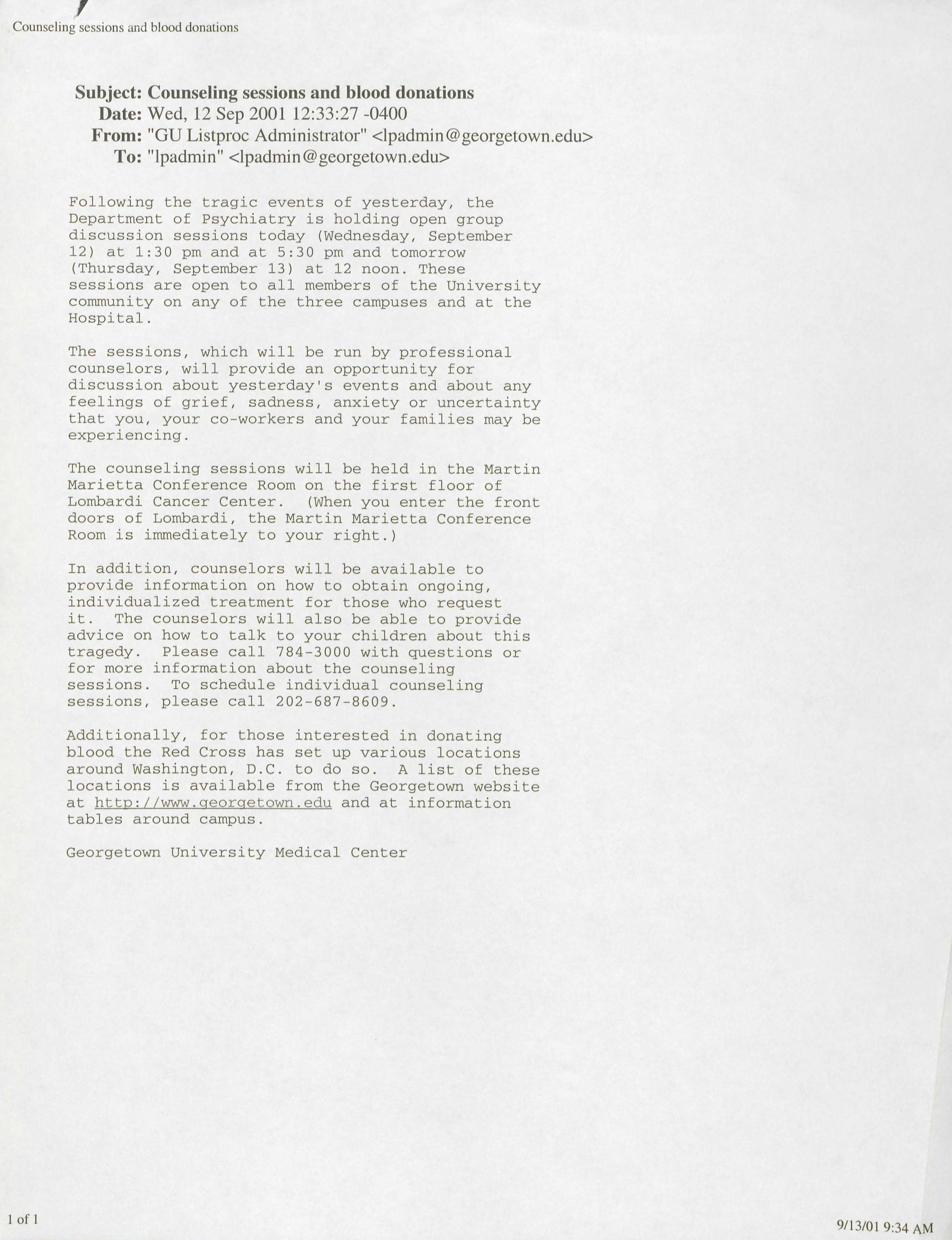
“Counseling sessions and blood donations.” Email from the Georgetown University Medical Center to faculty and staff, September 12, 2001
Large numbers of students, staff, and faculty offered to donate blood at the Georgetown University Hospital on September 11 but the Hospital was unable to accept donations because of a shortage of staff. Donors were directed downtown or asked to return later in the week.
In the days following the attacks, student volunteers coordinated with the National Headquarters of the Red Cross to organize blood donation drives across campus. When on-campus donation sites reached capacity, vans were mobilized to transport students to other donation sites.
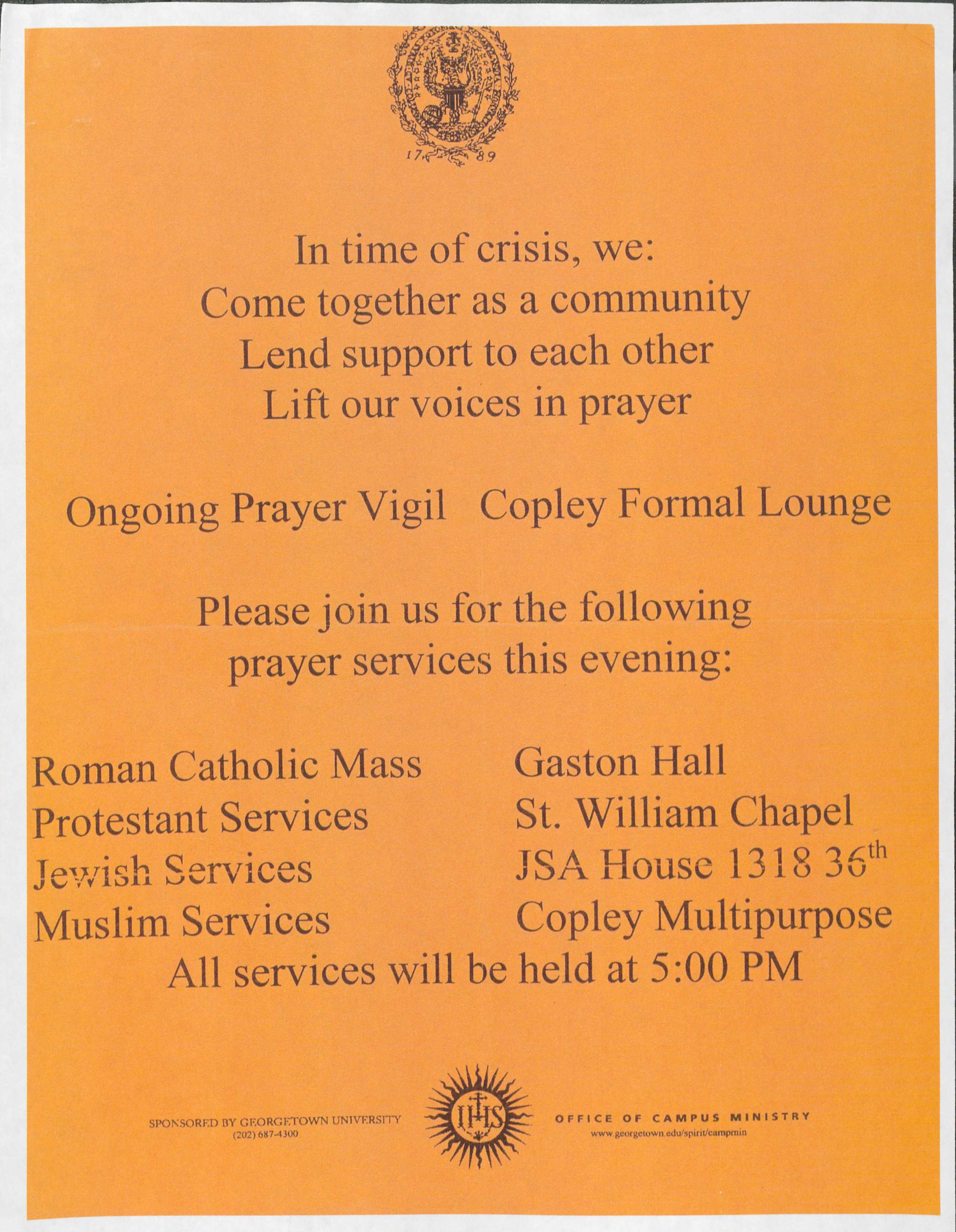
Flyer for evening prayer services, undated but likely from September 12, 2001
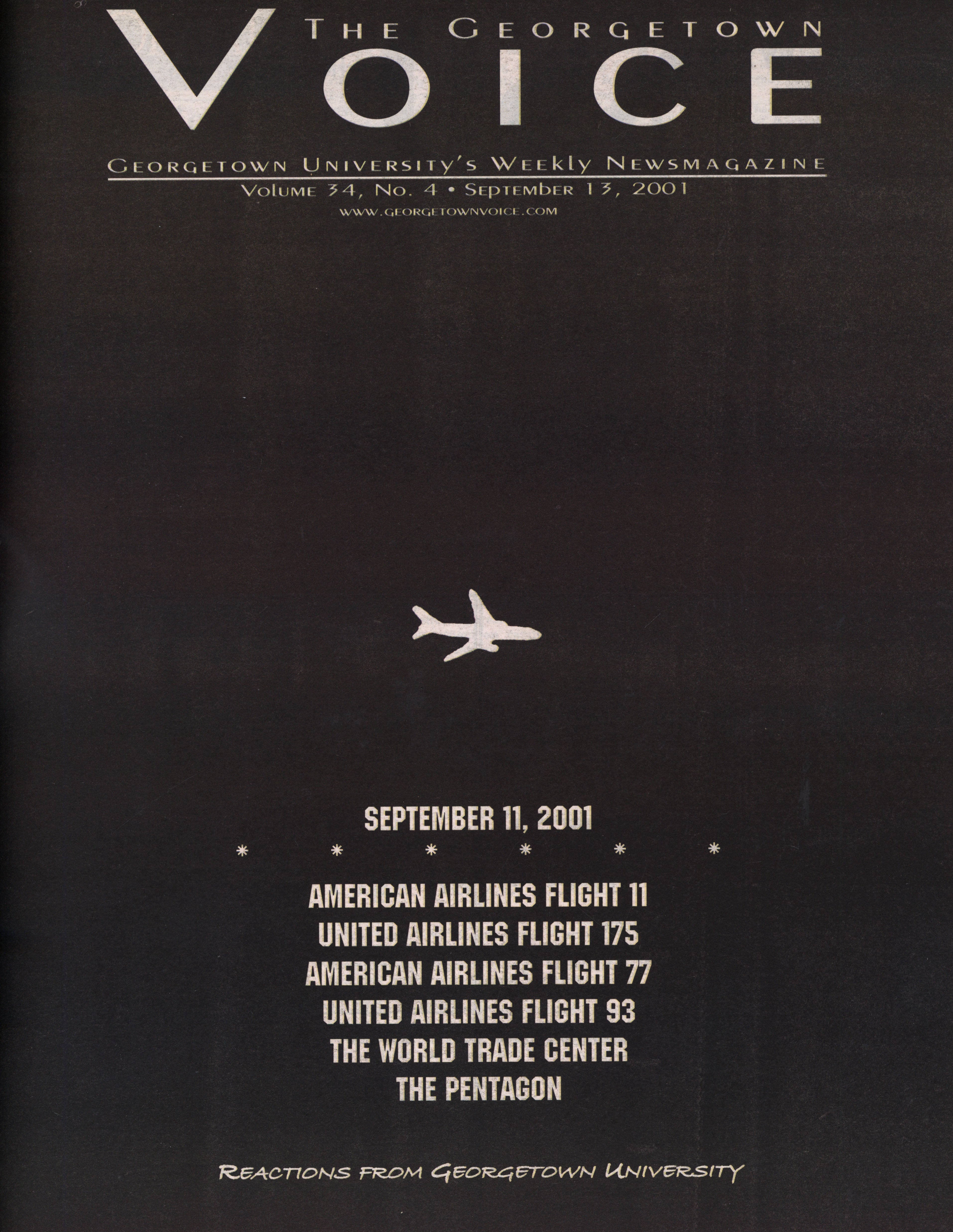
Cover of the Georgetown Voice, September 13, 2001
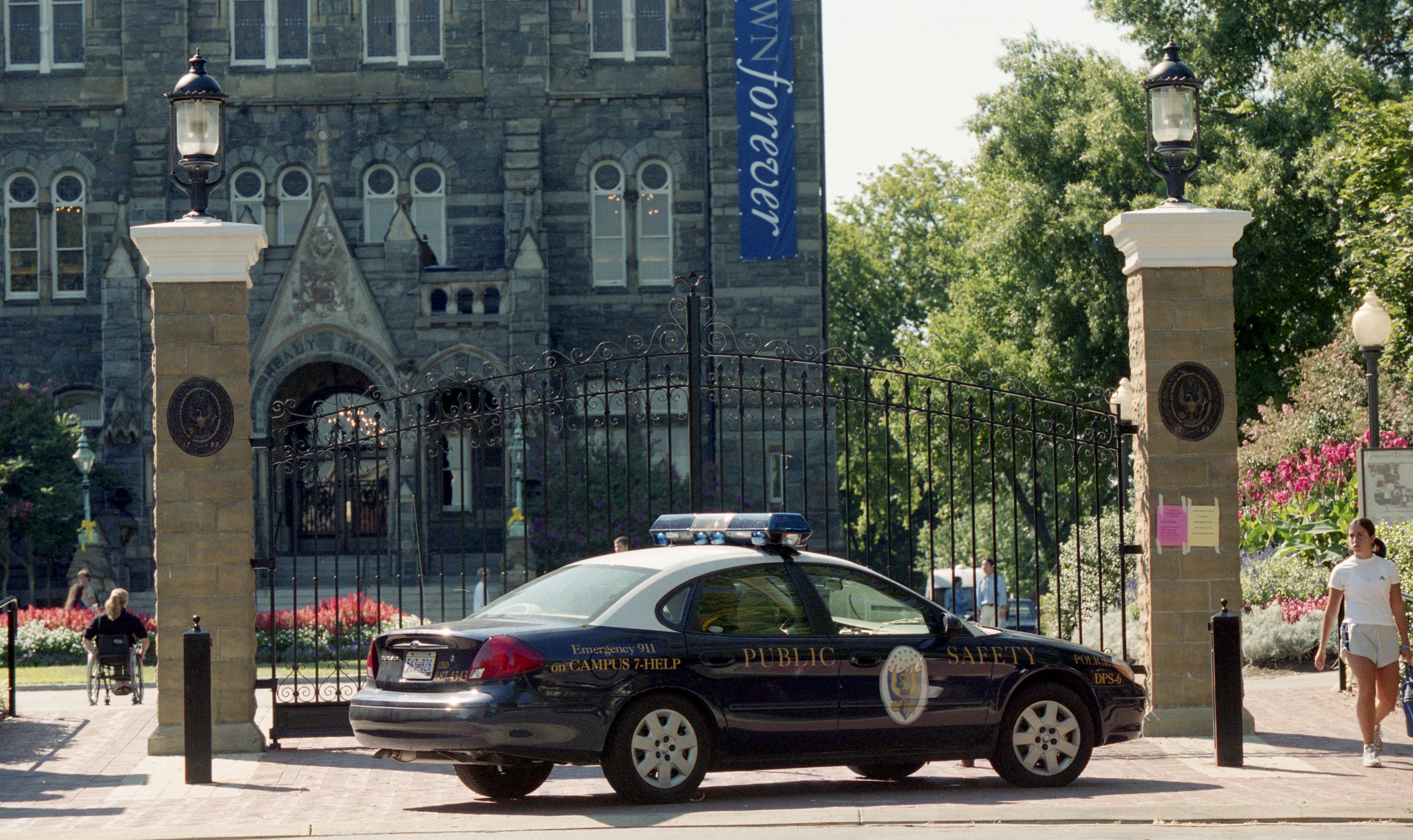
Security measures at the main gates of Georgetown University, September 13, 2001
As news of the attacks broke, the main University gates were closed and the University’s Department of Public Safety (DPS) quickly began manning all entrances to campus, stopping cars and pedestrians to verify a University association. No cars without a University parking permit, other than delivery vehicles, were allowed onto campus. DPS officers began operating on 12 hour shifts.
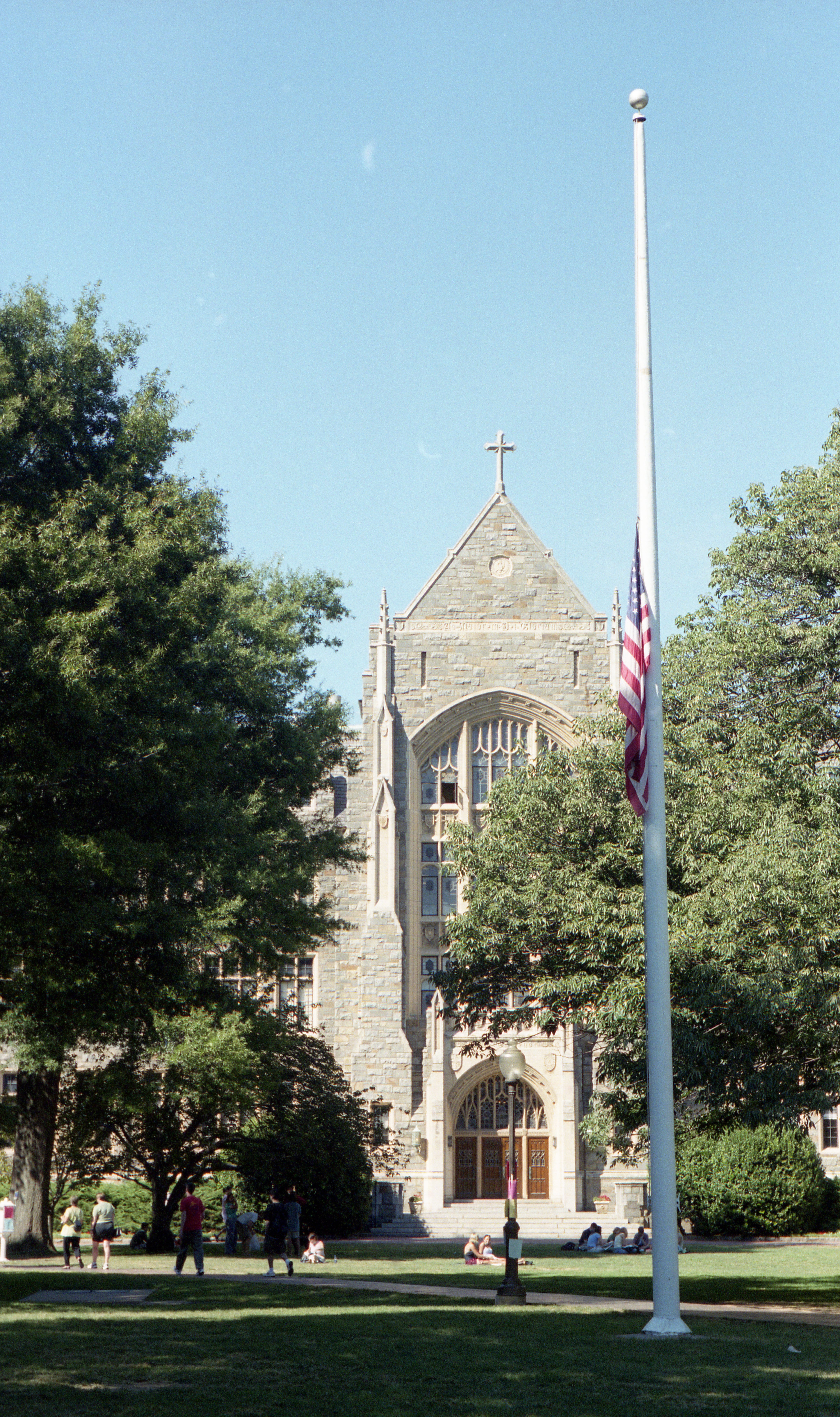
Flag on Copley Lawn at half-staff, September 13, 2001
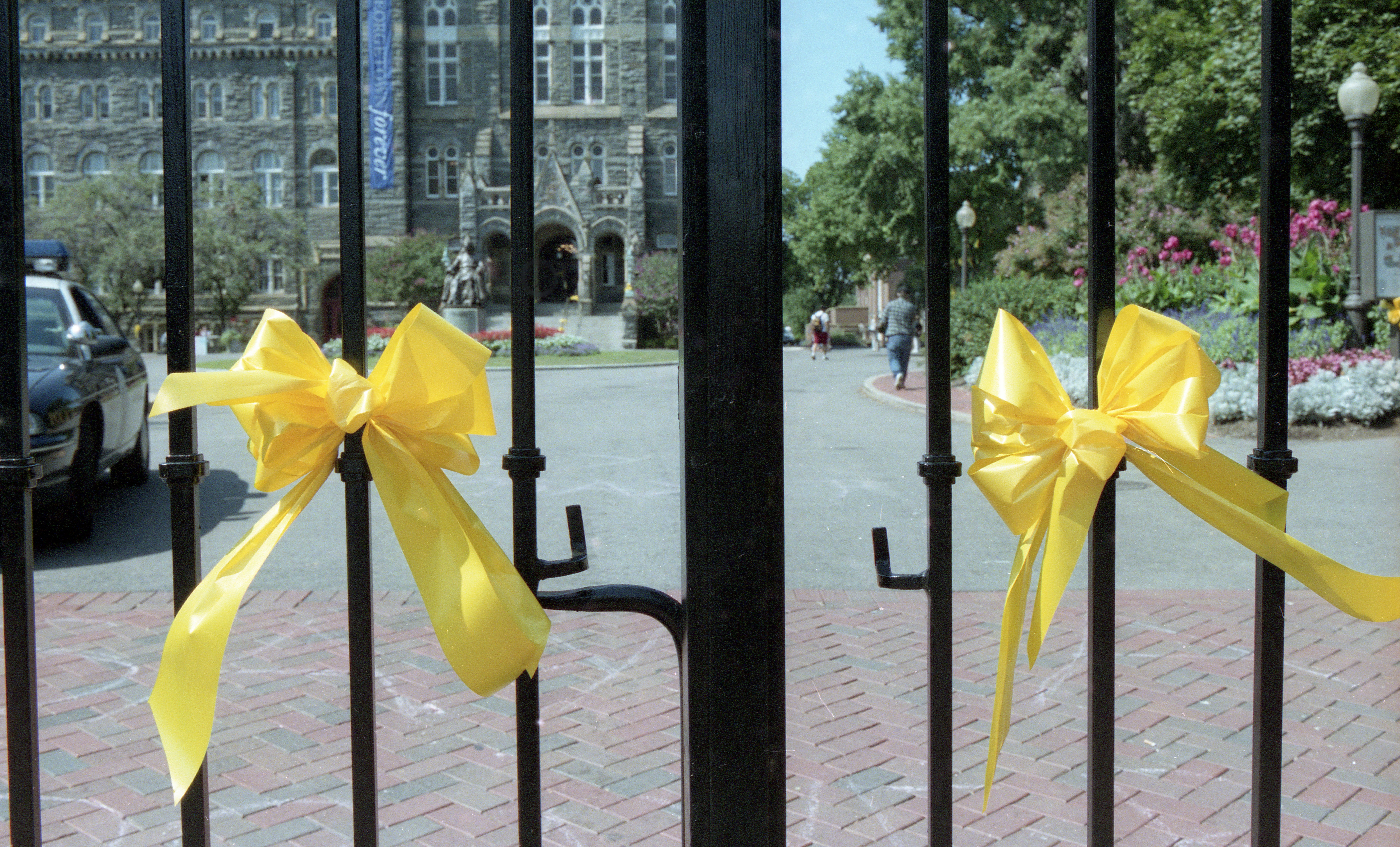
Yellow ribbons on the closed front gates of the University, September 13, 2001
In remembrance and solidarity, students wore yellow ribbons and also hung them throughout campus.
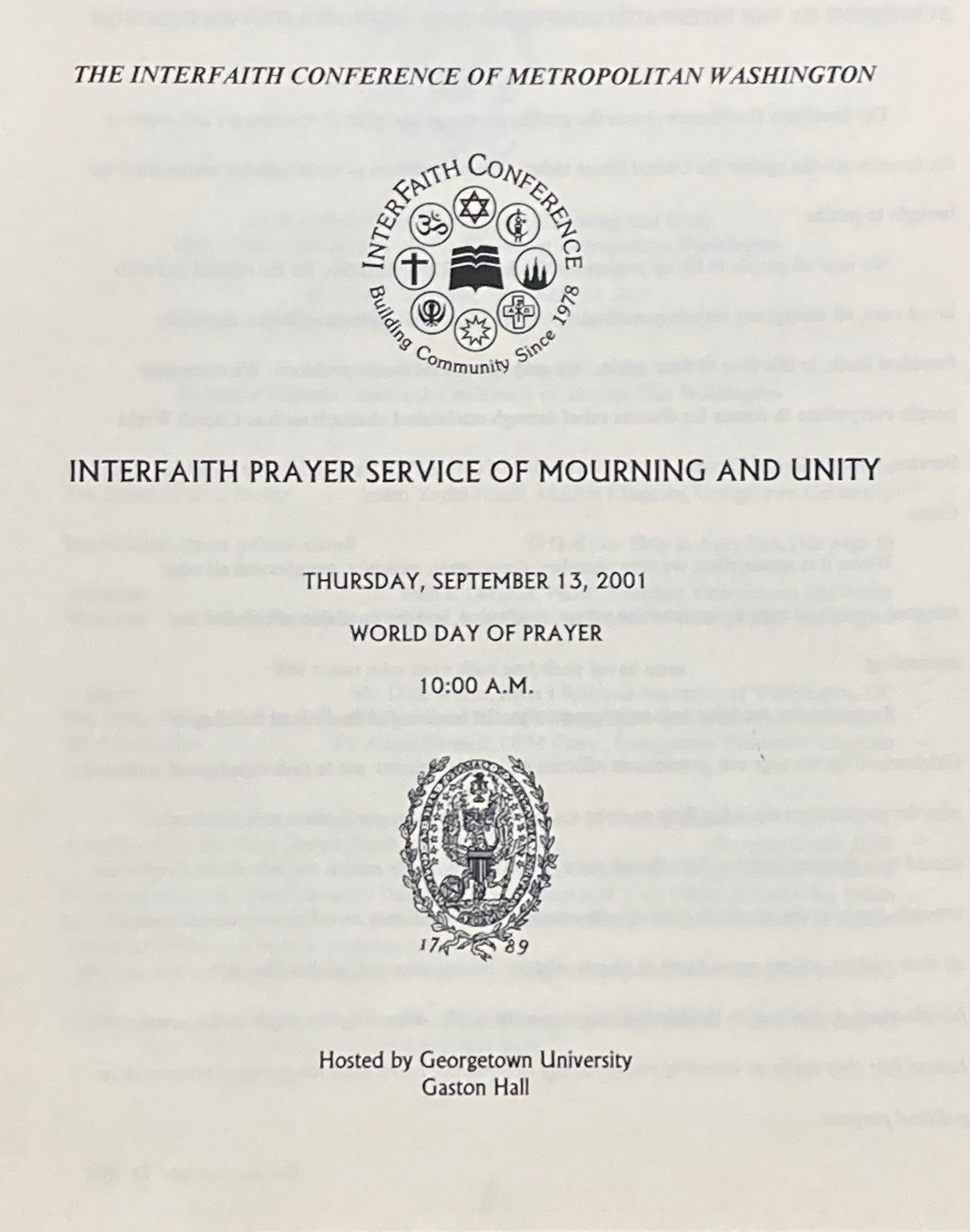
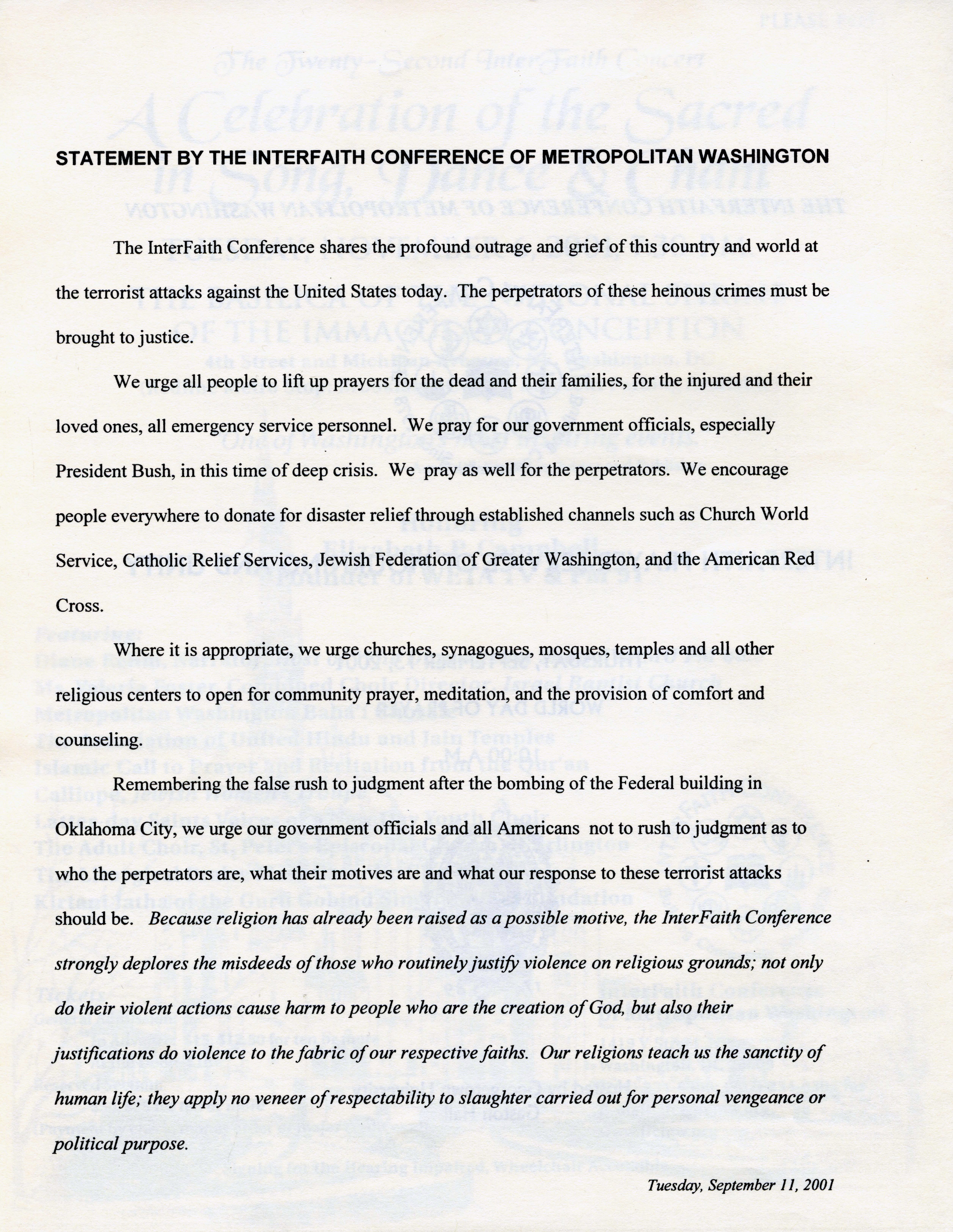
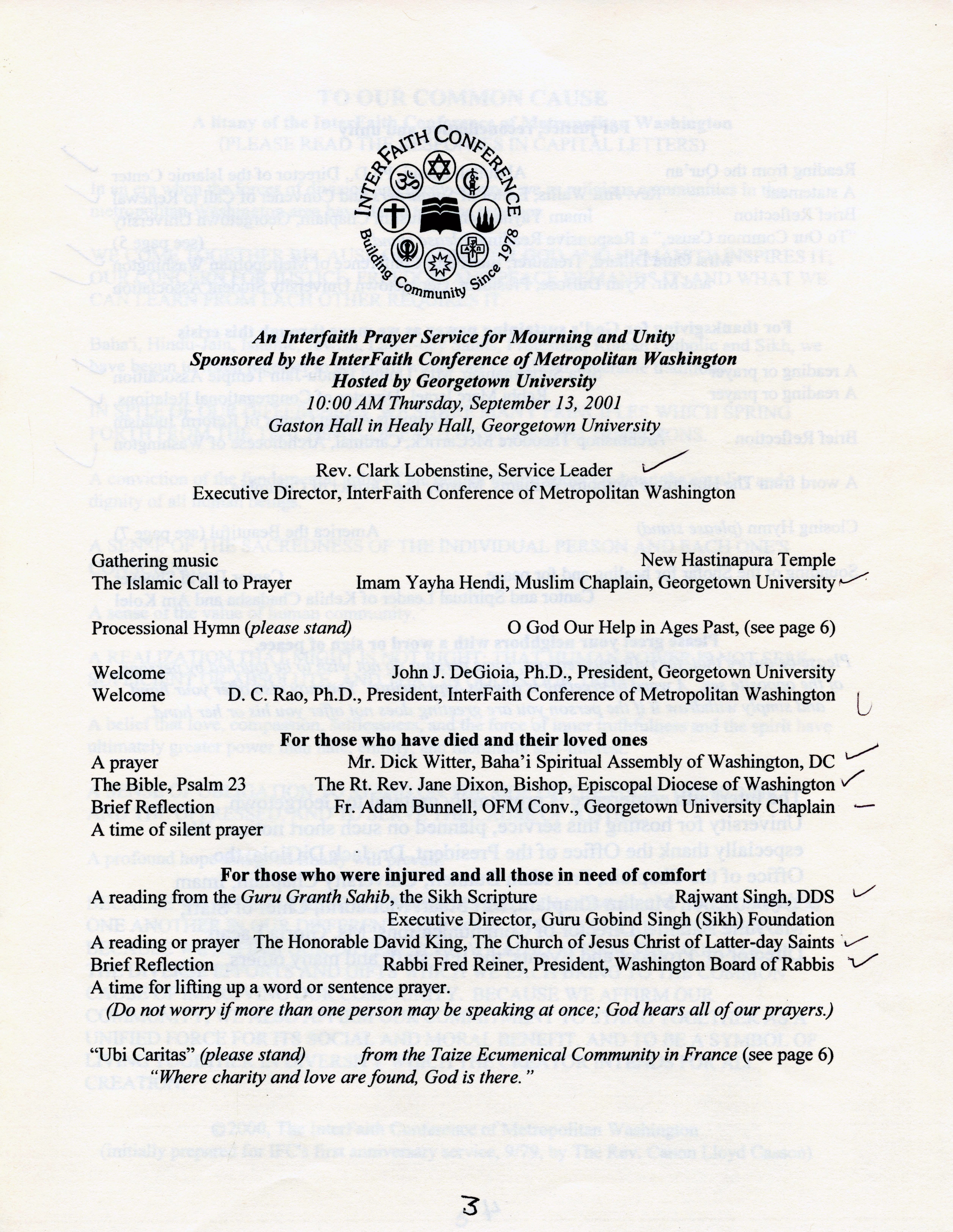
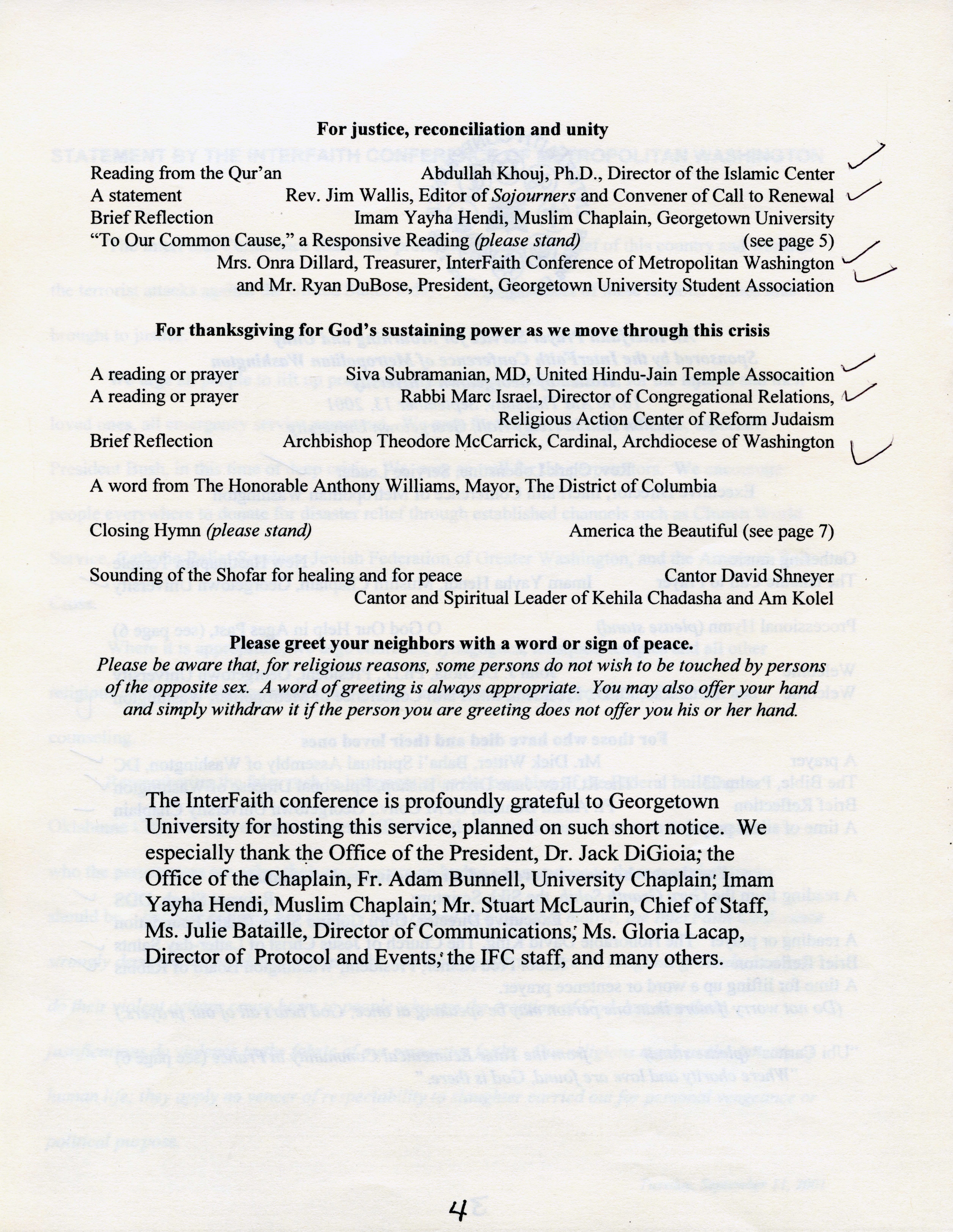
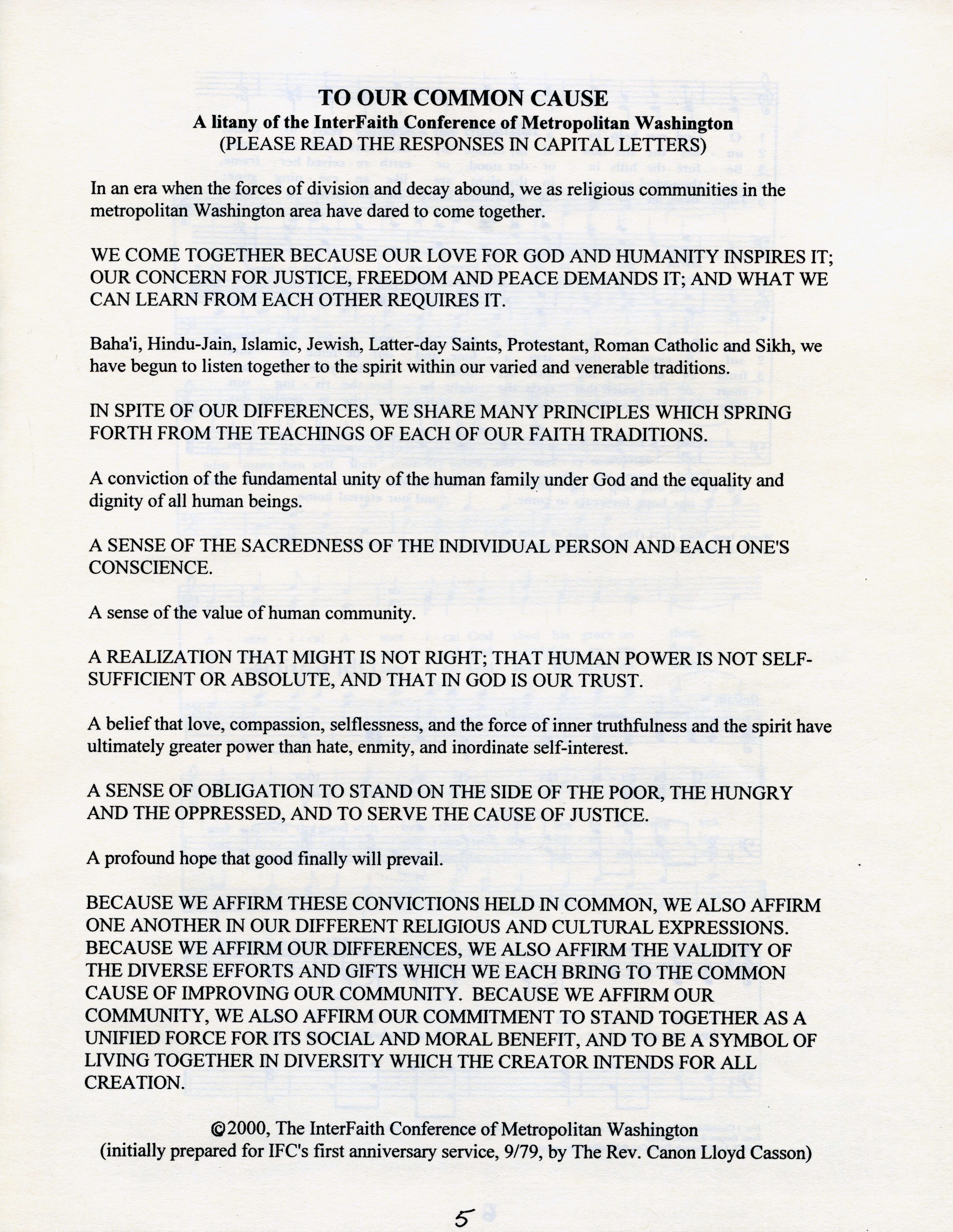
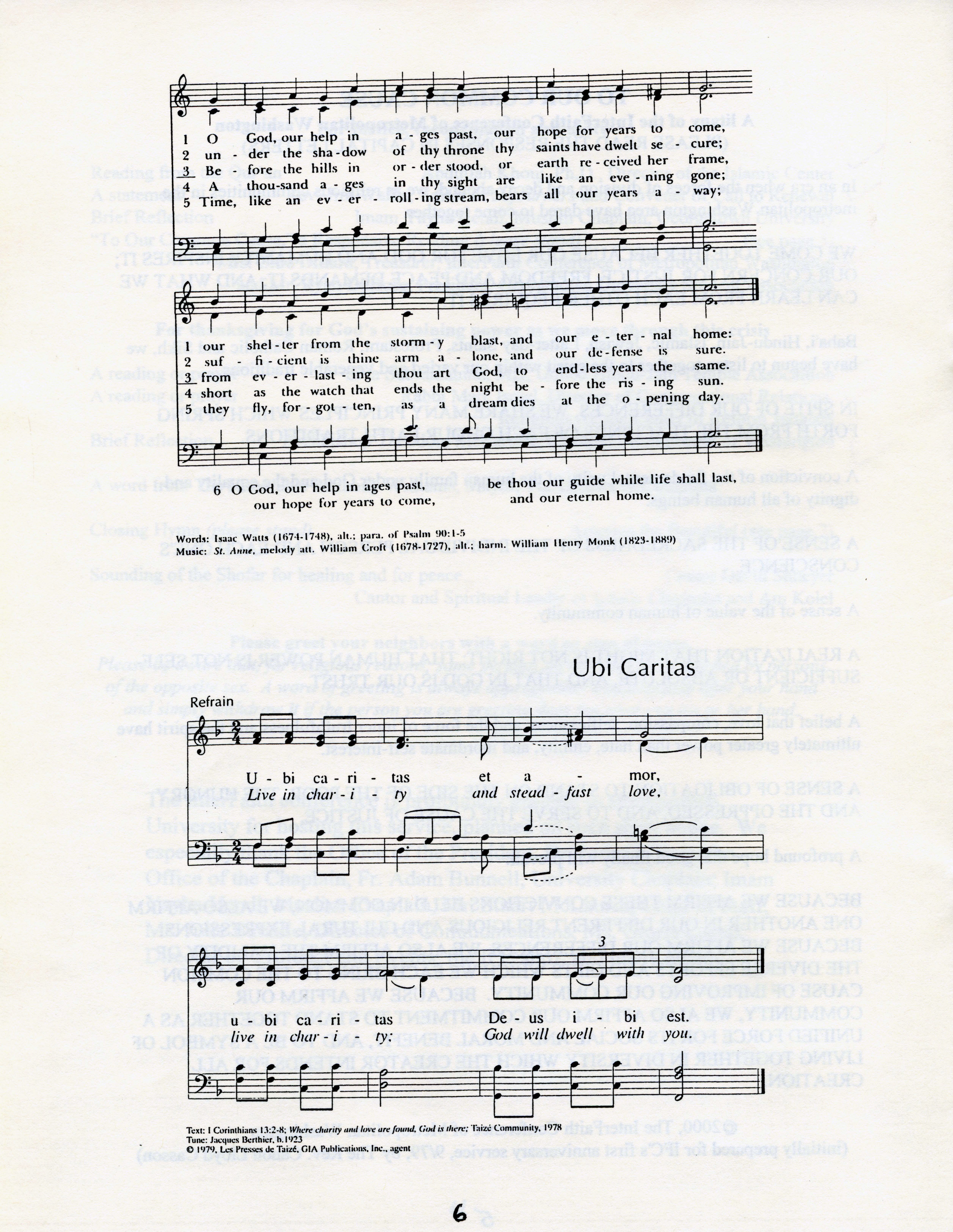
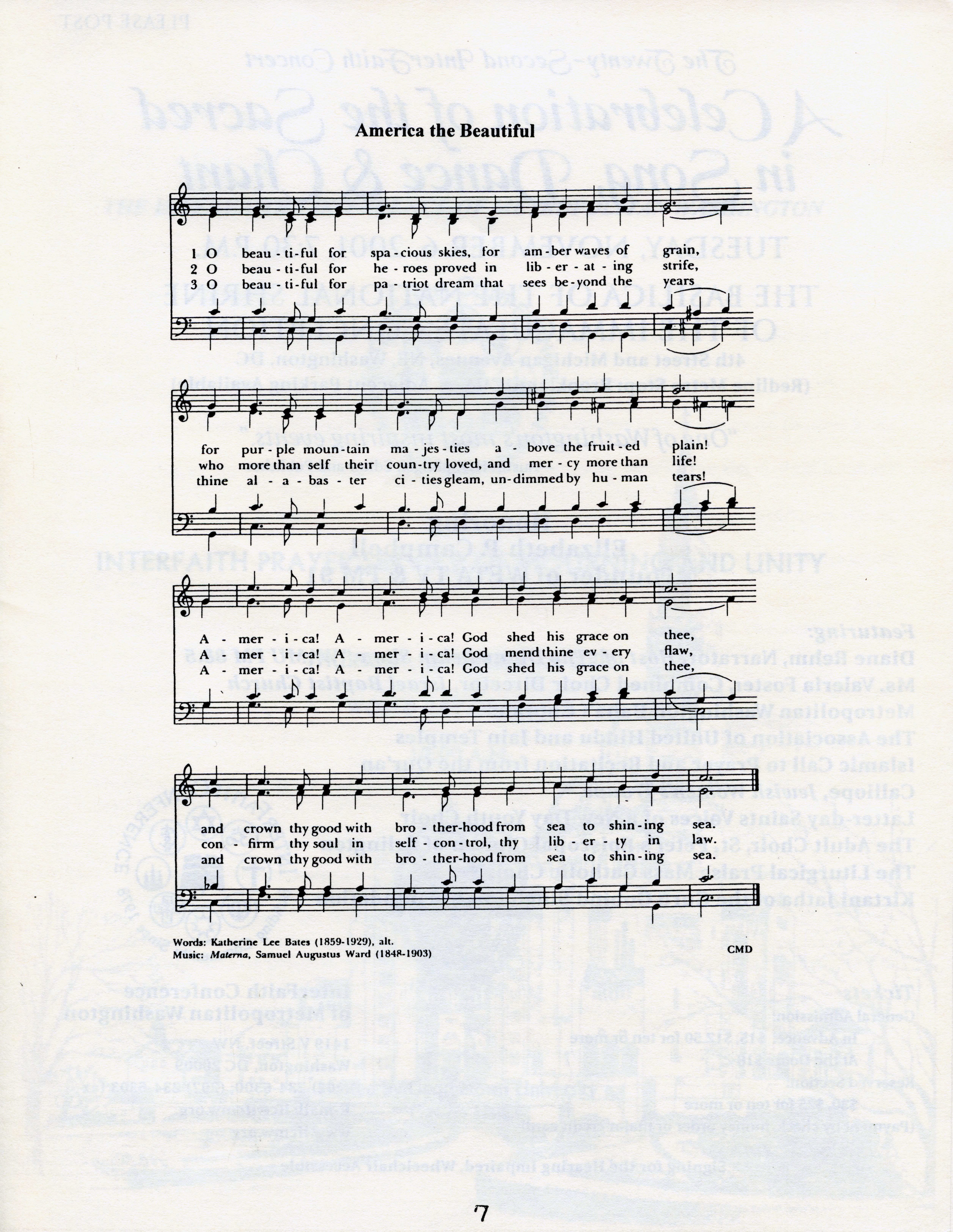
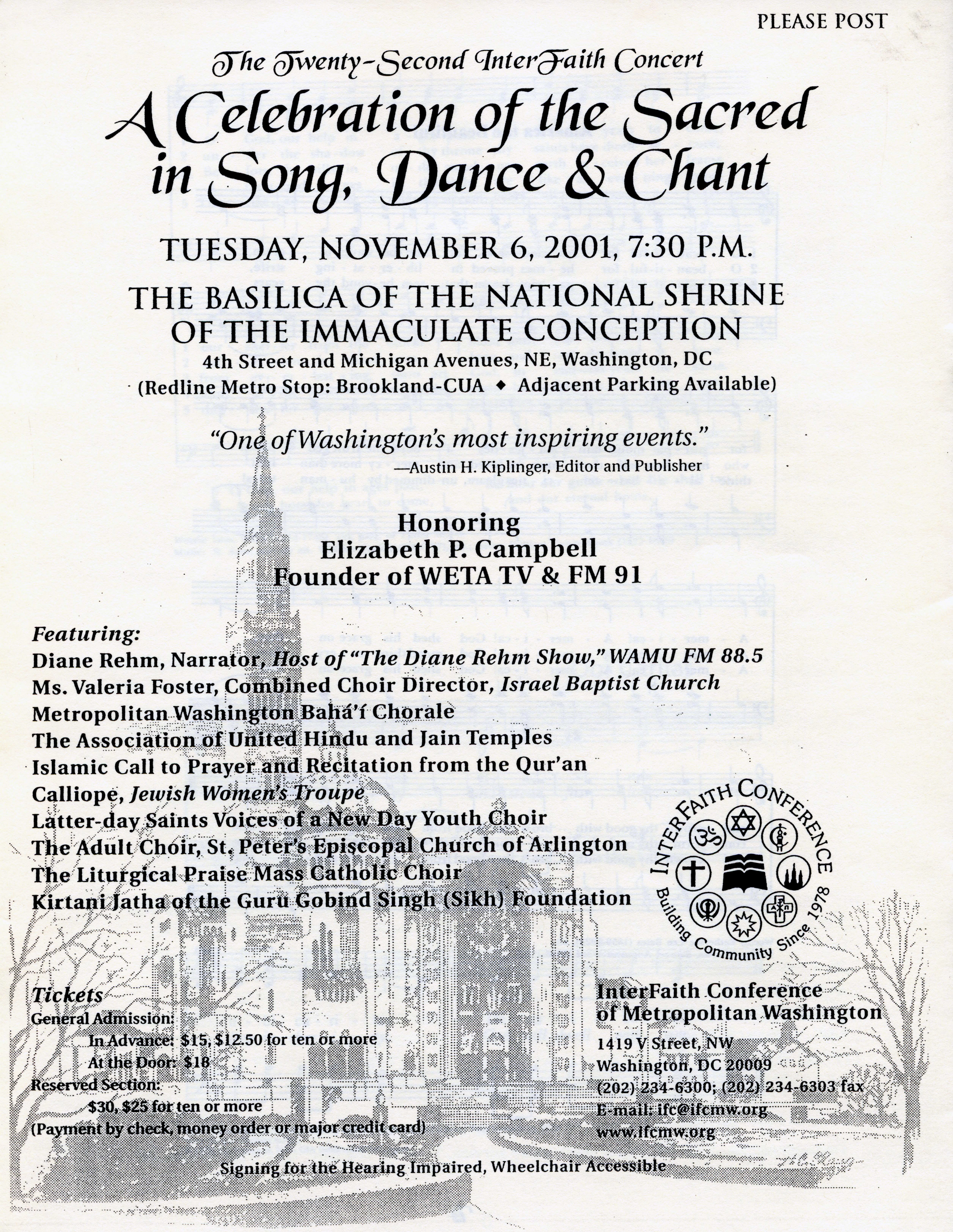
Program from the Interfaith Prayer Service in Gaston Hall, September 13, 2001
The service, sponsored in partnership with the InterFaith Conference (IFC) of Metropolitan Washington, commemorated the victims of the September 11 terrorist attacks and their families. In addition to President John J. DeGioia, participants included: Rev. Adam E. Bunnell, OFM Conv, Georgetown University Chaplain; Bishop Jane Dixon, acting Episcopal Bishop of Washington; Imam Yahya Hendi, Muslim Chaplain at Georgetown; Rabbi Fred Reiner, President of the Washington Board of Rabbis; Rajwant Singh, DDS, Executive Director of the Guru Gobind Singh Foundation; and D.C. Mayor Anthony A. Williams.
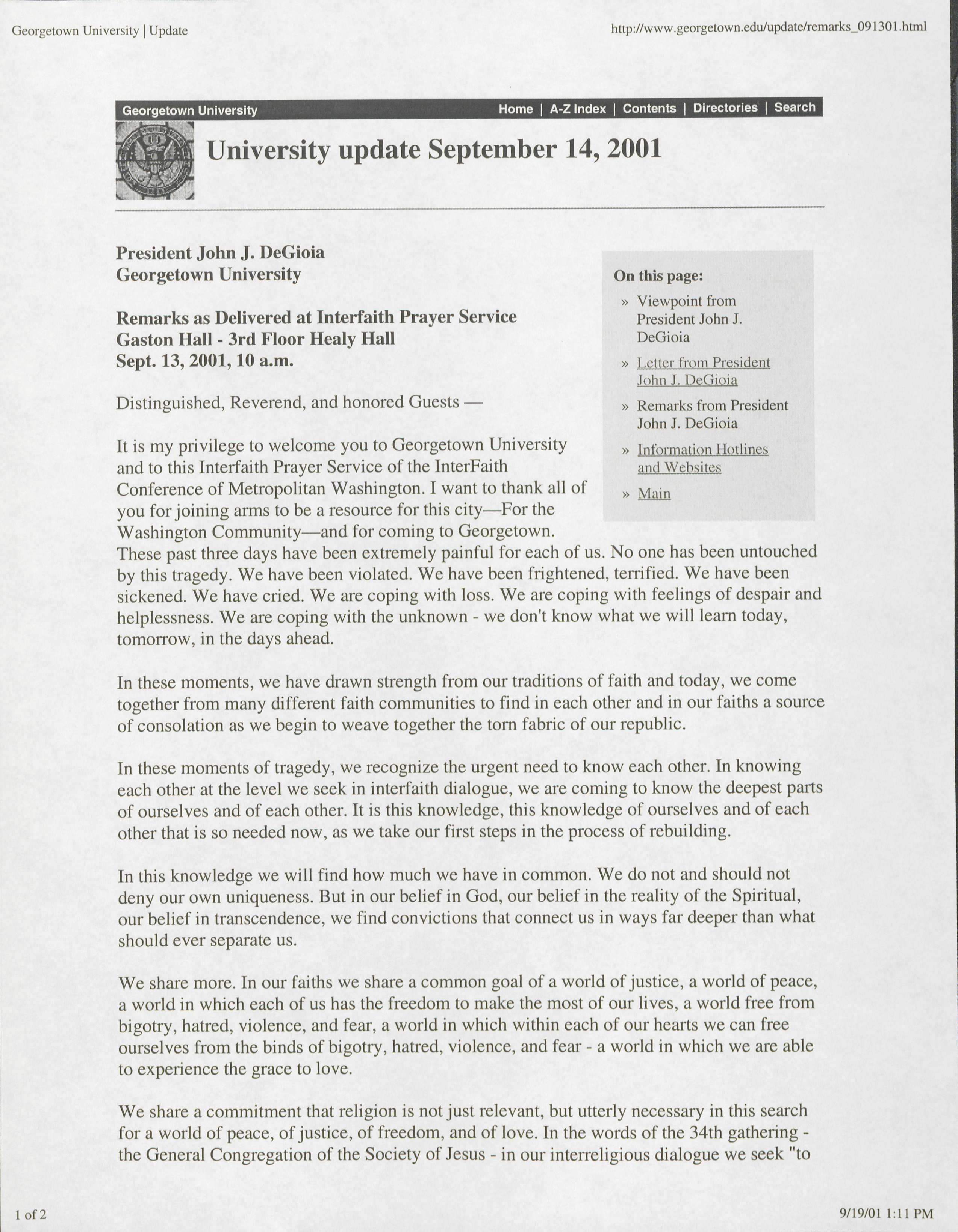
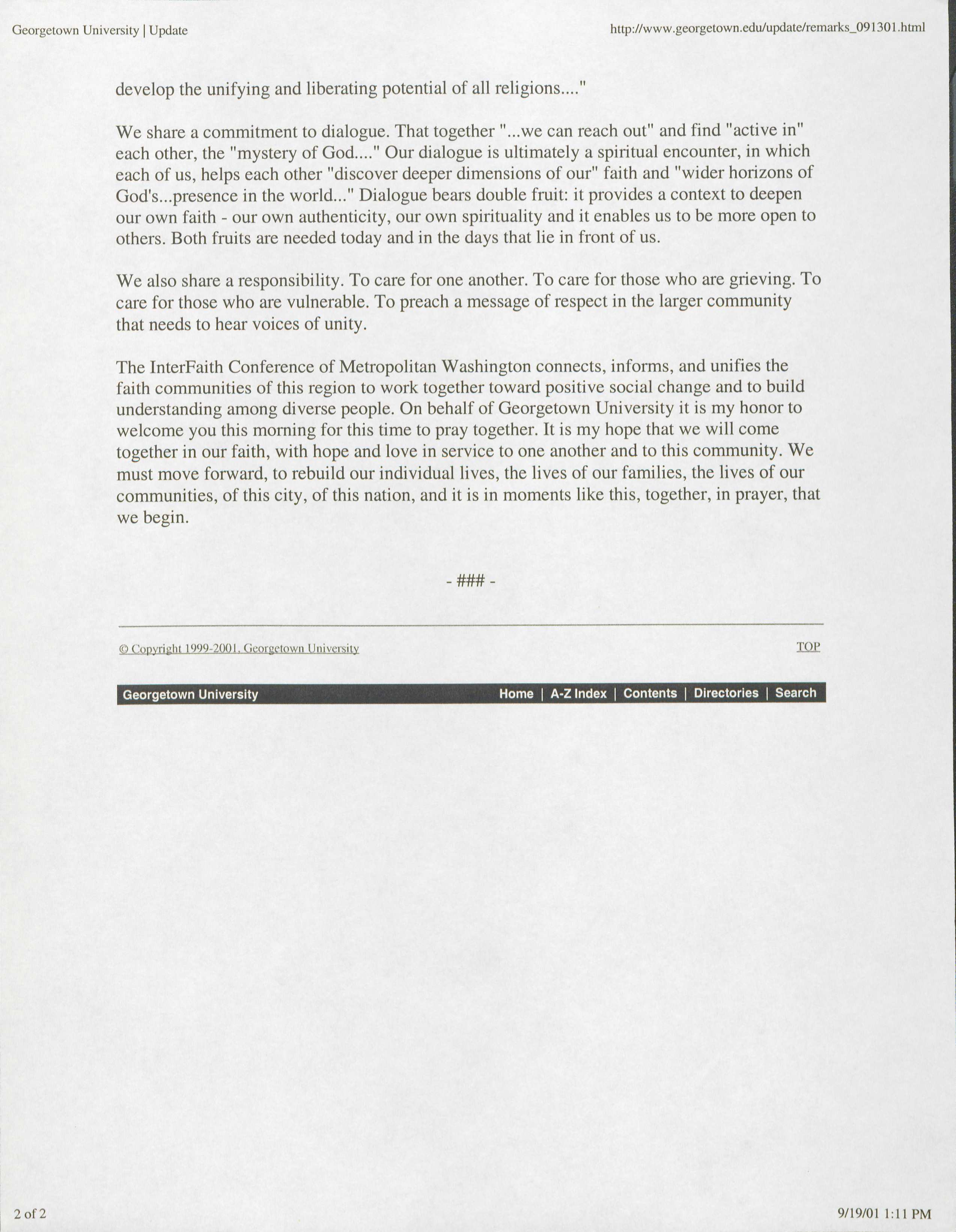
Remarks delivered by President John J. DeGioia at the Interfaith Prayer Service in Gaston Hall, September 13, 2001
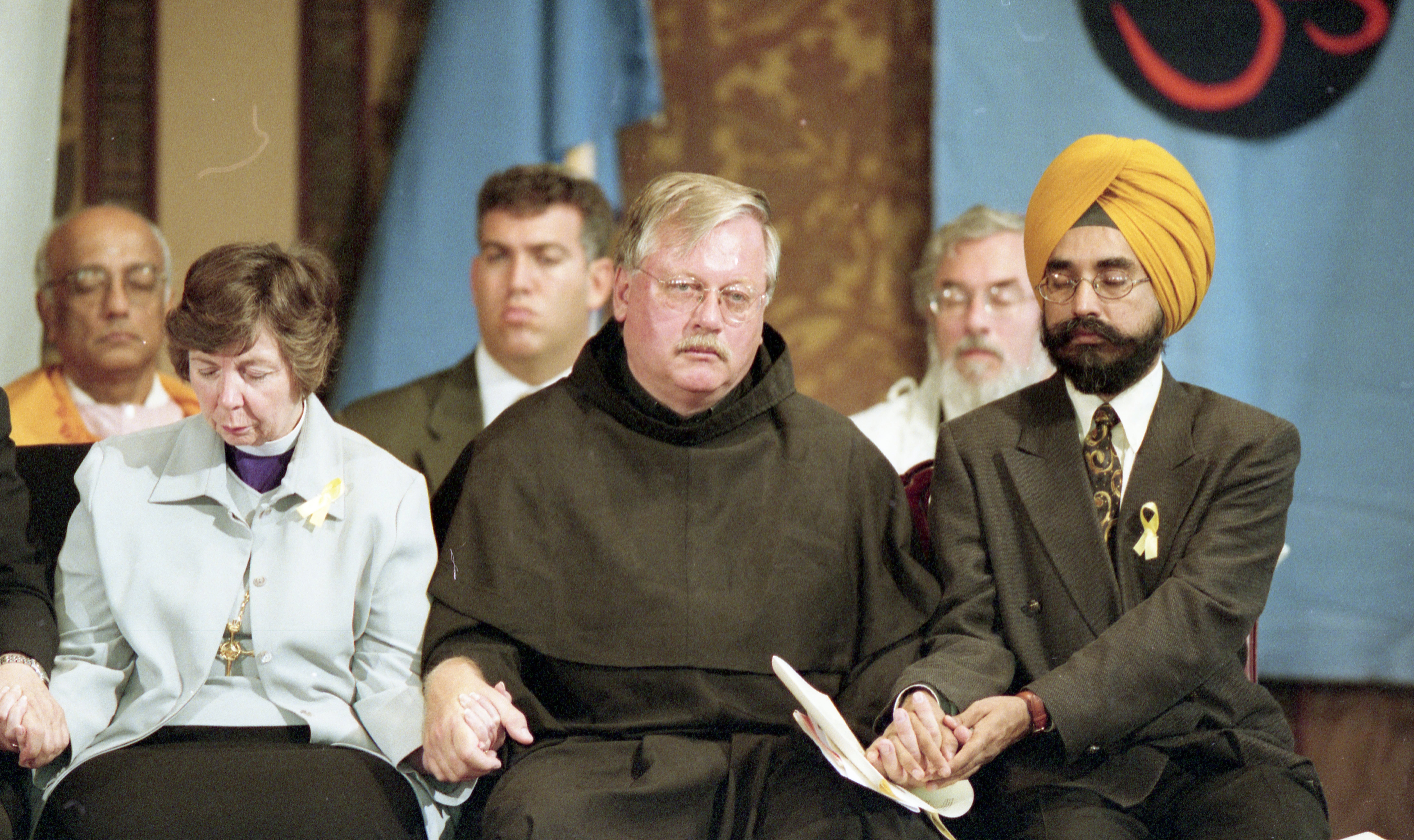
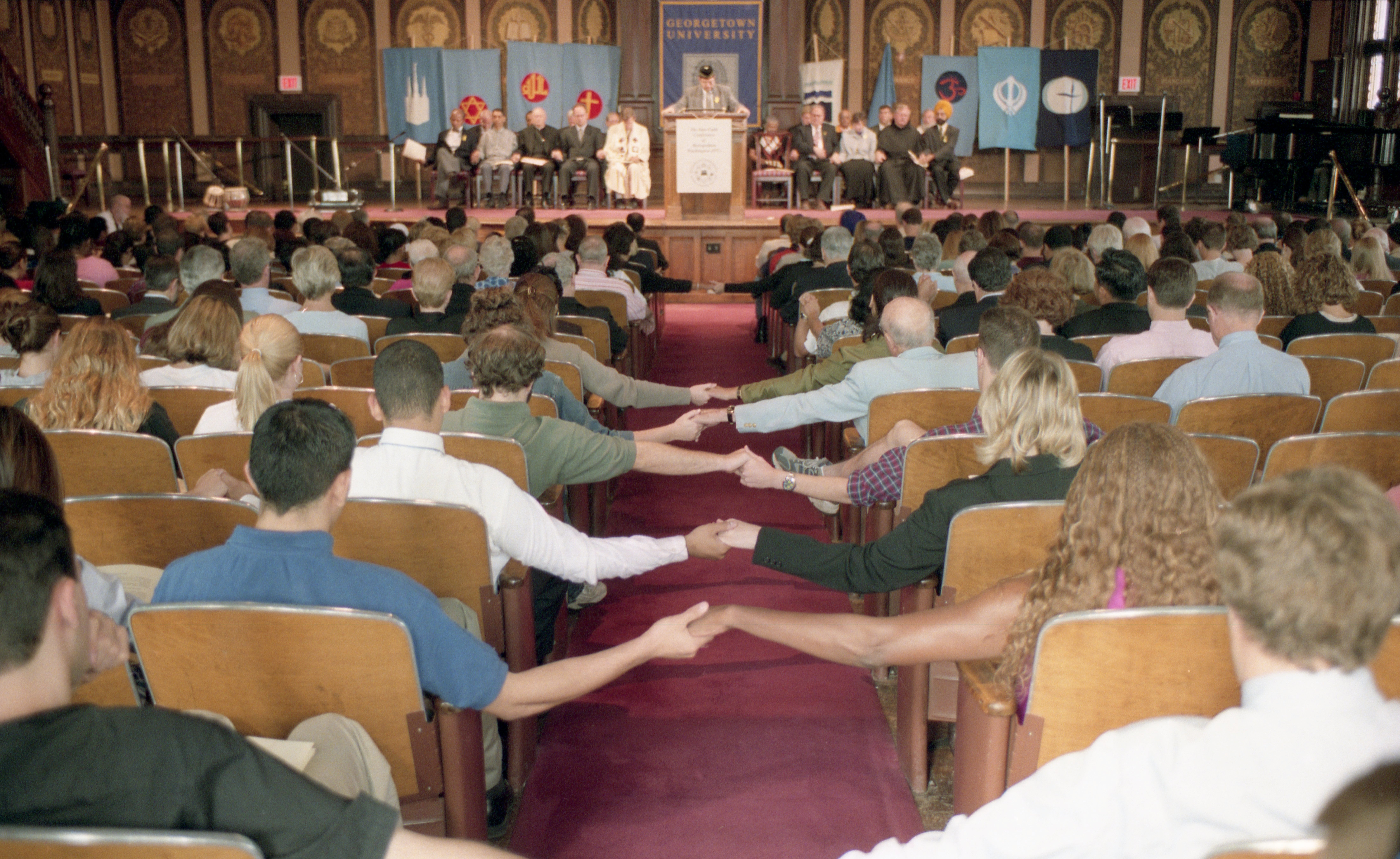
Photographs of the Interfaith Prayer Service in Gaston Hall, September 13, 2001
Left, Bishop Jane Dixon, acting Episcopal Bishop of Washington, Rev. Adam E. Bunnell, OFM Conv, Georgetown University Chaplain, and Rajwant Singh, DDS, Executive Director of the Guru Gobind Singh Foundation pray. Right, worshippers at the service hold hands.
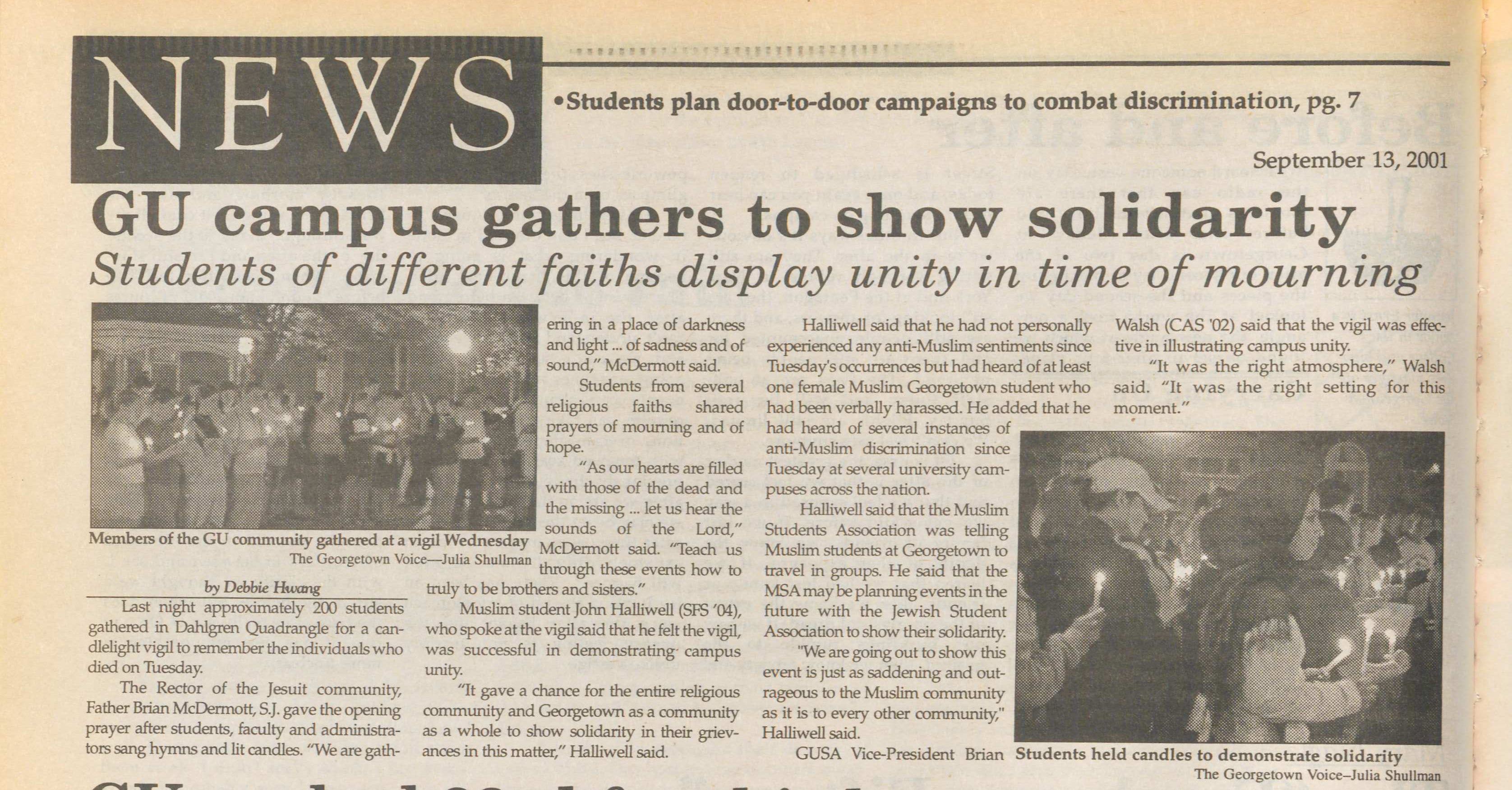
“GU campus gathers to show solidarity - Students of different faiths display unity in time of mourning.” Coverage of a vigil held on September 12, Georgetown Voice, September 13, 2001
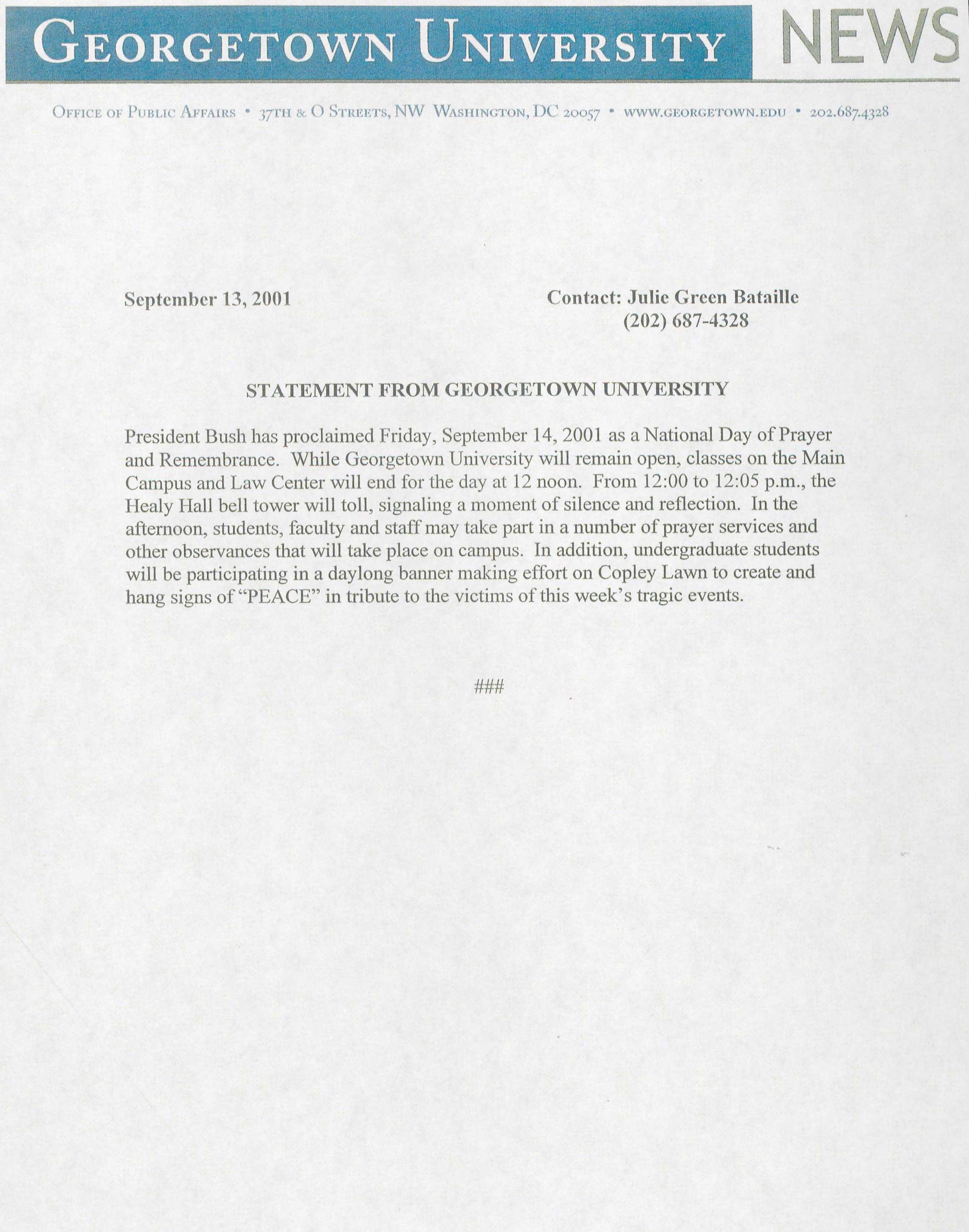
Statement from Georgetown University about the September 14 National Day of Prayer, September 13, 2001
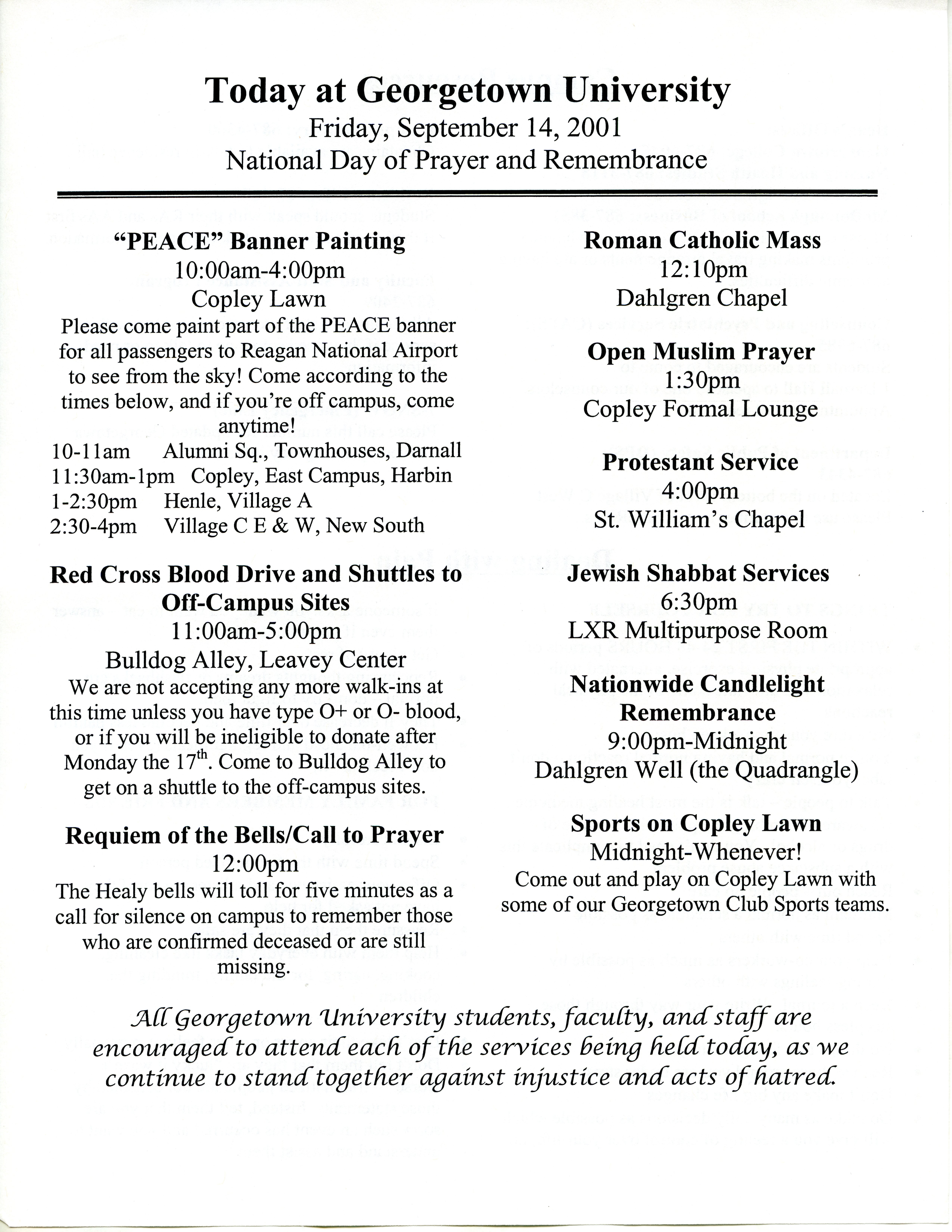
"Today at Georgetown University," Friday, September 14, 2001
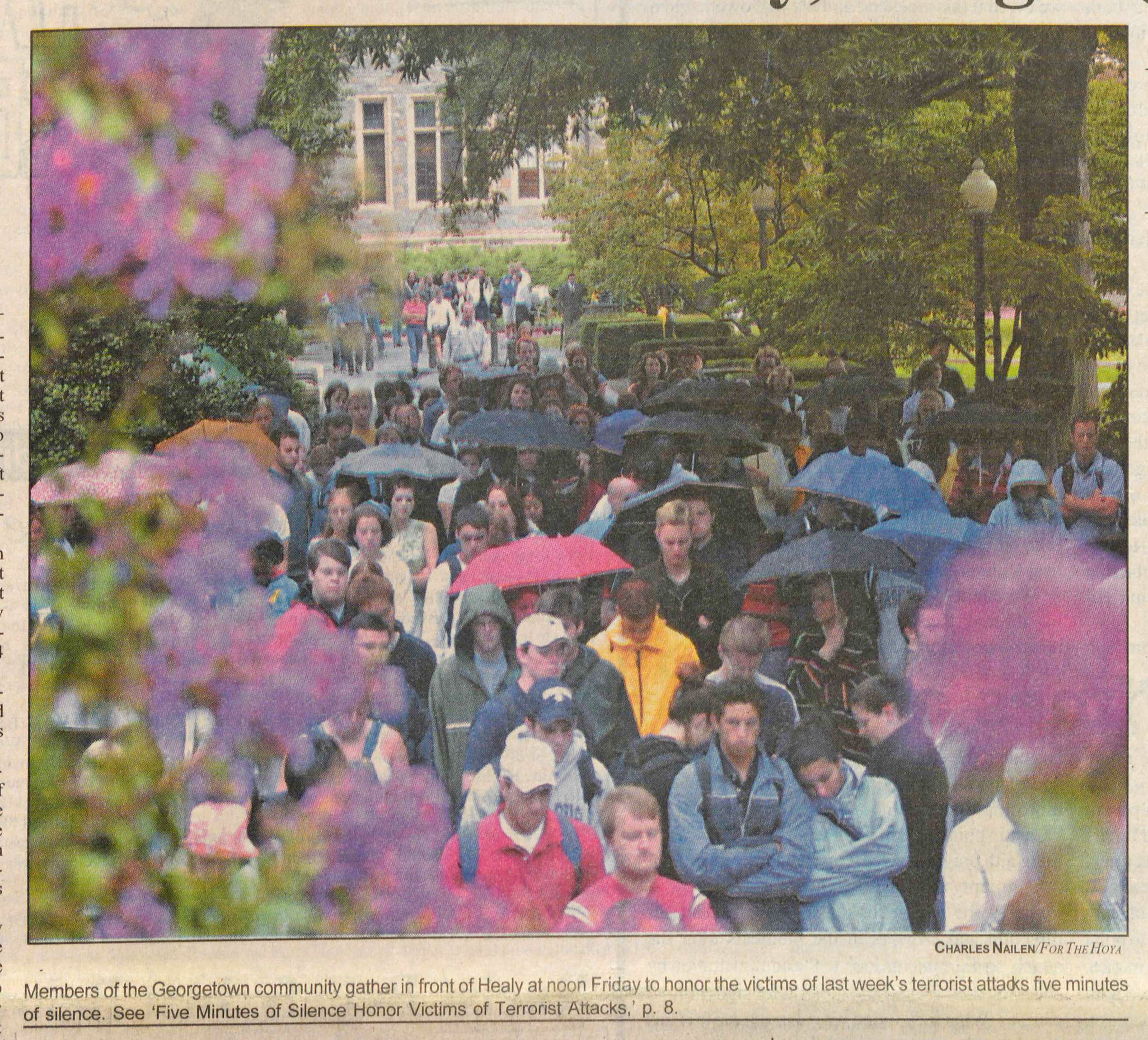
National Day of Prayer and Remembrance, September 14, 2001. Photograph from The Hoya, September 18, 2001
All classes on the main campus ended at 11:50 a.m. on September 14. Hundreds gathered outside in silence amid a light rain. At noon, the bells of Healy Hall tolled, signaling campus to observe a moment of silence to honor the victims of the attacks.
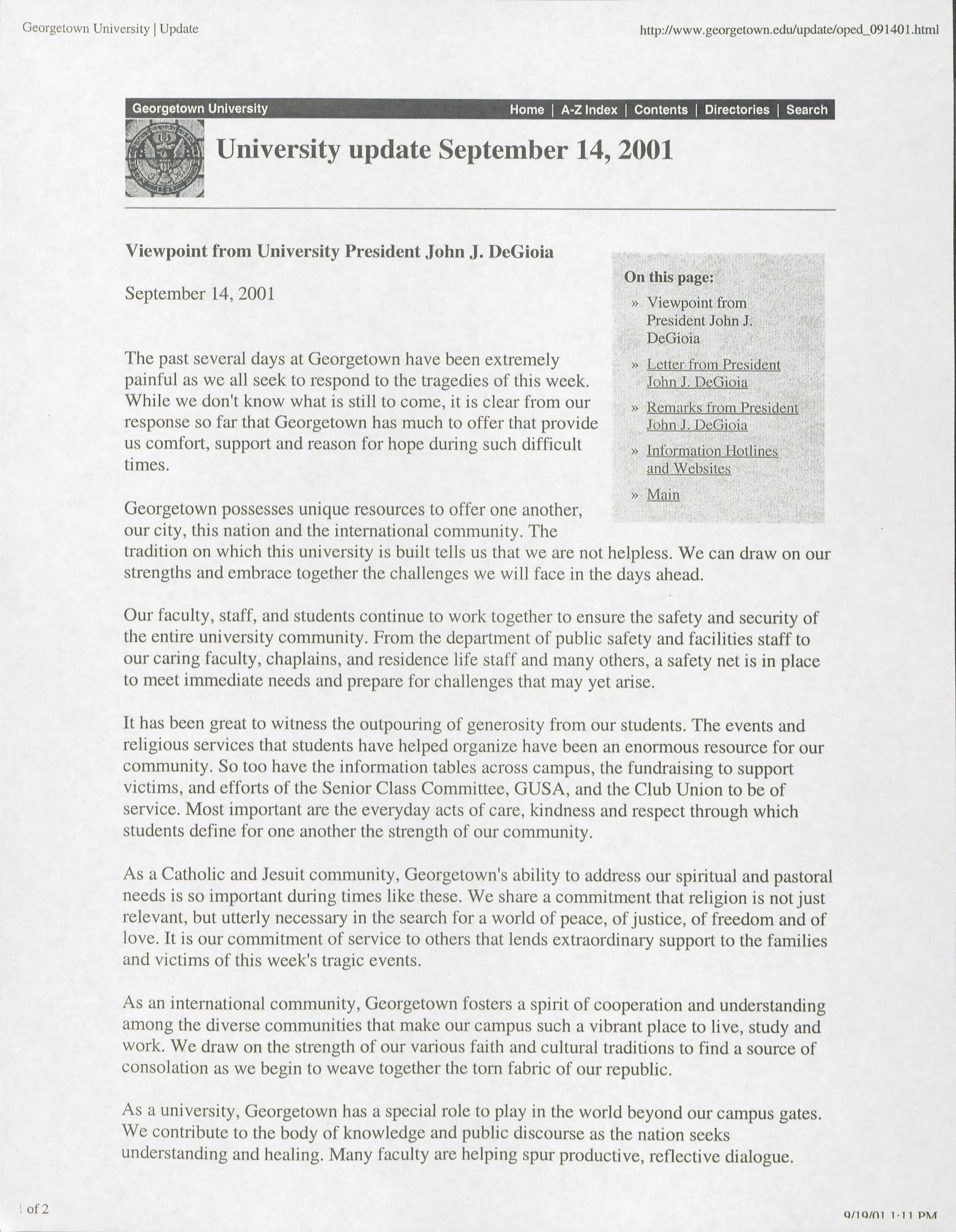
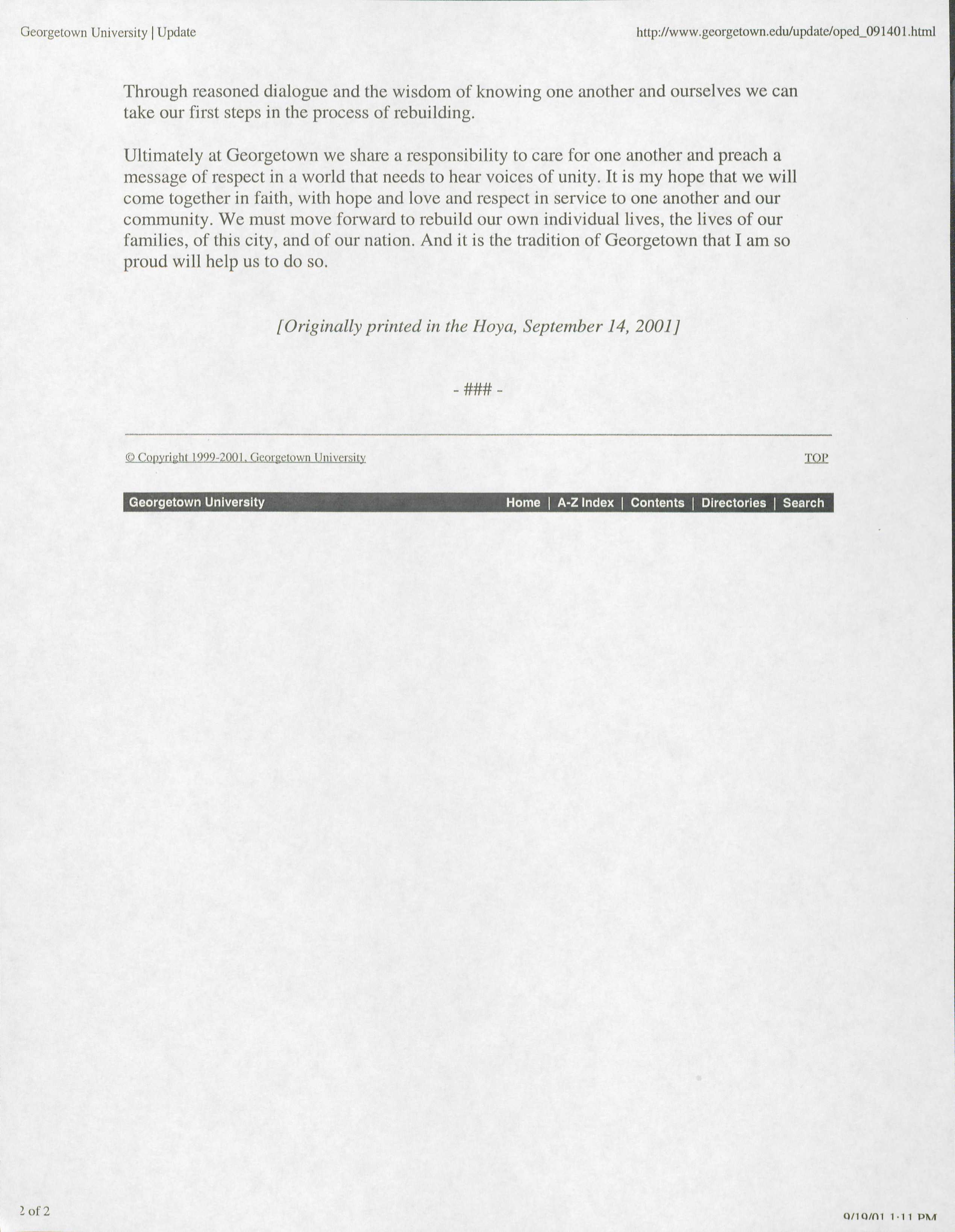
"Viewpoint from University President John J. DeGioia," September 14, 2001
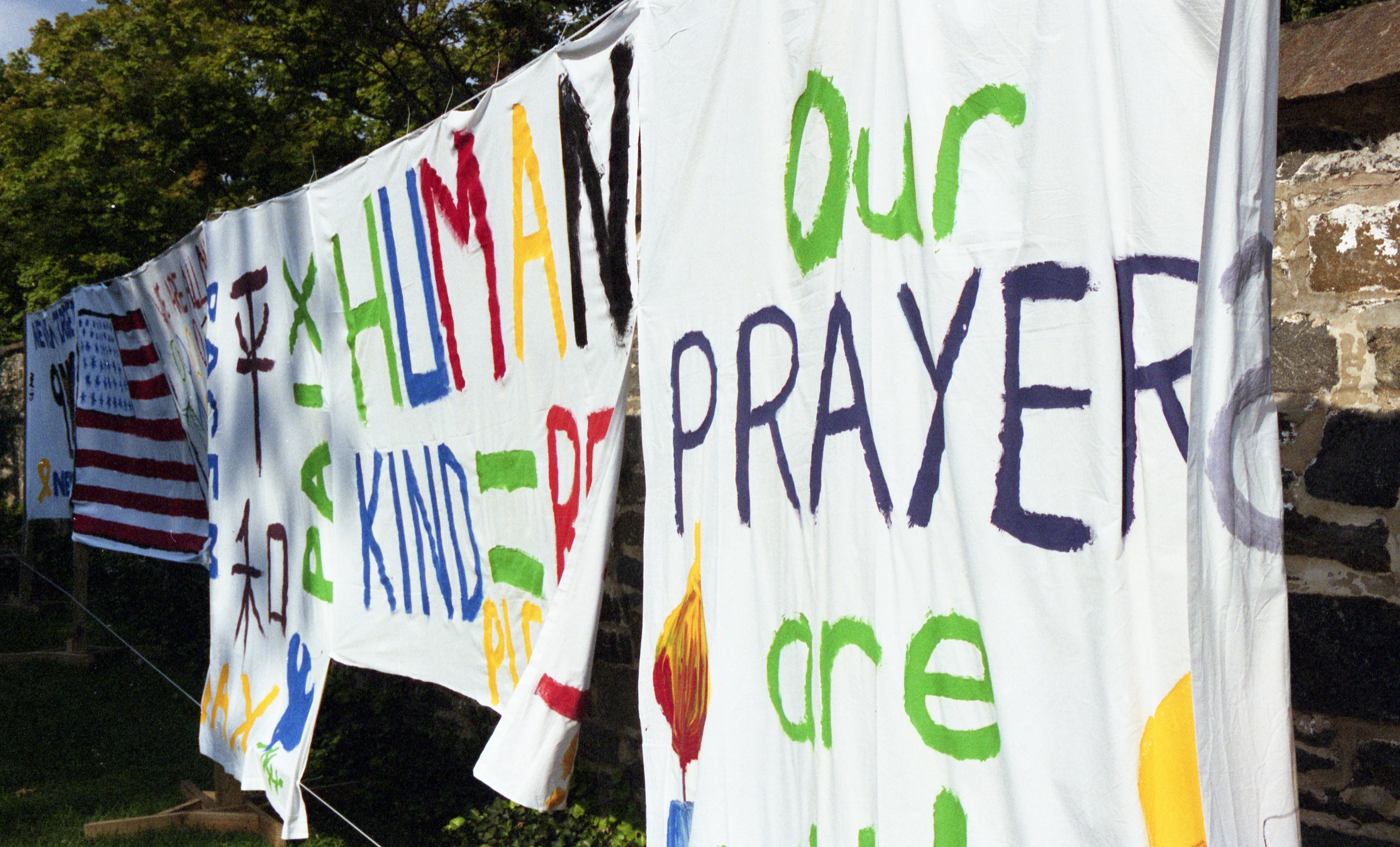
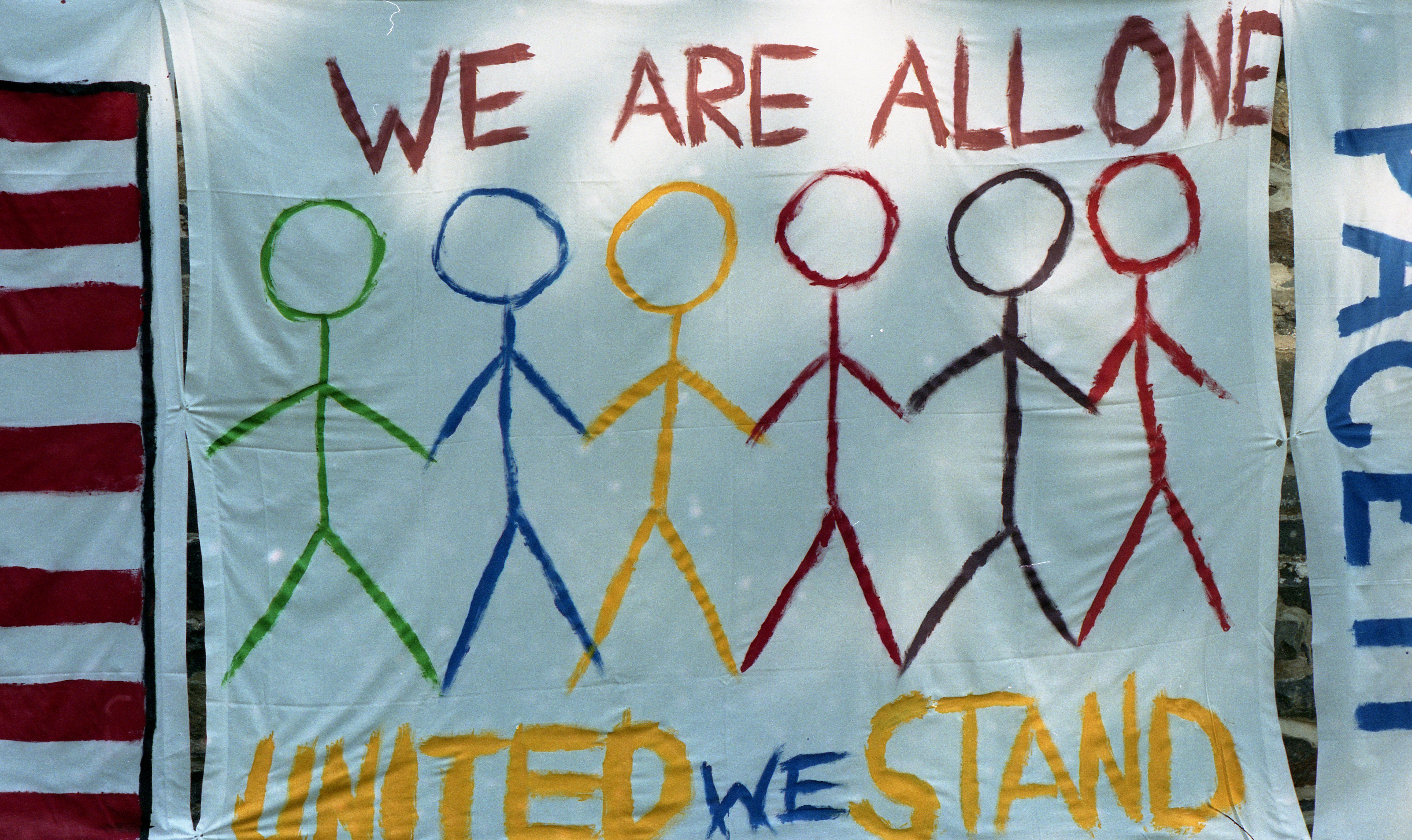
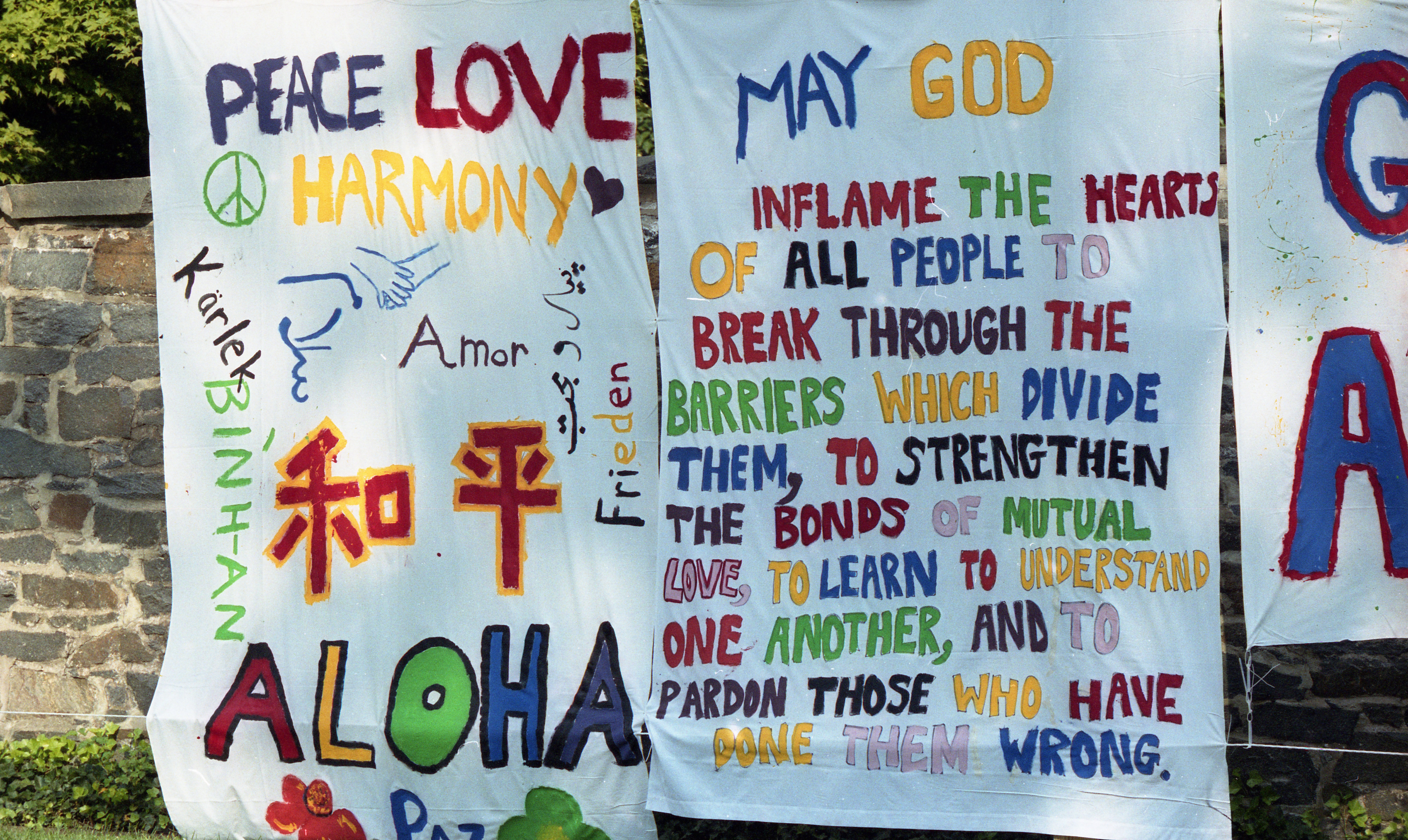
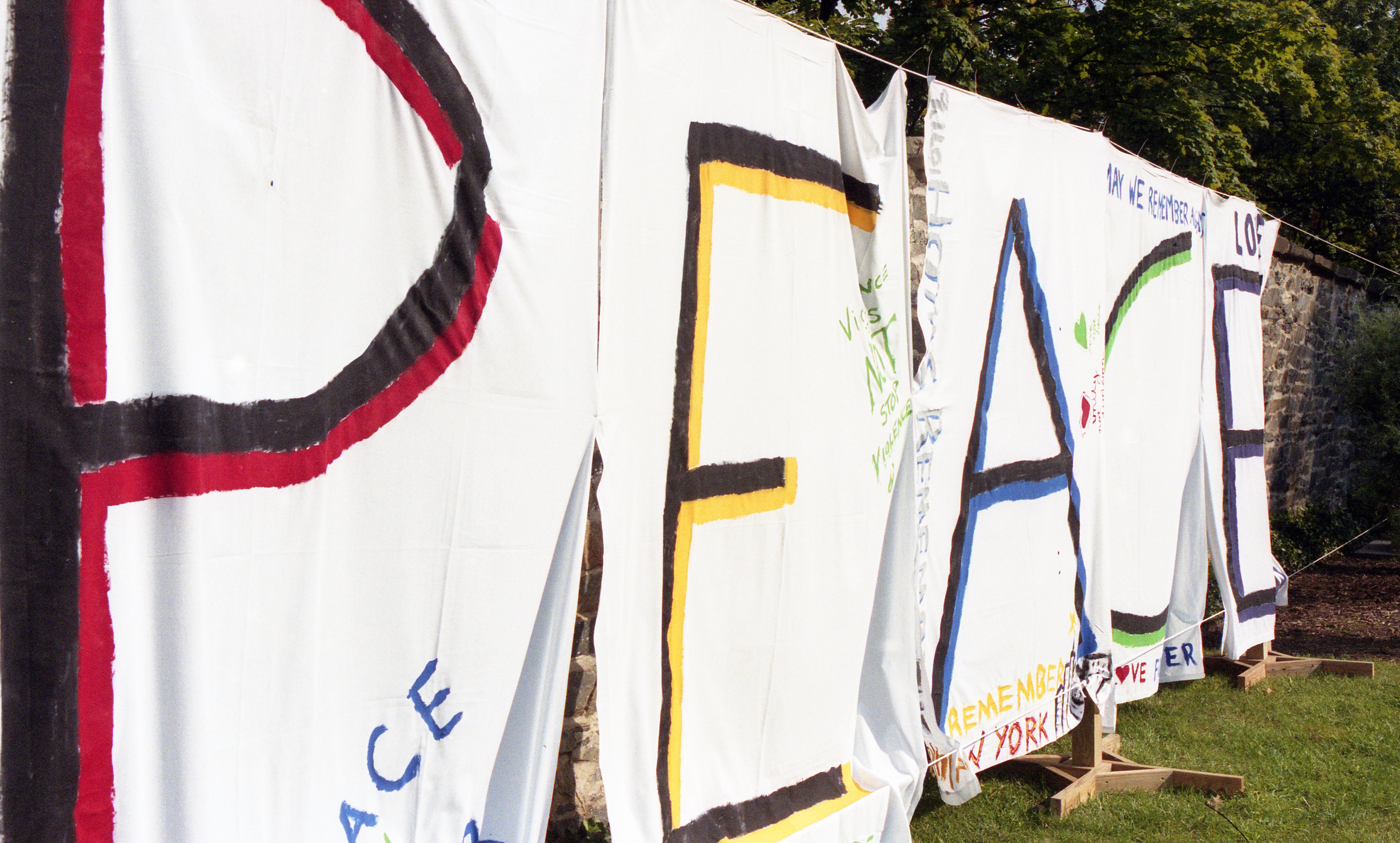
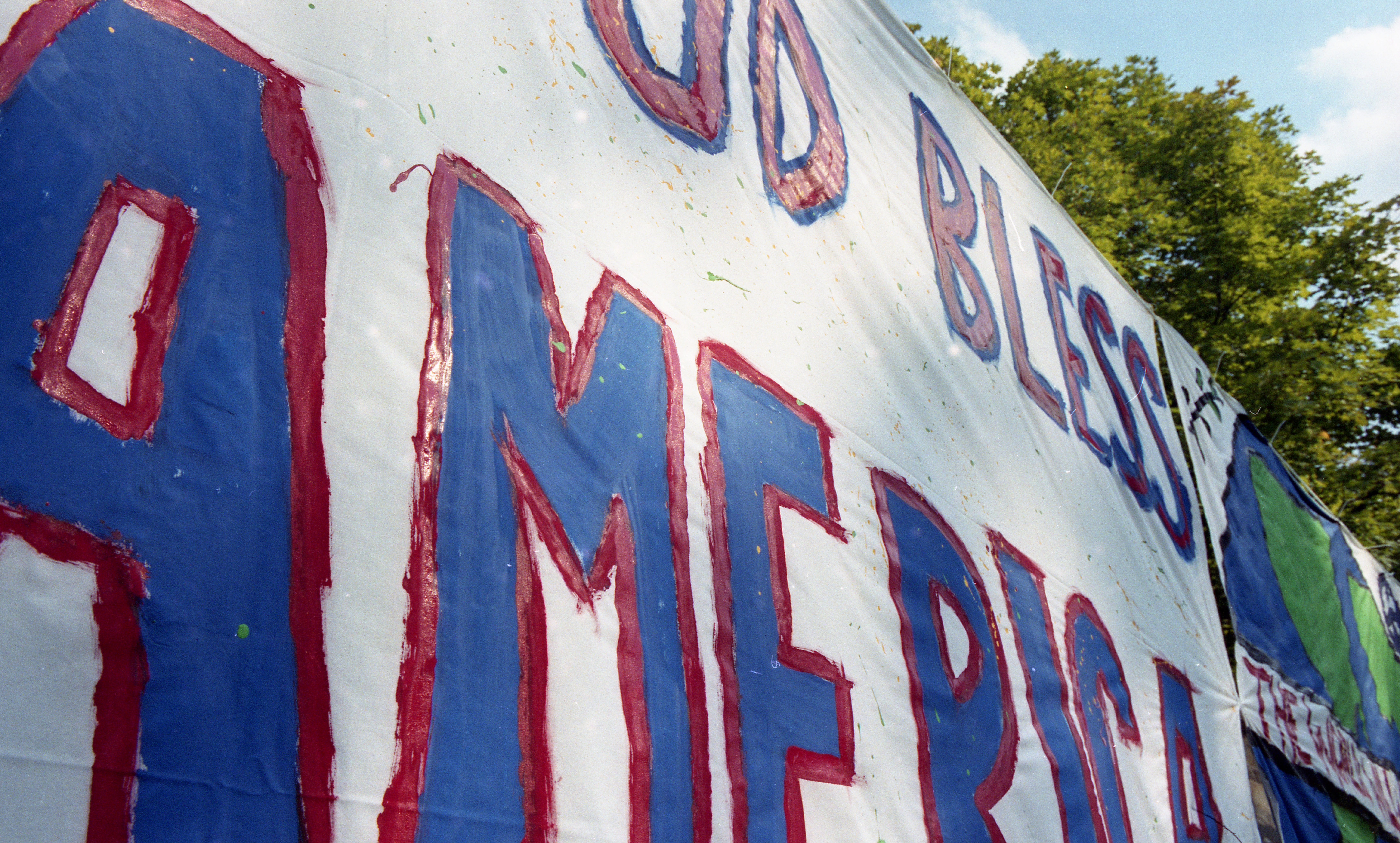
Banners on campus, September 15, 2001
Students hung American flags from dorm windows and off-campus houses and decorated bedsheets with messages of support, unity, and patriotism.
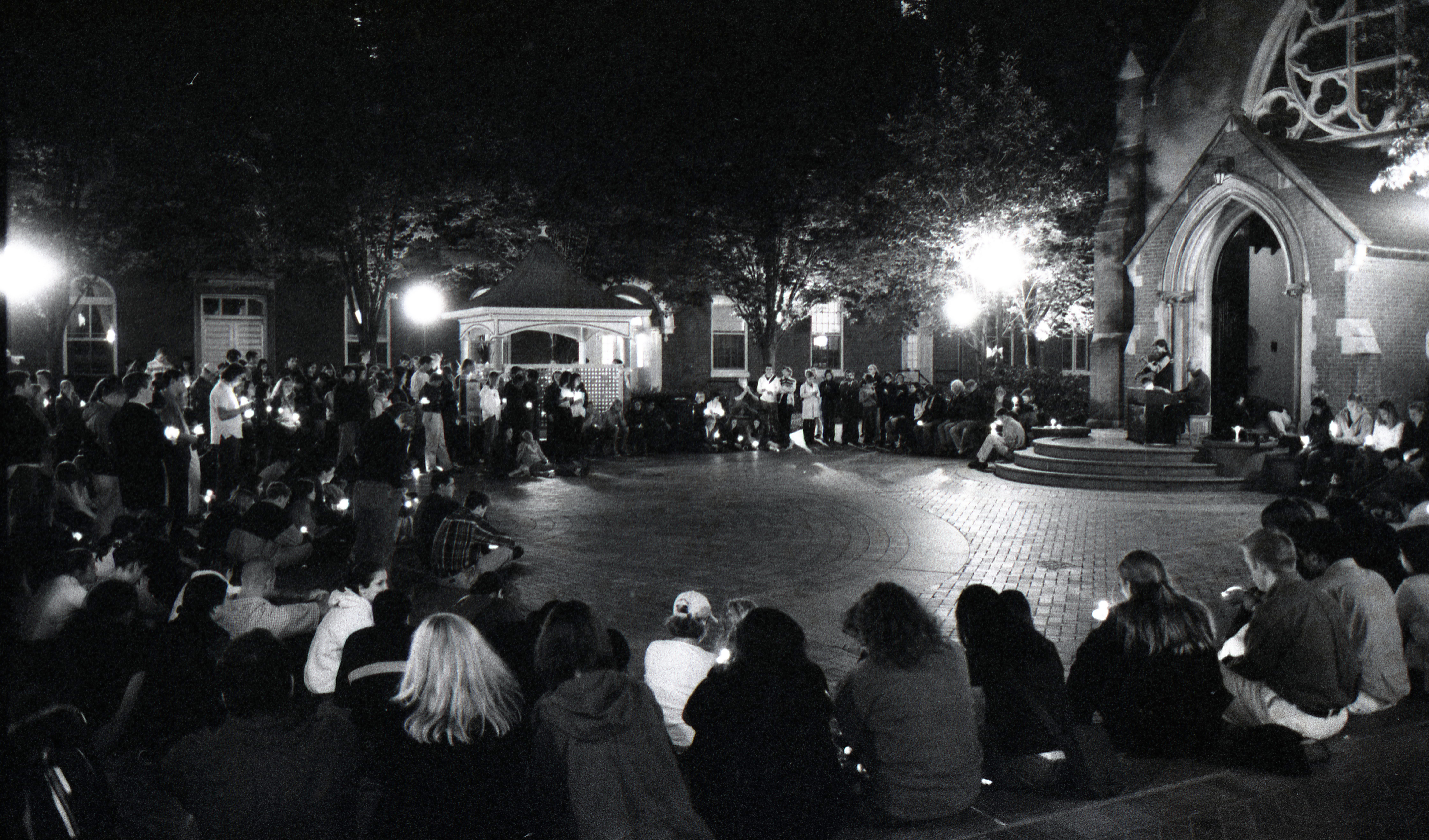
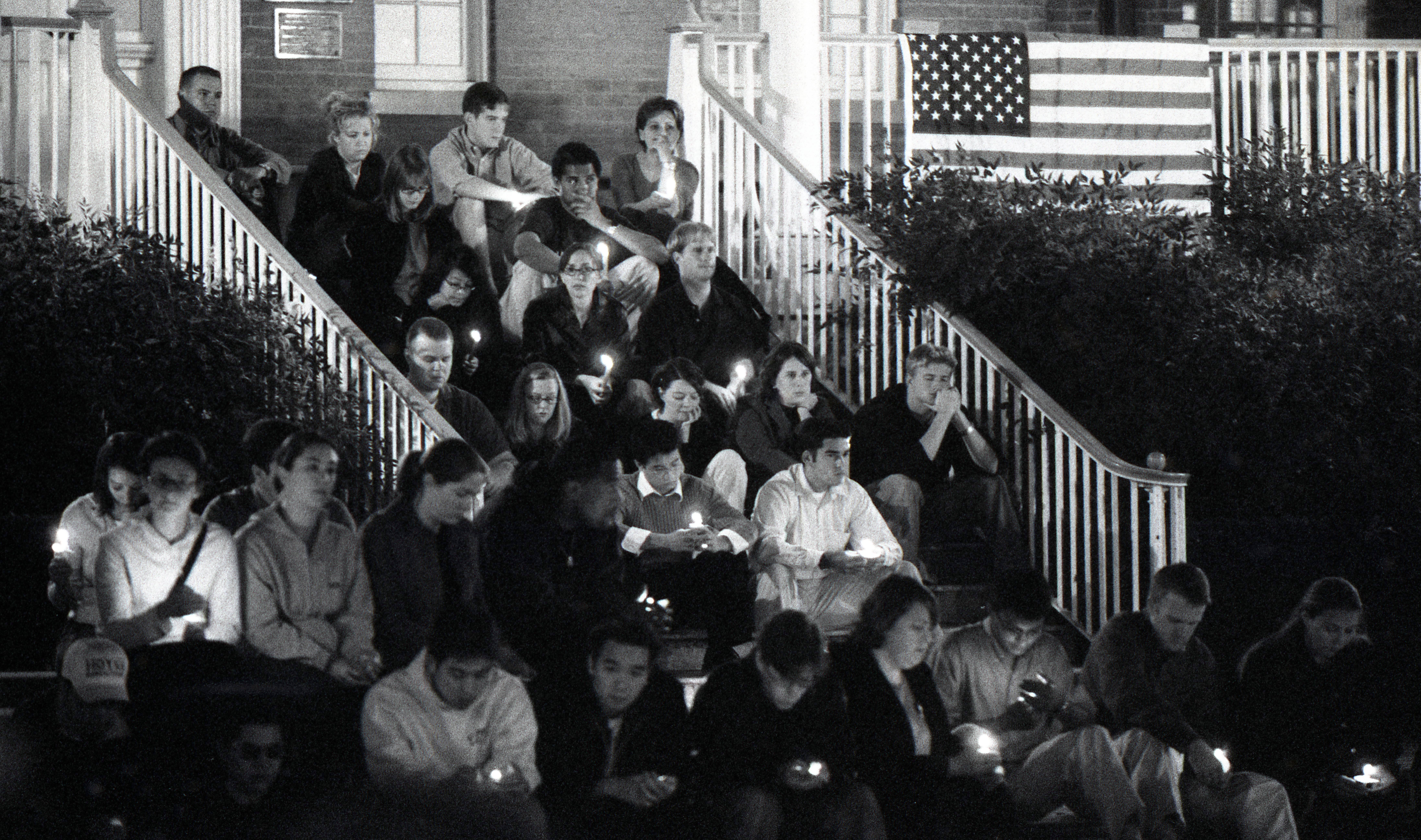
Candlelight vigil in the Quadrangle, September 15, 2001
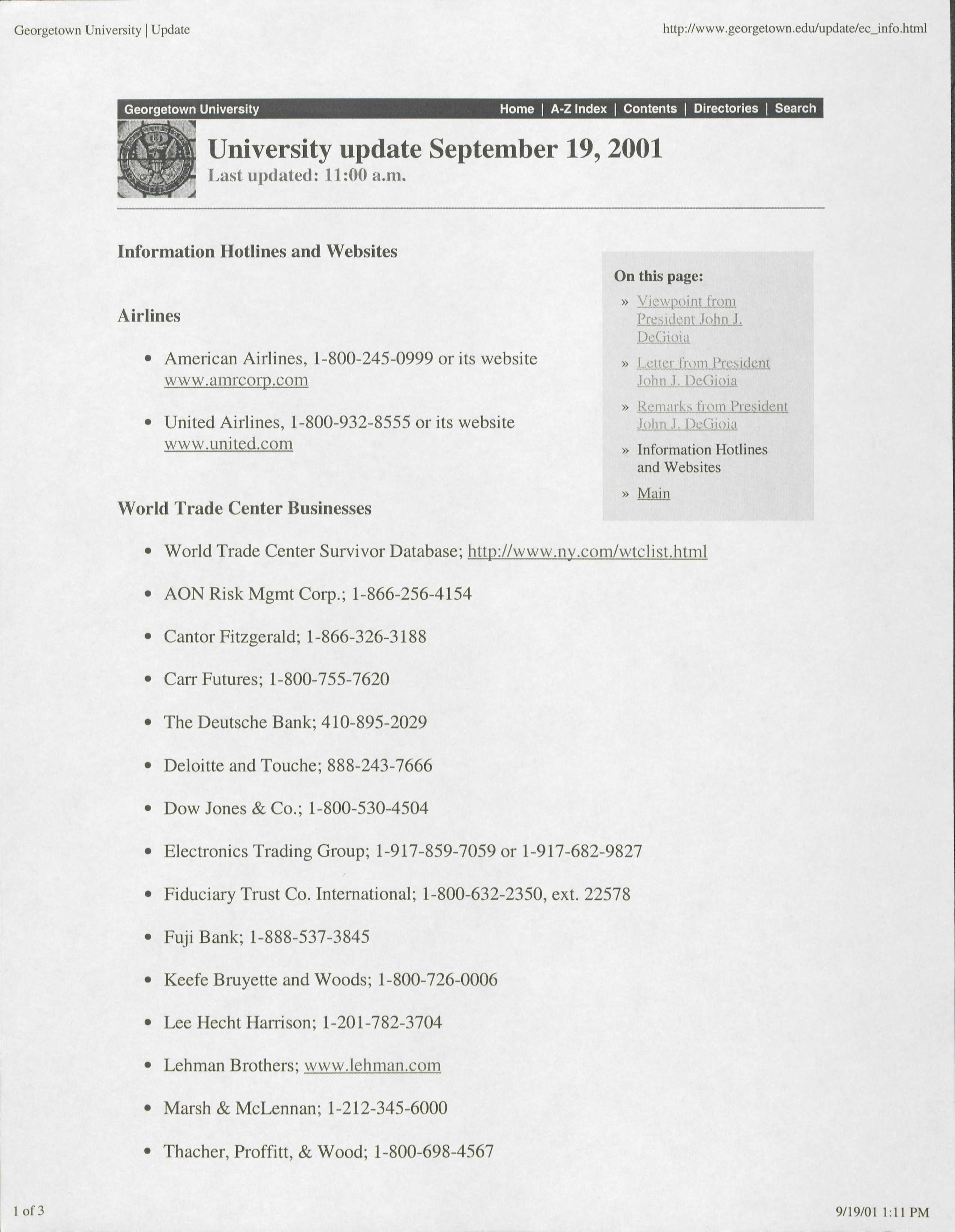
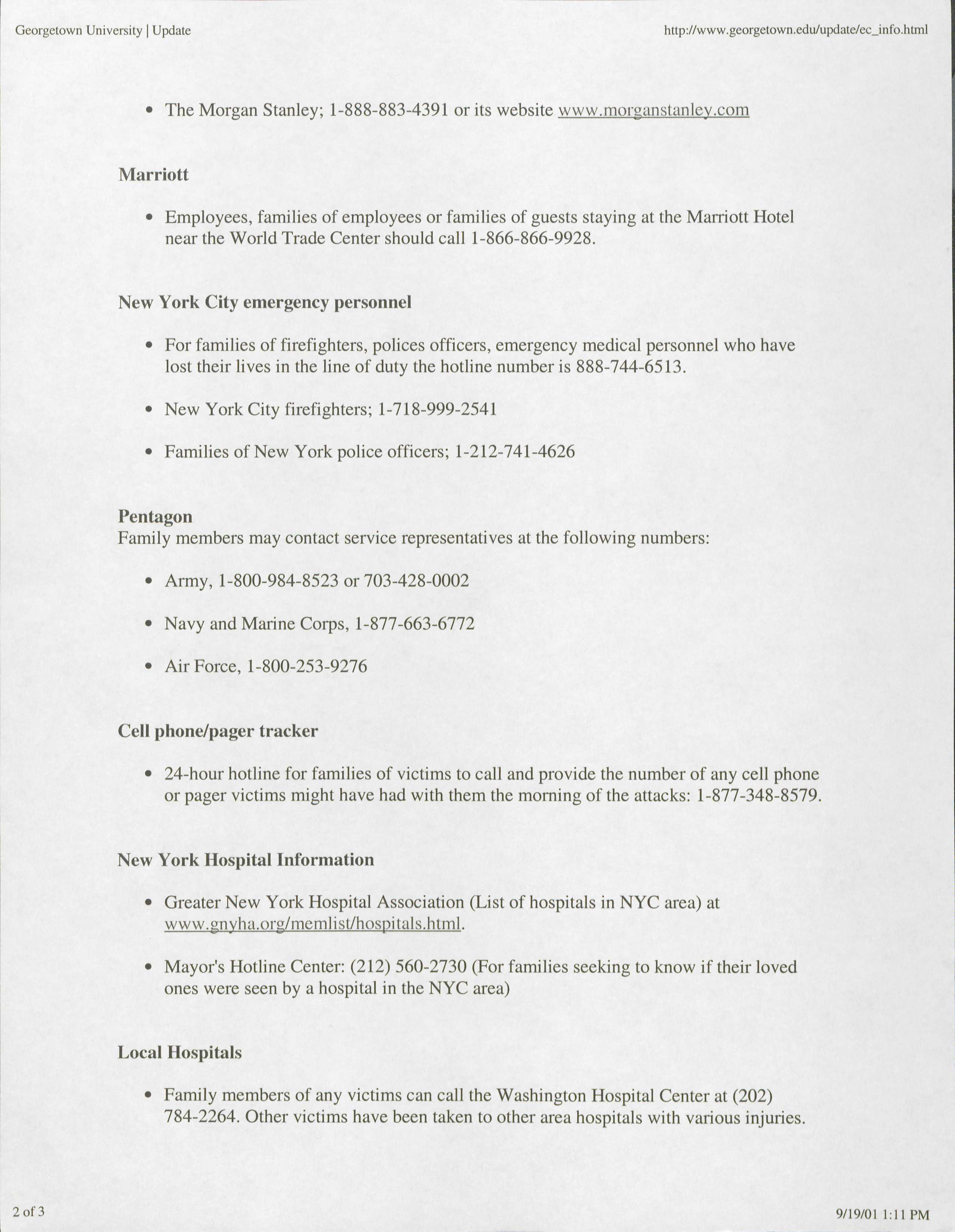
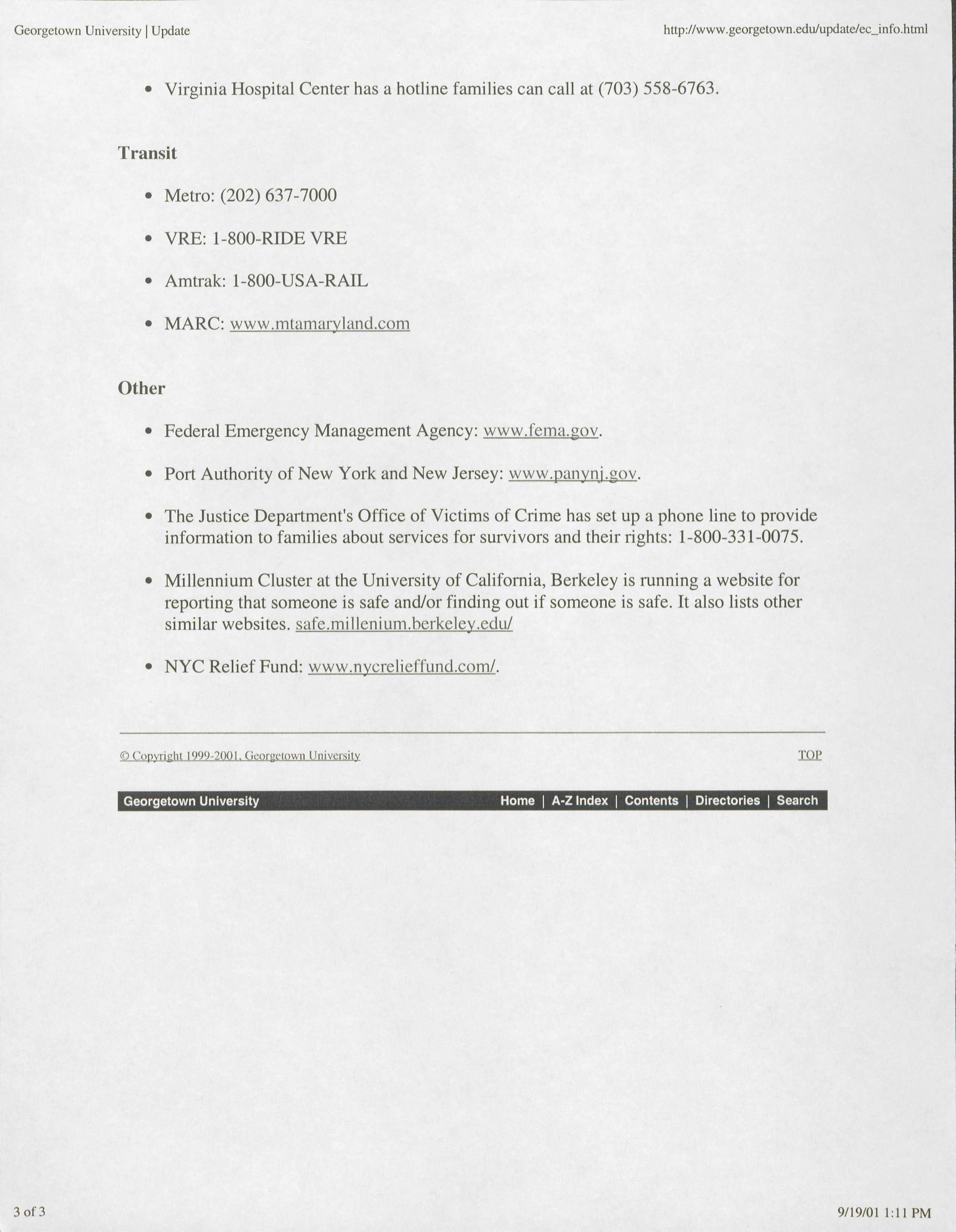
Information Hotlines and Websites, Georgetown University website, September 19, 2001 update
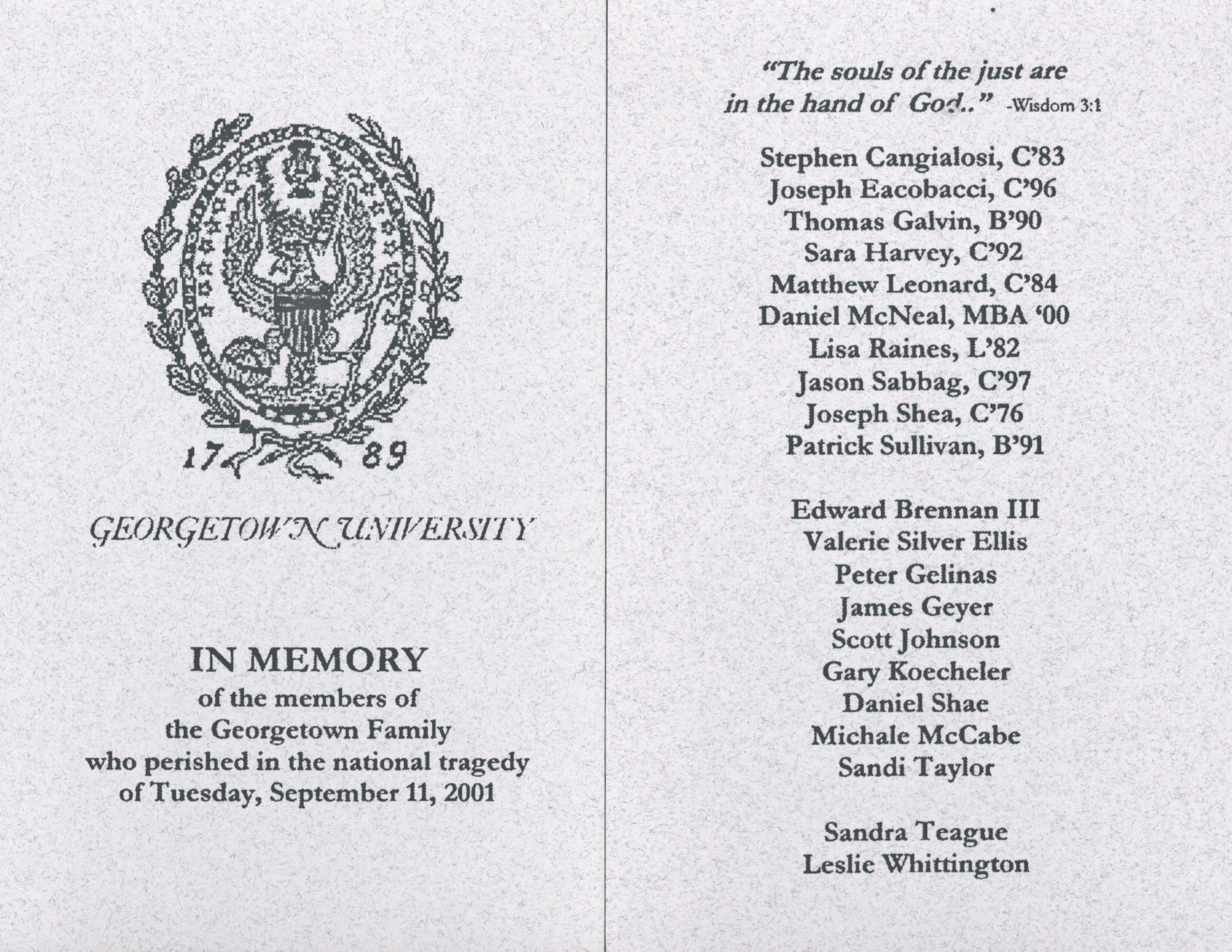
"In Memory of the members of the Georgetown Family who perished in the national tragedy of Tuesday, September 11, 2001"
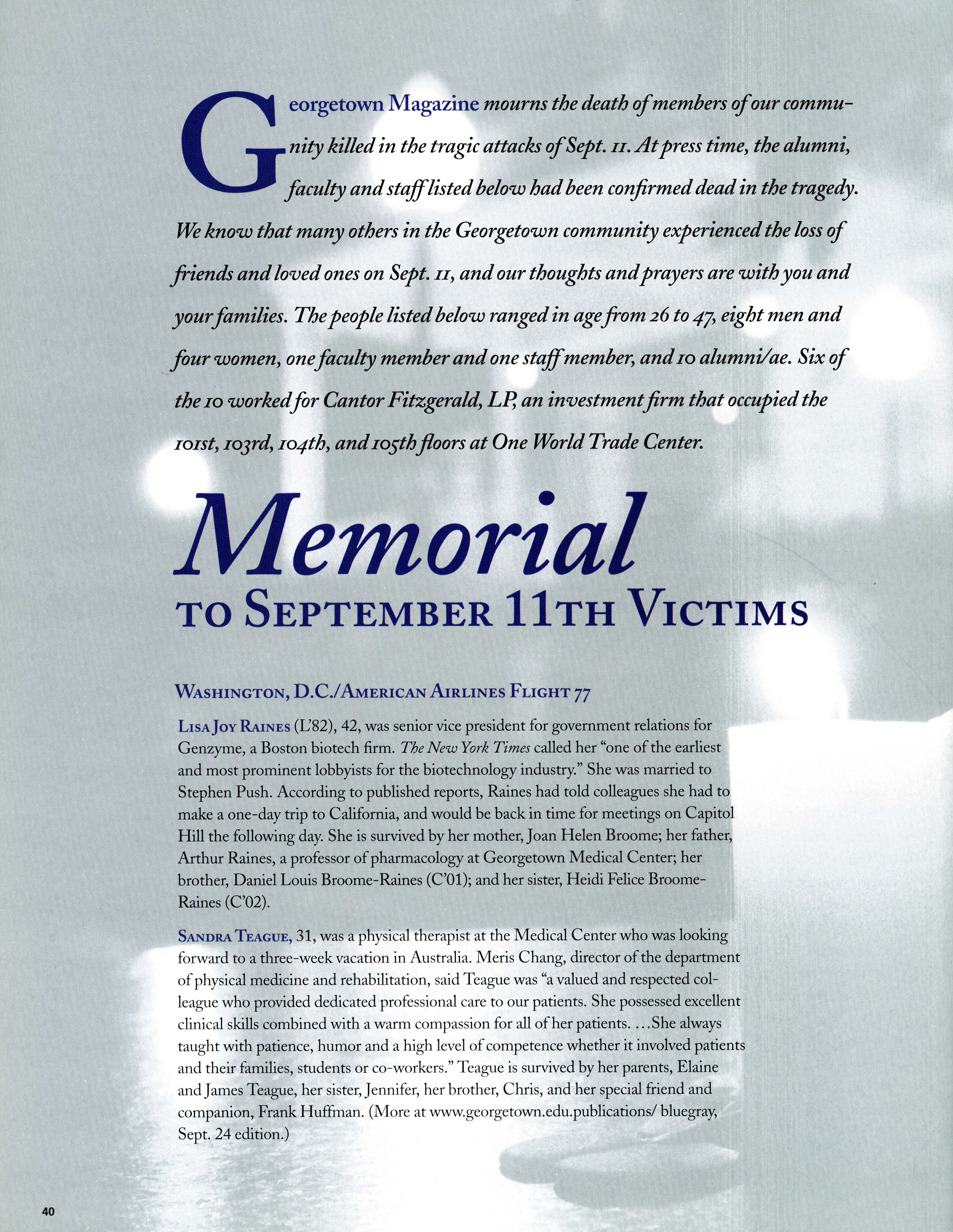
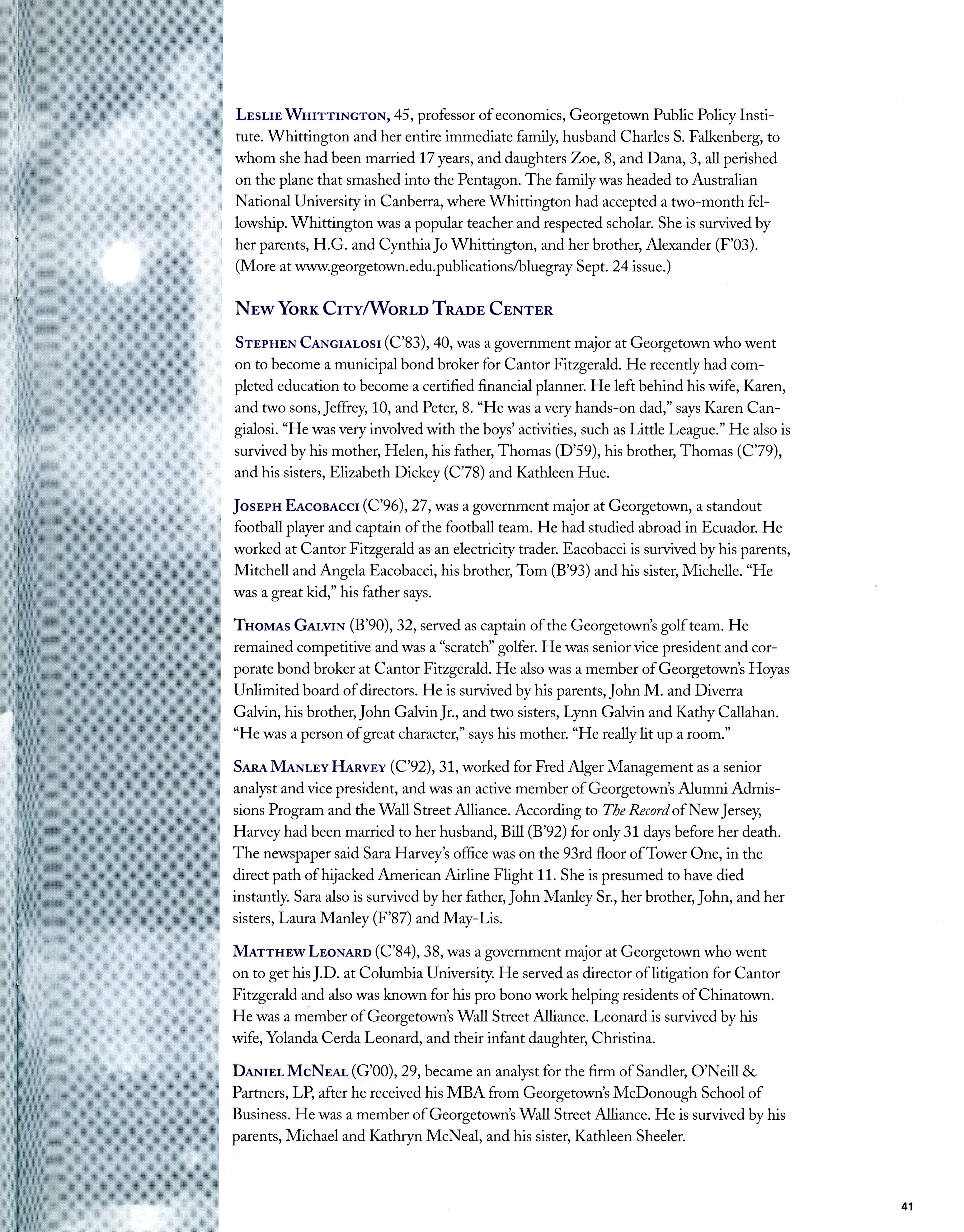
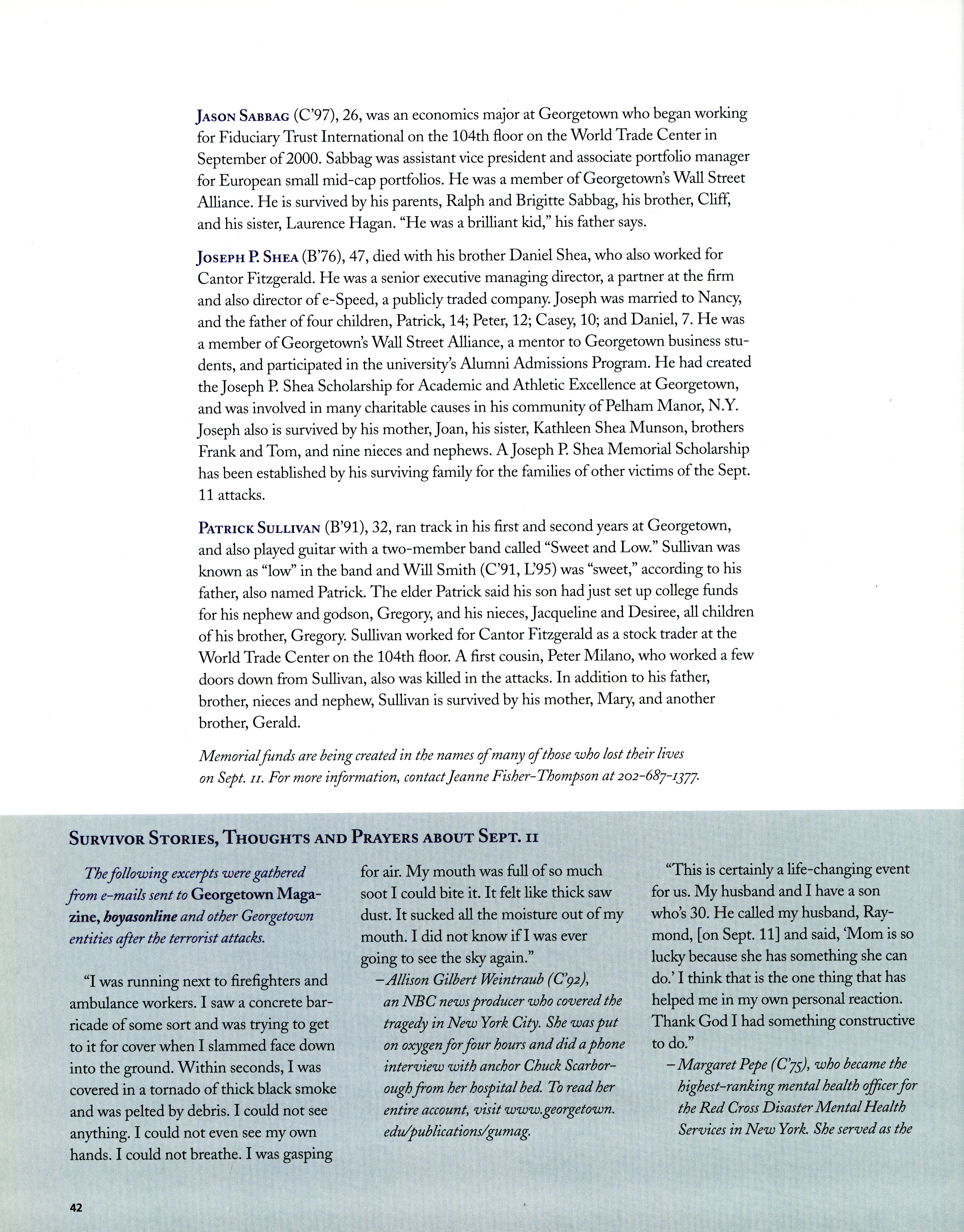
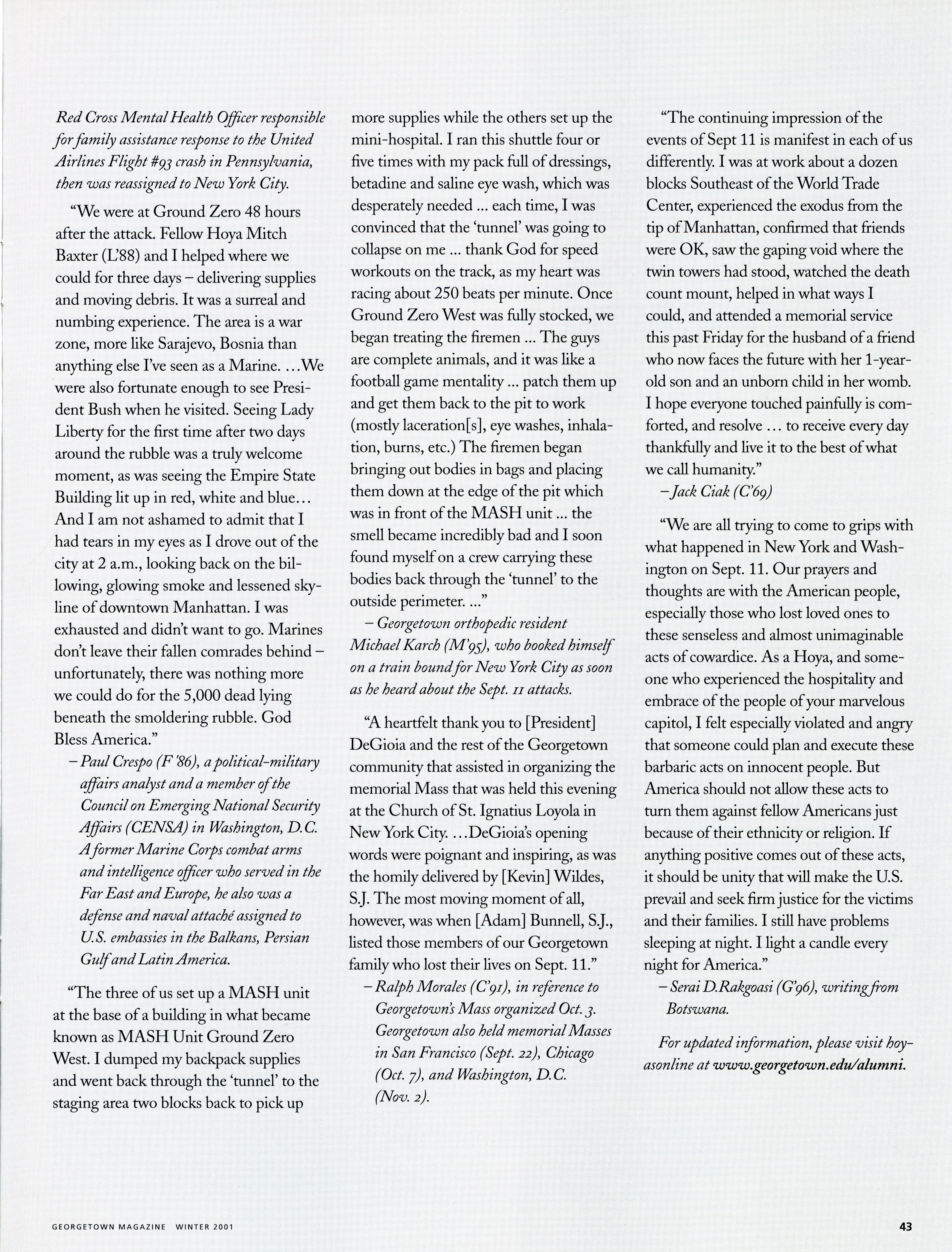
“Memorial to September 11th Victims.” Georgetown Magazine, winter 2002
Curated by Lynn Conway, Georgetown University Archivist