Although the general public associates President Woodrow Wilson with the idea for the League of Nations following World War I, few may know that President William Howard Taft, his predecessor, supported the cause of creating a world body to prevent war and promote peace before Wilson finalized his plans for the League. Over the years, many organizations to prevent war gained a following. According to historian David H. Burton, Wilson first advocated for a “league of nations” as early as 1889 in his book The State (1). However, it was the destruction and suffering caused by World War I that led to even greater commitments towards peace. Many contended that there must be an international body in place to mediate disputes in which an attack on one member would result in collective political, economic, or even military action to deter offender nations.
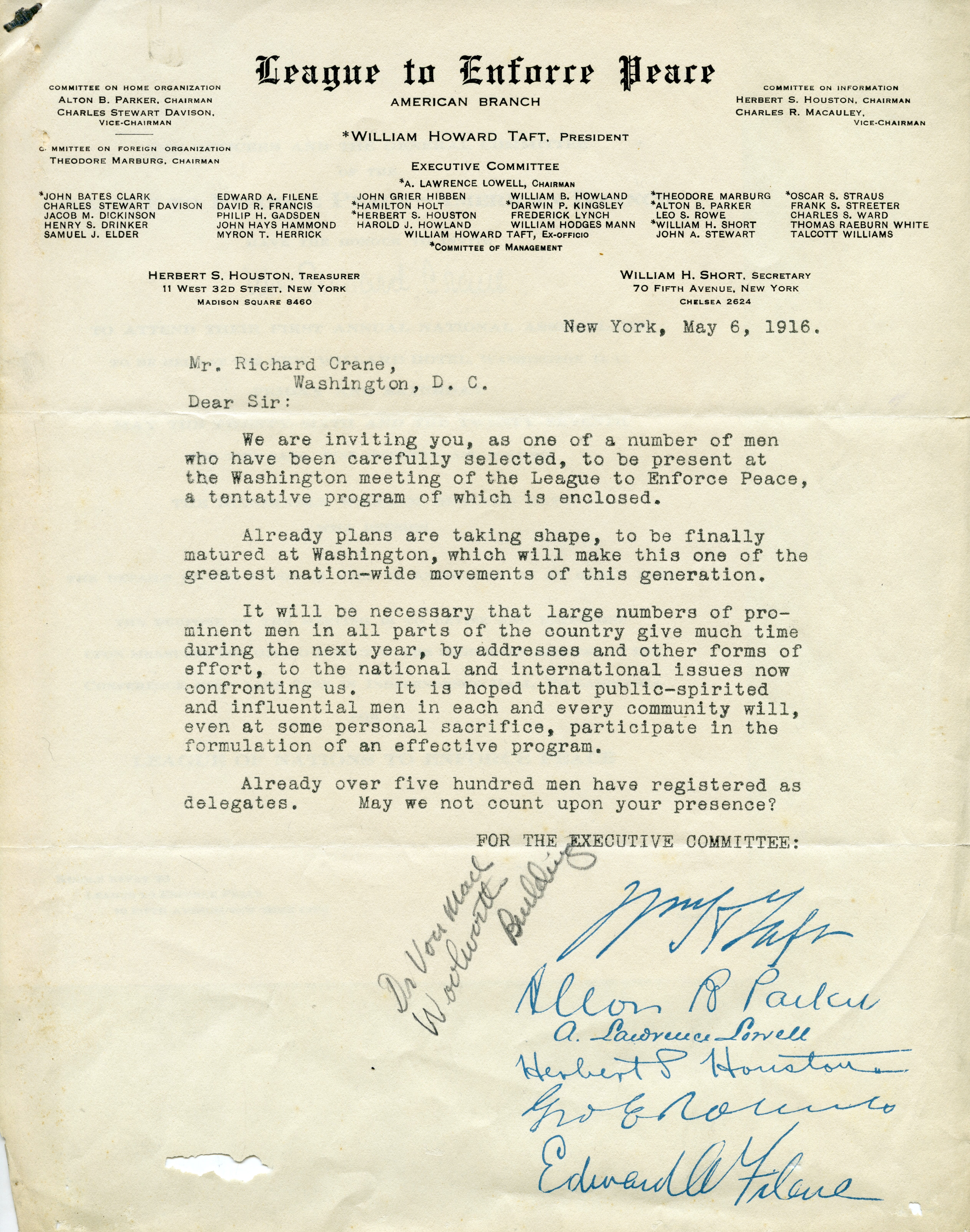
Box 1 folder 56 of the Presidential Autographs Collection in the Booth Family Center for Special Collections in the Georgetown University Library contains a typed letter dated May 6, 1916 from William Howard Taft, president of the League to Enforce Peace, to Richard Crane. The letter was addressed to Crane in Washington, D.C. Taft invited Crane, “as one of a number of men who have been carefully selected,” to attend a meeting in Washington, D.C. of the League to Enforce Peace. Taft enclosed two attachments (see below). He insisted that the event would make the group “one of the greatest nation-wide movements of this generation.” Taft called for many advocates, nationwide, to promote the entity in its efforts to face the “national and international issues now confronting us.” Taft closed by stating, “Already over five hundred men have registered as delegates. May we not count upon your presence?”
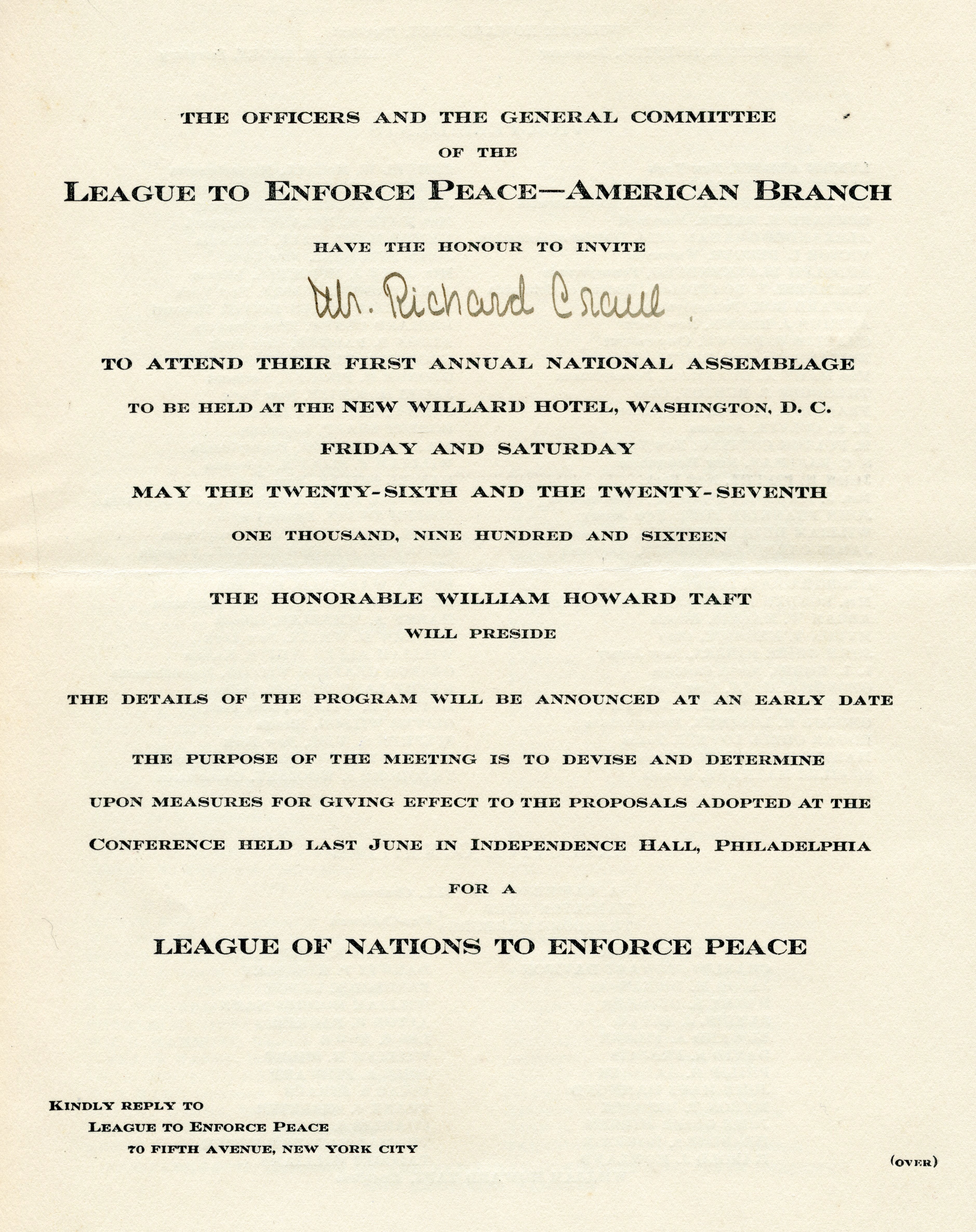
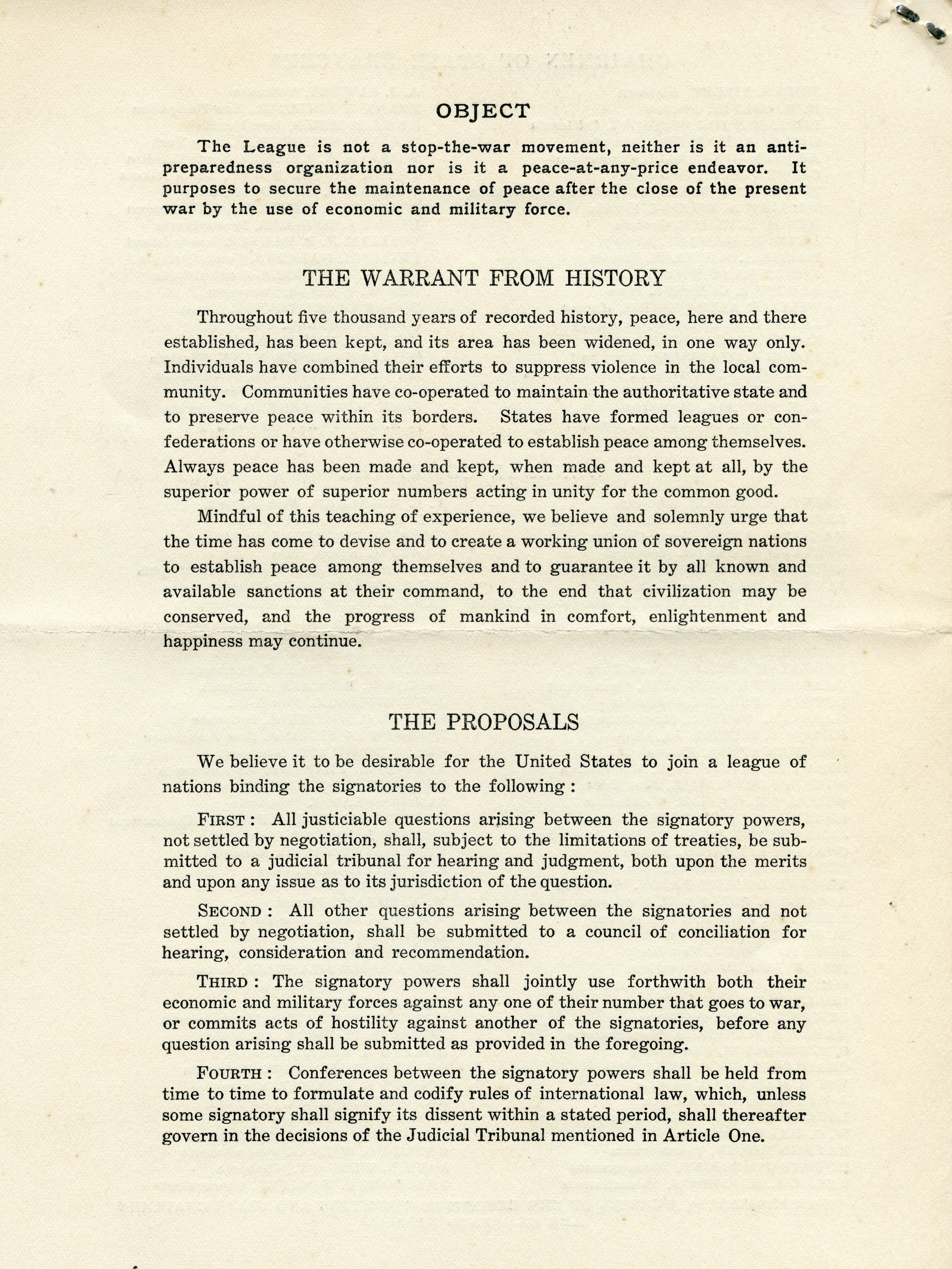
The first attachment sent by Taft was an official invitation to Crane to attend the meeting of the League to Enforce Peace on May 26 and 27, 1916, at the Willard Hotel in Washington, D.C. The meeting would further the efforts of the organization at its meeting in Philadelphia the previous June. The second attachment presented the object, charge, and proposals of the League to Enforce Peace.
The typed letter in question was written on letterhead of the League to Enforce Peace from its headquarters in New York City, and it was signed by several members of the organization. Taft’s name appears as “Wm H Taft.”
Richard T. Crane (1882-1938) was the recipient of this letter. In 1915, he became private secretary to U.S. secretary of state Robert Lansing. Wilson appointed Richard Crane as the first U.S. ambassador to the newly formed nation of Czechoslovakia, where he served from 1919 to 1921. His father, Charles, was president of the Crane Company, a bathroom fixture manufacturer in Chicago. It was actually Taft, a Republican, who tapped Charles as U.S. minister to China in 1909, but the elder Crane resigned before taking his post. Charles switched his support to the Democrat Wilson, who reappointed him envoy to China. The Booth Family Center curates two parts of the Richard T. Crane Papers: the Richard T. Crane Papers 1 and the Richard T. Crane Papers 2.
Wilson attended the post-World War I peace conference in Versailles, France in person. He formalized the covenant for the League of Nations in 1919 and toured the U.S. praising its merits. Opponents, including U.S. Senator Henry Cabot Lodge, proposed amendments to Wilson’s League. In particular, they feared that the U.S. government would lose its independent sovereignty to decide for itself whether to go to war or not. Taft, for his part, agreed that some changes should be made. In the end, Wilson refused to make any alterations to the League. In March 1920, the U.S. Senate defeated Wilson’s League of Nations proposal. In any case, the League was created and lasted from 1920 to 1946. However, the lack of an American presence limited its effectiveness. World War II erupted in spite of the League’s existence.
Taft’s letter to Crane demonstrated the former president’s commitment to international peace. A lawyer by training and a future Chief Justice on the U.S. Supreme Court (1921-1930), Taft had a legal frame of mind. He searched for justice both at home and abroad.
(1) David H. Burton, Taft, Wilson, and World Order (London: Associated University Presses, 2003), 15.
Scott S. Taylor, Manuscripts Archivist