The Library has created a new page dedicated to Slavery, Memory, and Reconciliation resources and activities. The page collects the many Slavery, Memory, and Reconciliation-related resources and activities from the Library that were previously dispersed across many departments in a single place. “We hope this information will not only highlight the work that has already been done, but also create opportunities for creative collaborations to produce new scholarship and learning on these critical issues,” said Meg Oakley, the Library’s director of copyright and scholarly communication and the page’s creator. It is intended not only to support the research and teaching of the Georgetown community, but also genealogists, researchers, and others who are interested in the topic.
The Library’s page contains links to research materials in the Library’s main collections, the Booth Family Center for Special Collections (including the University Archives and the Maryland Province Archives), and DigitalGeorgetown. Visitors can also see student projects; information about the University’s Working Group on Slavery, Memory, and Reconciliation; research and teaching resources; and information for the descendents of people once enslaved by the Maryland Province Jesuits.
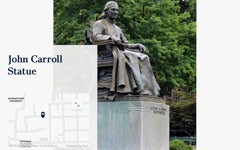
Among these resources is a new StoryMap, “The Price of Georgetown: A Walking Tour of Slavery, Memory, and Reconciliation at Georgetown University,” which highlights buildings and sites on and near the Georgetown campus that are significant to the history of slavery and allows readers to tour them either in person or virtually. Students in Professor Adam Rothman’s fall 2019 Slavery, Memory, and Reconciliation @ GU class researched these locations, and Kathleen Oakley, a summer fellow at the Library’s Booth Family Center for Special Collections, adapted the information into the StoryMap format. The StoryMap will be expanded in the future as students conduct more research into the history of slavery at Georgetown and the surrounding neighborhoods.
Other recent Library activities related to slavery, memory, and reconciliation include:
- The purchase of subscriptions to four databases: ProQuest History Vault: Slavery, the Slave Trade, and Law and Order in the 19th Century; African American Newspapers, Series 2, 1835–1956; African Americans and Jim Crow: Repression & Protest, 1883–1922; and Black Authors, 1556–1922: Imprints from the Library Company of Philadelphia. These databases are funded by a multi-year grant in honor of University Librarian Emerita Artemis Kirk.
- Forming a Diversity, Equity, and Inclusion committee, which is working to help ensure the Library is a welcoming, equitable, and supportive community for all staff and users.
- Issuing a Statement on Racial Justice in June 2020.
- Starting a project to digitize the Archives of the Maryland Province of the Society of Jesus, with the eventual goal of making them available online.
- Digitizing the Joseph P. Mobberly, S.J., Papers and publishing them in DigitalGeorgetown. Mobberly was a Jesuit who worked as manager of St. Inigoes in St. Mary’s County, Maryland, and as a teacher at Georgetown College. His papers include five diaries that relate events occurring from 1805–1827 and provide valuable insights on Jesuit slaveholding in the early 19th century.
- Beginning work on the "On These Grounds: Modeling and Sharing Archival Materials about Slavery" project, a collaboration among Michigan State University, Georgetown University Library, and the University of Virginia that will develop and test a prototype linked open data model to better describe slavery-related archival materials and enhance the ability of scholars, students, alumni, and descendants to gain new insights and understanding of the lived reality of bondage at these institutions.
- Publishing “Logbook from the Slave Ship Mary: A New Lease on Life,” a video shot and edited by Barrinton Baynes, multimedia specialist in the Library’s Gelardin New Media Center, and student Yasmine Bouachri (C’21) for the Spring 2020 Facing Georgetown’s History class about a slave ship’s logbook that was recently donated to the Library, and which has been digitized and published in DigitalGeorgetown.
- Participating in programs with Ford’s Theater, where SMR Curator Mary Beth Corrigan showed secondary school teachers documents related to the Maryland Jesuits’ 1838 sale of 272 enslaved people, and discussed how they can be read to understand the intentions and interests of the people involved; and Tudor Place and Dumbarton House, where Corrigan and Booth Family Center for Special Collections Director Keith Gorman discussed historical documents from the family collection of Neville Waters, a sixth-generation Black Georgetown resident, and offered guidance on preserving historical items.
Georgetown began its Slavery, Memory, and Reconciliation initiative in 2015 to more deeply understand and respond to the University’s role in slavery and its legacies on our nation. Since the beginning of the initiative, the Library's archivists and librarians have been working with Georgetown faculty, students, and staff to promote research and learning on slavery through its archives, collections, events, instruction, and outreach activities. The Library's Booth Family Center for Special Collections holds the Maryland Province Archives and the University Archives, which together hold most of the primary source materials documenting the history of Jesuit slaveholding and Georgetown College's reliance on the slave trade, including the 1838 sale of 272 enslaved individuals, the proceeds of which benefitted the college. More recently, the nationwide protests against police brutality and racism have served as a reminder about how critical it is to promote research and understanding of the legacy of slavery in order to successfully address issues of racial justice facing the country today.