By: Anjelika Deogirikar Grossman, MPP ’14, MA ’26 in Engaged and Public Humanities
Creating the “Art in your Hands” Program
In Spring 2026, in partnership with the Booth Family Center for Special Collections (BFCSC) at Georgetown University Library, I designed the “Art in your Hands” program to introduce students and the community to artists' books in the University's collection, and for participants to learn to make their own zines.
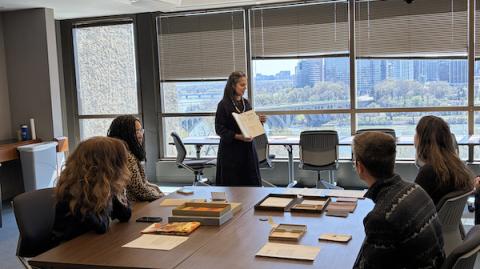
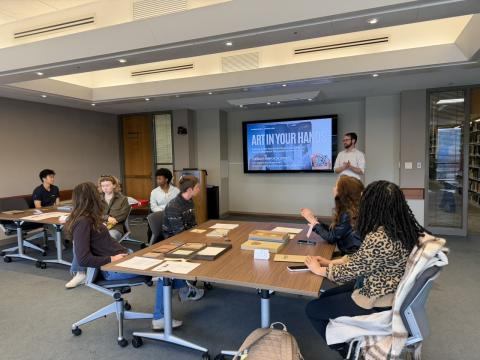
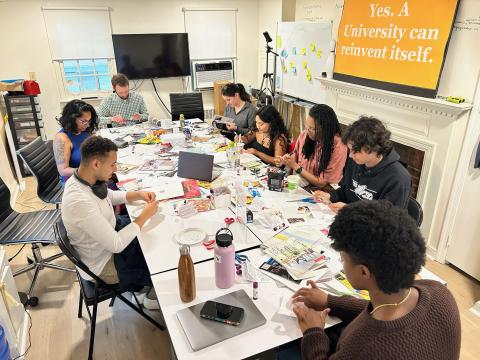
On Tuesday, March 24, 2026, twenty-five students, faculty, staff and members of the public came together in the Murray Room at Lauinger Library at Georgetown to explore nine artists’ books. After researching in the collections, I selected these specific artists’ books because I thought that they introduced an idea or topic in a new way through touch-based inquiry, they interrogated the idea of a “book,” and they created a sense of awe and wonder — leaving me with curiosity to explore more questions on the topic.
The scaffolding I developed for the program was — See / Discuss / Create / Reflect. This type of experiential learning builds on the work of John Dewey and David A. Kolb's Experiential Learning Theory, as well as my previous work in experiential learning.
See / Discuss allowed participants to experience the selected artists’ books on their own terms with question prompts projected on slides at the front of the room. As part of Create / Reflect, participants were invited to create their own one-page zine and to contribute their own found poetry to a single-edition artists’ book “Florilegia” that I created. As described in their chapter “AB to Z: Artists’ Books and Zines, Special Collections Library Instruction, and Community Engagement,” Diane Dias De Fazio, Emily Martin, and Jay Sylvestre describe zines as “limited-run, noncommercial publications devoted to ‘often unconventional’ subjects, created using inexpensive materials.” A zine is a type of artists’ book and because of the often low-fidelity nature of zines, I have found that they are an accessible way to introduce participants to making, particularly under time constraints.
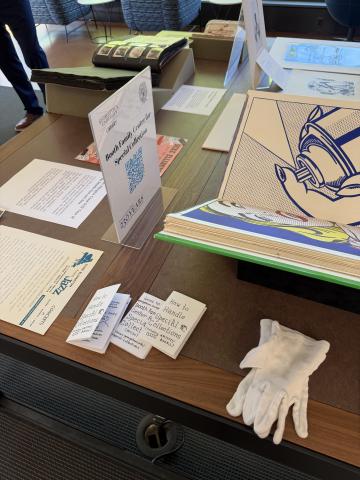
To help lower this barrier to entry to experiencing Special Collections and Artists’ books, I created two zines as artifacts that were shared and distributed to participants: "How to Handle Special Collections (including Artists' Books)" and "Guide to Georgetown University Booth Family Center for Special Collections." I designed these one-page zines based on my own experiences of learning how to handle artists’ books and how to access Special Collections. What better way to show how to create a one-page zine than by modeling one — or two! Since the event, BFCSC and the Library have used the zines in public-facing programming. Please note that these zines are available for printing and distribution.
While two-thirds of participants knew about the concept of artists' books and two-thirds had explored works in the Booth Family Center for Special Collections prior to the program, I received overwhelmingly positive feedback from participants that they plan to explore more about Artists' Books, and also they plan to visit the Booth Family Center for Special Collections after attending “Art in your Hands.”
As described in my model See / Discuss / Create / Reflect, it was important to me to create a space for participants to experience creating a zine, which is a type of artists’ book, alongside their experience of interacting with artists’ books in Special Collections. Some participants particularly described the importance of having the space to create during the program: “I don't usually think of myself as a visual artist, and I actually had some negative experiences with it in the past. This was a fun way to dip back in, and also contribute to something that we share.” In addition, another participant shared that they want to explore more about zines: “I would like to explore other artists' "zine" creations. It is such a delightful way to experience art, writing, and other creative expressions. It would be a lovely medium for poetry.”
Learning with Artists’ Books
As I’ve experienced the University’s artists’ books and the range of topics that they explore, I have uncovered how these objects not only demonstrate the artist’s creativity to push the boundary of a concept, but also that the interactive nature of the artists’ book elicit a new way to be introduced to an idea.
As an artist and educator, I have always been fascinated by artists’ books because I believe that they present ideas in a novel and tactile way, that they bring a sense of awe and wonder. While often in single or limited edition runs, artists’ books are special not only for their presentation but also the ideas that are explored. For example Georgetown’s collection explores topics as varied as nature, technology, time, politics, and surveillance.
Artists’ books have a long history in higher education as these rare books present ideas in novel ways in the form of a “book.” In their chapter “Call and Response: Teaching with Artists’ Books at the Joan Flasch Artists’ Book Collection at the School of the Art Institute of Chicago,” April Sheridan and Doro Boehme describe artists’ books as “editioned artwork” that they believe are “the mind map of an artist’s idea.”
Anne Evenhaugen, the Head Librarian for the Smithsonian’s American Art and Portrait Gallery Library, writes in 2012 on the Smithsonian Library and Archives’ Blog “Unbound” that artists’ books are “art in book form” but also acknowledges that “it’s not that simple.” Even at Georgetown University, you can find artists’ books cataloged in Special Collections and different ones in the Art Collection, which are two different repositories.
In addition, artists’ books are often not digitized because of their tactilel and interactive nature, but many university libraries and special collections invest in artists’ books as teaching tools and reference materials that can be brought into the classroom, to special events, or experienced in the reading room.
Learning beyond the Library
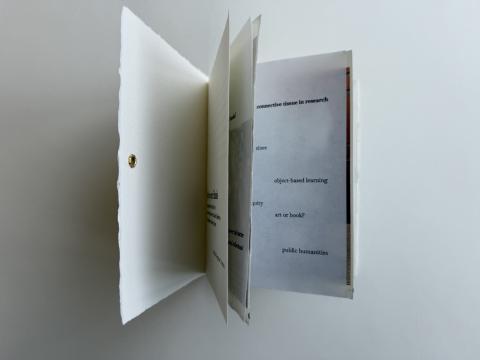
In learning more about artists’ books and sharing my love of artists’ books and zines with others, I created my own artists’ book “Art in your Hands” to share my experience with this project. I thought creating an artists’ book about my capstone would be a creative way to reflect on my experience designing and implementing the program throughout the semester. In creating this artists’ book, I felt like I was creating a “mind map” of my capstone experience.
This experience has also given me a chance to consider future ways I hope to continue building on the “Art in your Hands” program in other settings or through other collaborations. Based on the positive feedback from the “Art in your Hands” program, I’m excited to imagine future opportunities and to develop more research about how and why artists’ books are an important pedagogical method in higher education and also for K-12 learners. I already hosted a pop-up event to learn more about making zines at the end of this semester, “Study Break: Zine-Making.” And I am presenting with my collaborators on Tuesday, May 19, 2026 at TLISI 2026 “Teaching with Artists’ Books from the Booth Family Center for Special Collections at Georgetown University Library.”
Acknowledgements:
Thank you to my capstone mentor Jay Sylvestre, Curator of Rare Books at the Booth Family Center for Special Collections for his support through this research and programming.
About the Author:
Anjelika Deogirikar Grossman, MPP ’14, MA ’26 in Engaged and Public Humanities, is a Washington, DC educator, artist, and researcher. A FY25 grantee of the DC Commission on the Arts and Humanities’ Fellowship Program, Anjelika is an artist-in-residence at the Georgetown Lombardi Arts and Humanities Program at MedStar Georgetown University Hospital, where she regularly teaches free, online watercolor classes. Anjelika is the co-founder of District Collage, launched in 2026. Learn more at AnjelikaArt.com
References: Learn more about this topic through these references found through library.georgetown.edu:
Chatterjee, Helen J., and Leonie Hannan. “An Introduction to Object-Based Learning and
Multisensory Engagement.” Engaging the Senses, edited by Leonie Hannan and Helen J. Chatterjee, 1st ed., Routledge, 2015, pp. 1–18, https://doi.org/10.4324/9781315579641-1.
Dale, Vicki, Nathalie Tasler, and Lola Sánchez-Jáuregui. “Object-based learning: active
learning through enquiry.” Ideas for Active Learning. Edited by Paolo Oprandi and Tab Betts, University of Sussex Library, 2022, pp. 566-574.
De Fazio, Diane Dias, Emily Martin, and Jay Sylvestre. “AB to Z: Artists’ Books and Zines,
Special Collections Library Instruction, and Community Engagement 1.” Teaching Text Technologies and Critical Bibliography Among the Disciplines, edited by Donna A. C. Sy and Barbara Heritage, 1st ed., Routledge, 2025, pp. 169–75, https://doi.org/10.4324/9781003519133-18.
Evenhaugen, Anne. “What Is an Artist’s Book?” Unbound, Smithsonian Library and
Archives, 1 June 2012, blog.library.si.edu/blog/2012/06/01/what-is-an-artists-book. Accessed 13 Mar. 2026.
Sharp, Arabella, Linda Thomson, Helen J. Chatterjee, and Leonie Hannan. “The Value of
Object-Based Learning within and between Higher Education Disciplines.” Engaging the Senses, edited by Leonie Hannan and Helen J. Chatterjee, 1st ed., Routledge, 2015, pp. 97–116, https://doi.org/10.4324/9781315579641-8.
Sheridan, April, and Doro Boehme. “Call and Response: Teaching with Artists’ Books at
the Joan Flasch Artists’ Book Collection at the School of the Art Institute of Chicago.” The JAB Anthology: Selections from the Journal of Artists’ Books, 1994-2020, edited by Johanna Drucker and Brad Freeman, University of Iowa Press, 2023, pp. 75–81. JSTOR, https://doi-org.proxy.library.georgetown.edu/10.2307/jj.5627630.12. Accessed 14 Mar. 2026.