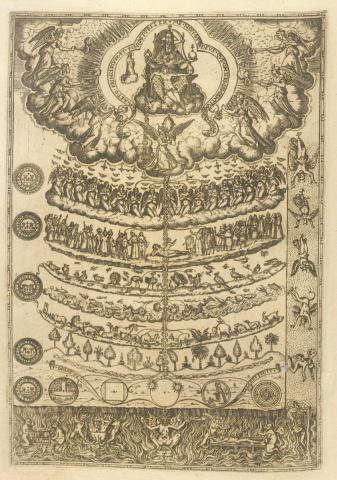
The Booth Family Center for Special Collections recently acquired a fascinating and rare book, titled Rhetorica Christiana (Christian Rhetoric). Written in 1579 by the Franciscan priest, Diego Valadés, the work is a treatise on the practice of preaching to the newly colonized Mesoamerican Indians, drawing on classical texts, and explicitly advocating the use of images, mnemonics, and the natural imagery of “the new world” so as to enculturate the faith in a pictographic culture. Though recently contested, Valadés was purported to be born in Mexico himself, with an Indigenous mother and a Conquistador father, and his parentage mirrors the book’s blending of identities as a Catholic European worldview (religious, political, and pedagogical) is brought to the new world. The work is filled with etchings that showcase the colonization of the social imaginary of Aztec culture, most notably in Valadés' image of The Great Chain of Being. The image (pictured above) depicts the worldview of Aristotelian metaphysics, with its hierarchical reality, (God the Father at the pinnacle, angels, human, animals, and plants in descending order), but superimposed onto the natural world of Mexico. The work is filled with etchings that demonstrate how this moment of encounter between Europe and the New World was first and foremost a test of interpretations, as different metaphysical, political, and religious lenses were brought to bear upon a new horizon.
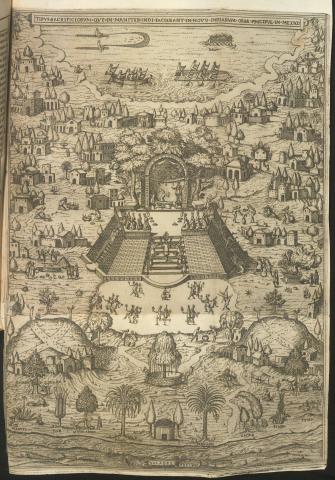
The work is not only a guide to preaching, but it also serves as a promotional text for the work of the Dominicans, with etchings demonstrating their work and success, and as a site of information on “the New World” for a supremely interested European public. In explaining the work of the Dominican mission, Valadés justifies their activity by contrasting their Christian aims to the pre-colonial Aztec culture of sacrifice, likened to devil worship, while also including information on other indigenous cultural practices. In one famous image (pictured below), he depicts the city of pre-colonial Tenochtitlan (present-day Mexico City), with a human sacrifice being conducted in the main temple (Templo Mayor) in the center, while positioning other cultural practices (fishing, dancing, and funeral ceremonies) and new world crops throughout the rest of the city. Though it’s a work of Christian apologetics, it also serves as a historical record of Aztec culture, albeit a contestable one.
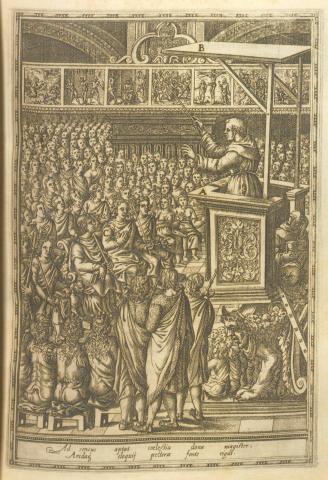
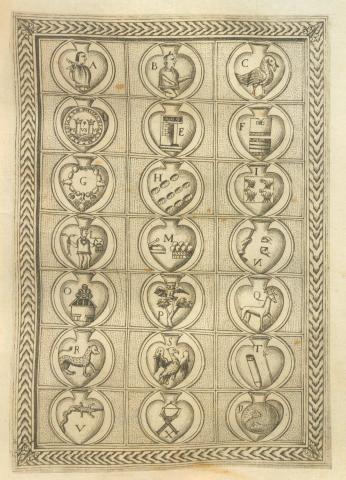
In addition to its interpretive and historical aspects, the work is also of interest for the pedagogical tools it employs for its new cultural context. In teaching either the Catholic catechism or literacy, Valadés argues for the use of images and mnemonic devices. In a famous etching (pictured below), he depicts a Franciscan Friar preaching to a native audience, pointing to a backdrop of large images illustrating different moments in the life of Christ. Another series of pages connect the letters of the alphabet with different everyday objects within the culture to help with memorization (pictured below). It’s a demonstration of the different tools employed by the Franciscans to enculturate Christian stories and European knowledge systems to a pictographic culture.
Scholars continue to be fascinated by Rhetorica Christiana, with recent histories analyzing its relationship to Franciscan theology, its place in Indigenous classrooms, its relationship to political struggles between Philip II and the Pope, and its relationship to art history. My colleague, Jade Madrid, the liaison librarian to the Spanish and Portuguese Departments, has put together a helpful bibliography for those interested in learning more about the contemporary scholarship. For the month of April, we will have it available for all to see in our Spotlight Case, just outside the Booth Family Center for Special Collections.
-Adrian Vaagenes (Woodstock Librarian)